Best HubSpot Alternative for AI Search Visibility in 2026
Let's get this out of the way: HubSpot is a genuinely good platform. The CRM is solid. Email automation is mature. The landing page and forms workflow has been refined over a decade. If you're running B2B demand generation through HubSpot, you have a real, capable tool — not something you need to replace.
This isn't a post about abandoning HubSpot.
It's about a specific gap that HubSpot doesn't fill, and increasingly can't afford to ignore. In 2026, a meaningful share of B2B buying decisions start with an AI-generated answer — not a Google results page. A buyer researching marketing automation software might ask ChatGPT "what are the best HubSpot alternatives" before ever visiting a comparison site. They might ask Perplexity "which CRM is best for mid-market B2B teams" and get a synthesized recommendation that never routes through your SEO-optimized landing pages or your HubSpot-tracked email sequences.
HubSpot's SEO tools can tell you whether your blog post ranks on page one of Google. They cannot tell you whether your brand is cited in the AI-generated answer that now sits above those organic results in an increasing share of commercial queries.
That's the gap. HubSpot closes the loop on what happens after someone reaches your website or opens your email. It has no visibility into what AI search engines say about your brand during the research phase — before the buyer decides who to evaluate.
What HubSpot Does Well (Genuinely)
Understanding what HubSpot is actually strong at makes it clearer what you're shopping for when you look for an alternative. HubSpot's product is genuinely broad.
CRM and contact management. HubSpot's CRM is the foundation of the platform — contact timelines, deal tracking, pipeline management, and integration with the full marketing and sales stack. For teams that grew up on it, the contact timeline is a real productivity asset.
Email marketing and automation. The workflow builder handles drip sequences, lifecycle-based triggers, lead nurturing, and behavioral follow-up. The deliverability infrastructure is solid, and the email health tools help avoid spam classification. For mid-market teams, this is table-stakes functionality done well.
Content hub and blogging. HubSpot's content tools include the blog editor, SEO recommendations (meta titles, internal links, keyword suggestions), landing page builder, and a CMS for hosting the full marketing site. The SEO module surfaces on-page optimization recommendations tied to keyword targets and tracks traditional Google keyword rankings across your domain.
Social publishing and monitoring. HubSpot can publish to LinkedIn, Instagram, Facebook, and X, schedule posts, and track engagement. Social monitoring pulls in stream data for saved searches — useful for tracking brand mentions in public posts.
Ad management. Integration with Google Ads, LinkedIn Ads, and Facebook Ads connects campaign spend directly to CRM contact records and pipeline attribution. For teams running paid + inbound in parallel, the attribution is genuinely useful.
Analytics and reporting. HubSpot's multi-touch attribution model, custom report builder, and dashboards let teams connect specific marketing activities to revenue outcomes. For B2B teams reporting to revenue-focused leadership, this is a meaningful capability.
Here's where it stops: none of the above touches AI-generated answers. HubSpot tracks what happens in Google's traditional SERP, in social feeds, on your website, and in your email sequences. It has no data model for what ChatGPT says when someone asks about your product category, whether Perplexity recommends you or a competitor, or how your share of voice in AI search has shifted over the past quarter.
The AI Visibility Gap HubSpot Can't Fill
To be precise about the problem, here's what HubSpot cannot tell you in 2026:
1. Whether your brand is cited in AI-generated answers
HubSpot's SEO tool tracks traditional keyword rankings — position 1 through position 100 in Google's blue-link organic results. It can surface which pages are indexable and which keywords your content targets.
What it doesn't track: whether your brand appears in the AI Overview that now sits above position 1 in an increasing share of commercial queries. "Ranking" and "being cited in the AI answer that displaces your ranked result" are two completely different outcomes.
2. What ChatGPT or Perplexity say when buyers research your category
B2B buyers increasingly use ChatGPT and Perplexity for vendor discovery — "what are the best project management tools for mid-market B2B?", "compare HubSpot Marketing Hub vs Marketo for a 50-person team." These queries generate AI-synthesized answers that influence shortlists before the buyer ever submits a form, opens an email, or lands on a page HubSpot can track.
HubSpot tracks what happens after the buyer decides to investigate you. It has no visibility into the AI-generated answers the buyer saw before that decision was made.
3. Your competitive position in AI answers
AI engines don't just answer questions — they make recommendations and comparisons. "Which CRM should I use?" isn't a ranking — it's a recommendation. Whether your brand is mentioned in that recommendation, how it's characterized, and whether a competitor is positioned ahead of you are all data points that matter enormously to pipeline. HubSpot's competitive intelligence tools (built around SEO traffic and backlink analysis) are completely blind to this.
4. Forensic diagnosis of citation changes
When your AI visibility metrics shift — your citation rate in ChatGPT drops, a competitor starts appearing in Perplexity answers where you used to dominate — you need to know why. Did the AI change how it frames your category? Did a competitor publish something that got picked up? Did the response structure change entirely?
Forensic diff tracking captures the exact text of AI answers over time and shows word-level changes between any two dates. Without this, a citation rate trend is just a number — you know something changed but not what, and not what to do about it. HubSpot has no mechanism for this kind of diagnosis, nor does any traditional marketing platform.
5. Share of Voice in AI-generated answers
The AI visibility version of Share of Voice is: when queries about your product category are posed to AI engines, what percentage of responses mention your brand versus each named competitor? This is the competitive metric that tells you whether you're winning or losing ground in AI-generated results over time.
HubSpot's share of voice reporting is built around organic search traffic estimates and keyword overlap. It doesn't read AI response content at all.
The 6 Best HubSpot Alternatives for AI Search Visibility
1. RankScope — Best Dedicated AI Visibility Layer for Marketing Teams
RankScope was built specifically for the measurement problem HubSpot isn't designed to solve: tracking what AI search engines say about your brand, diagnosing why it changes, and giving you the competitive data to act on it.
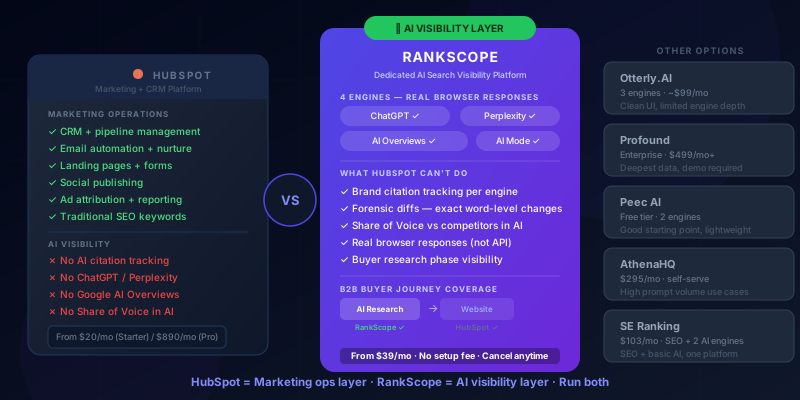
For HubSpot users specifically, the framing matters: HubSpot closes the loop on what happens after a buyer enters your pipeline. RankScope closes the loop on whether your brand appears in the AI-generated answers buyers see before they enter your pipeline. These are sequential but disconnected stages in the modern B2B buyer journey, and most marketing teams currently have visibility into one and none into the other.
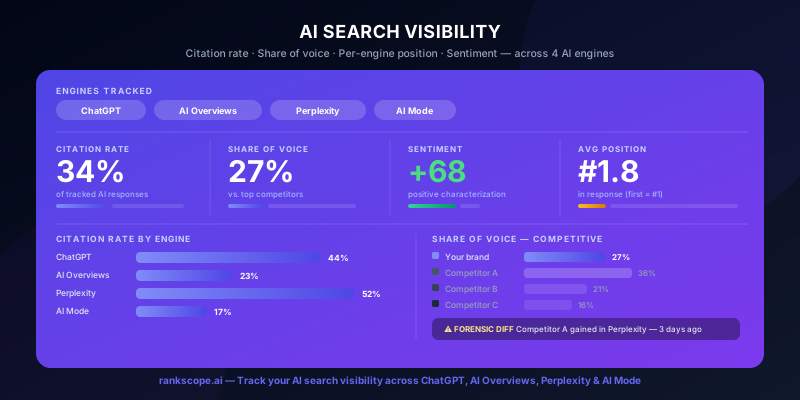
Engine coverage. RankScope tracks brand citations across four AI engines: ChatGPT, Google AI Overviews, Perplexity, and Google AI Mode. The four matter because buyer behavior differs by engine. Perplexity skews toward research-heavy B2B and technical audiences. ChatGPT is increasingly used for product comparisons and vendor discovery. Google AI Overviews appear in roughly 15-20% of all US Google searches and sit above all organic results, including the pages you've spent years optimizing in HubSpot's SEO module. Google AI Mode is the fully AI-first interface now rolling out as the default for a growing share of Google users.
Real browser responses, not API outputs. This distinction particularly matters for Google AI surfaces. Google personalizes and tests AI Overviews in ways that API queries don't capture. RankScope uses actual browser sessions to pull what a real user sees — making forensic diffs meaningful (you're seeing the real response, not a synthetic API approximation).
Forensic diffs. When citation metrics shift, RankScope shows you the exact text change — highlighted at the word level, filterable by engine and date range. If your brand dropped from a Perplexity response in week three, you can see whether a competitor was added, the response was restructured, or the AI changed how it characterizes your product category. This is the diagnostic layer that turns raw citation data into something your team can actually optimize around.
Share of Voice per engine. For any tracked prompt set, RankScope calculates what percentage of AI-generated answers mention your brand versus each tracked competitor, broken down by engine. This is the competitive signal your demand gen team should be reporting alongside pipeline data.
Pricing:
- Starter: $49/month — 2 engines (ChatGPT + AI Overviews), 40 prompts, 3 competitors, 5 manual scans
- Pro: $149/month — all 4 engines, 150 prompts, 10 competitors, 30 manual scans, GA4/GSC/Looker integration, API access
- Agency: $399/month — all 4 engines, 400 prompts, unlimited competitors, 25 client workspaces, white-label
No setup fee. No sales demo required. No annual lock-in. See full RankScope pricing.
What HubSpot still wins on: everything RankScope doesn't do. CRM, email automation, landing pages, social publishing, ad attribution, SEO keyword tracking, contact workflows, pipeline management. These tools are complementary, not competing. Marketing teams running serious AI search visibility programs alongside HubSpot typically use them for entirely separate parts of the buyer journey with zero redundancy. For a full breakdown of what RankScope tracks across all four engines, see the RankScope platform overview.
Get started with RankScope → — No setup fee · Cancel anytime
2. Otterly.AI — Best for Clean Stakeholder Reporting
Otterly has built a well-designed AI citation monitoring product with one obvious strength: the reporting UI is polished enough to drop into a leadership deck without post-processing. Citation trend charts are clean, the competitive comparison view is easy to read, and setup takes under an hour.
The coverage is three engines — ChatGPT, Perplexity, and Gemini. No Google AI Overviews, no Google AI Mode. For HubSpot users whose primary goal is showing AI visibility trends to CMOs or VPs of Marketing who want a simple trend line, the UI advantage matters. For teams actively trying to diagnose and improve AI citation performance, the missing engine coverage and lack of forensic diffs are real constraints.
Where it fits: Marketing teams where the primary use case is stakeholder reporting on AI visibility trends, particularly where Google's AI surfaces aren't yet a priority.
Pricing: Starts around $99/month.
3. Profound — Best for Enterprise Marketing Teams
Profound is the market-leading enterprise option. If you're managing AI visibility for a large brand — Fortune 500, major B2B SaaS, or a marketing team with significant budgets and dozens of tracked competitors — Profound has the most mature infrastructure in this space.
The tradeoff is access: there's no self-serve option. Evaluation requires a sales demo and a procurement cycle. For enterprise marketing teams where this is normal, the depth is often worth it. Profound covers all four major AI engines and goes deeper than any other tool on competitive intelligence at scale.
Where it fits: Enterprise marketing and communications teams with $499/month+ budgets and formal procurement processes.
Pricing: $499/month+, demo required.
4. Peec AI — Best Low-Friction Entry Point
Peec AI is worth evaluating for HubSpot users who want to understand the AI visibility landscape before committing budget. The free tier gives you basic citation tracking across ChatGPT and Perplexity with a small prompt set — enough to answer "does our brand appear at all in AI answers?" before deciding whether the problem warrants dedicated investment.
Practical limitations: no Google AI Overviews, no forensic diffs, limited competitive tracking depth. If you're already using HubSpot Professional or Enterprise, the incremental cost of RankScope Starter ($49/month) is likely lower than the time cost of evaluating a free tool that's too shallow for real diagnostic work. But for early-stage teams or those building the case for AI visibility investment internally, the free tier has value.
Where it fits: Early-stage AI visibility exploration, teams building internal budget justification, brands validating whether AI citation monitoring matters for their category.
Pricing: Free tier available. Paid plans for higher prompt volume.
5. AthenaHQ — Best for High-Prompt-Volume Use Cases
AthenaHQ handles AI citation tracking at scale — large prompt libraries, detailed competitive monitoring, growing engine coverage. G2 ratings are strong (4.9/5 Spring 2026). The product is aimed at teams tracking hundreds of queries across complex competitive categories.
At $295/month for the self-serve plan, AthenaHQ sits between RankScope and Profound. The pricing premium over RankScope (7.5x higher at comparable capability tiers) is most justified when your tracking needs genuinely require hundreds of prompts across many competitors. For typical HubSpot users running B2B demand generation for one or a few products, RankScope's prompt capacity is usually sufficient.
For a detailed breakdown, see the AthenaHQ alternative comparison.
Where it fits: Mid-market and enterprise teams with high prompt volume requirements and budget aligned to the $295/month tier.
Pricing: $295/month self-serve.
6. SE Ranking AI Toolkit — Best All-in-One Option if You're Replacing an SEO Tool
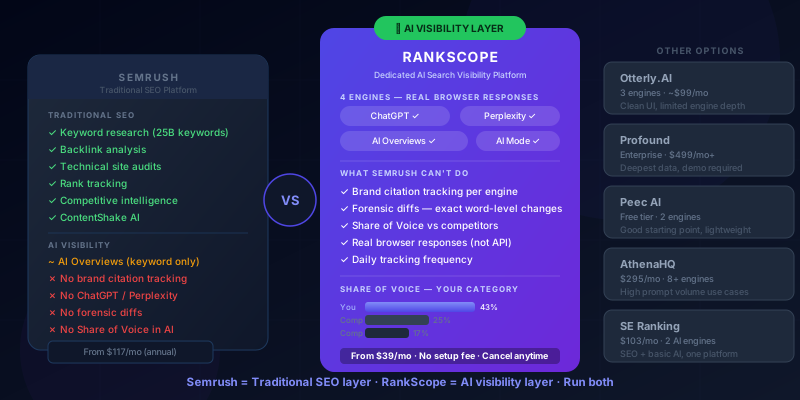
SE Ranking is a Semrush/Ahrefs competitor that includes basic AI visibility features alongside its traditional SEO platform — ChatGPT and Perplexity citation tracking, keyword tracking, site audit, and backlink analysis in one subscription starting at $103.20/month billed annually.
This matters for HubSpot users specifically: HubSpot's built-in SEO tool is functional but not deep. If you're using HubSpot primarily for CRM, email, and landing pages and want to add a more capable SEO layer with basic AI monitoring included, SE Ranking is the consolidation option that avoids paying for Semrush at $117/month plus a separate AI tool.
The AI monitoring module (ChatGPT + Perplexity only) is a secondary feature on a traditional SEO platform, not a dedicated AI visibility tool. For teams where AI citation tracking is the primary objective, a purpose-built tool gives substantially more depth. For teams where it's a secondary check, SE Ranking's bundling makes sense.
Where it fits: Teams looking to consolidate SEO + basic AI monitoring, particularly those replacing a standalone SEO tool.
Pricing: From $103.20/month billed annually.
Side-by-Side Comparison
| HubSpot | RankScope | Otterly.AI | Profound | SE Ranking | |
|---|---|---|---|---|---|
| Primary focus | Marketing operations + CRM | AI search visibility (dedicated) | AI citation monitoring | Enterprise AI visibility | Traditional SEO + AI add-on |
| AI citation tracking | No | Yes | Yes | Yes | Yes |
| ChatGPT | No | Yes | Yes | Yes | Yes |
| Google AI Overviews | No (keyword presence only) | Yes (citations) | No | Yes | No |
| Perplexity | No | Yes | Yes | Yes | Yes |
| Google AI Mode | No | Yes | No | Yes | No |
| Real browser responses | No | Yes | No | Yes | No |
| Forensic diffs | No | Yes | No | Partial | No |
| Share of Voice in AI | No | Yes (per engine) | Yes | Yes | Basic |
| CRM + email automation | Yes (full suite) | No | No | No | No |
| Traditional SEO tools | Basic | No | No | No | Full suite |
| Starting price | $20/mo (Starter) / $890/mo (Professional) | $49/mo | ~$99/mo | $499/mo+ | $103.20/mo (annual) |
| Self-serve signup | Yes | Yes | Yes | Demo required | Yes |
Why This Gap Specifically Affects HubSpot Users
The HubSpot AI visibility gap is more consequential than the same gap in a traditional SEO tool, for a specific reason: HubSpot's core users are marketing teams, and marketing teams are the ones responsible for pipeline. AI-influenced pipeline leaks happen upstream of every metric HubSpot tracks.
Here's the practical scenario. A B2B buyer at a 200-person company is evaluating marketing automation. They open ChatGPT and ask: "What marketing automation platforms should a Series B SaaS company consider for a five-person marketing team?" ChatGPT generates a list. If your brand isn't on it, you don't exist in that buyer's consideration set. They never visit your site, never open your HubSpot email sequence, never fill out your HubSpot landing page form. HubSpot has no record of this buyer's research — the loss happened in an AI-generated conversation before the buyer touched any HubSpot-tracked surface.
This is the blind spot. HubSpot is excellent at the middle and bottom of the funnel. It has no visibility into an increasingly important top-of-funnel channel where buyer consideration sets are being shaped before a website is visited.
The state of GEO in 2026 data makes this concrete: buyers who use AI engines for vendor research shortlist 2-3 vendors from AI-generated recommendations before consulting review sites or visiting websites. If you're not in the AI recommendation, you're often not on the shortlist.
How to Think About the HubSpot + RankScope Stack
HubSpot answers: What happens after a buyer decides to evaluate us?
RankScope answers: Does our brand appear in the AI-generated answers that shape which vendors buyers decide to evaluate?
These are sequential questions covering different stages of the buying journey. HubSpot can't answer RankScope's question. RankScope can't answer HubSpot's. There's almost no functional overlap.
The practical split looks like this:
HubSpot handles:
- CRM and contact management across the full pipeline
- Email sequences, nurture workflows, lifecycle marketing
- Landing pages, forms, lead capture
- Ad attribution and multi-touch reporting
- Social publishing and scheduling
- Traditional SEO keyword tracking and on-page optimization
- Content management and blogging
RankScope handles:
- Brand citation tracking across ChatGPT, AI Overviews, Perplexity, AI Mode
- Forensic diffs when AI responses change
- Share of Voice versus named competitors, per engine
- Prompt library management for systematic AI search coverage
- AI brand monitoring across all four AI engines
If your marketing team uses HubSpot and wants to know whether you're winning or losing in AI-generated buyer research — which is now a real question with real pipeline implications — RankScope is the layer you're missing.
The combined cost of HubSpot Starter ($20/month) plus RankScope Starter ($49/month) is $59/month. The combined cost of HubSpot Professional ($890/month) plus RankScope Pro ($149/month) is $1,039/month — still less than HubSpot Enterprise alone, and you get genuine AI visibility coverage instead of assuming the SEO work you're doing in HubSpot translates into AI search presence.
Spoiler: it doesn't, automatically. Generative engine optimization is a different discipline from traditional SEO, and traditional keyword rankings don't reliably predict AI citation rates. You have to measure them separately.
What to Look for in Any HubSpot Alternative for AI Visibility
If you're evaluating tools beyond the ones listed here:
1. Does it track Google AI Overviews at the brand citation level — not just keyword presence? Knowing a keyword triggers an AI Overview is different from knowing your brand is cited inside it. Most tools marketed as "AI visibility" tools only do the former.
2. Does it cover all four major AI engines? ChatGPT and Perplexity are table stakes. Google AI Overviews and Google AI Mode are the gaps most tools miss — and they're likely where the most HubSpot-relevant traffic decisions happen, since most of your leads probably still start on Google.
3. Real browser responses or API outputs? For Google's AI surfaces specifically, the two diverge in ways that matter. Browser-rendered responses are what real users see.
4. Forensic diffs included? Citation trend data without diagnostics is incomplete. You need to know what actually changed in the AI responses when your numbers move.
5. Share of Voice by engine, not just blended averages? Your ChatGPT presence and your AI Overviews presence may be completely different. Blended averages hide strategic information.
6. Tracking frequency? Daily snapshots catch what weekly tracking misses. AI responses change more often than most teams expect.
For a complete comparison of the AI visibility tools market, the best AI visibility tools breakdown covers every major option in detail.
HubSpot vs RankScope: The Direct Summary
HubSpot is the right platform for marketing operations. It's earned its market position through a decade of genuine product investment in CRM, email, content, and attribution tooling. The platform is broad, the ecosystem is mature, and switching costs are real — we're not suggesting anyone should.
RankScope is the right tool for AI search visibility. It's purpose-built for a measurement problem that HubSpot wasn't designed to address: what AI engines say about your brand during the buyer research phase, how it compares to competitors, and what changed when your citation data moves.
The marketing teams that are ahead of this curve in 2026 are running both. They use HubSpot to manage the pipeline after a buyer shows intent. They use RankScope to understand what AI-generated answers are shaping the buyer's consideration set before they show intent. Together, those two tools give a complete view of the modern B2B buyer journey that neither tool can provide on its own.
Get started with RankScope → — No setup fee · Cancel anytime
Frequently Asked Questions
Does HubSpot have any AI citation tracking built in? No. HubSpot's SEO module tracks traditional Google keyword rankings and surfaces on-page optimization recommendations. It doesn't track brand citations in ChatGPT, Google AI Overviews, Perplexity, or Google AI Mode. HubSpot's social monitoring covers published posts and social feed mentions — not AI-generated answers, which are synthesized at query time and don't live in a social feed.
What's a cheaper alternative to HubSpot Professional for AI visibility specifically? If your primary goal is AI citation tracking rather than marketing automation, RankScope at $49/month is significantly cheaper than HubSpot Professional at $890/month. However, if you need the CRM, email automation, and landing page functionality HubSpot Professional provides, the comparison isn't relevant — those are different tools solving different problems.
Can I import HubSpot data into RankScope? RankScope's Pro plan includes GA4 and Google Search Console integrations, so you can correlate your AI visibility data with your web traffic and conversion analytics from HubSpot-connected properties. There's no direct HubSpot CRM integration currently — RankScope doesn't need contact records; it needs your brand name, competitors, and a prompt library covering your product category.
How quickly does RankScope return data after setup? Data typically starts coming in within 24 hours of setup. You add your brand, configure a prompt library targeting your category and use-case queries, select competitors, and RankScope starts running queries and collecting response data. No sales call, no onboarding fee, no multi-week implementation.
Is HubSpot's content AI an alternative to AI citation tracking? No. HubSpot Content Hub includes AI-assisted writing tools for generating and optimizing content. This is a content production tool — it helps you create content faster. It has no relationship to tracking whether your brand is cited in AI-generated answers on ChatGPT, Perplexity, or Google AI Overviews. Those are different categories of software solving different problems.
What do mid-market B2B marketing teams typically use alongside HubSpot for AI visibility? Teams actively managing AI search visibility alongside their HubSpot stack typically add a dedicated AI citation tracking platform — RankScope for most budgets ($49–$149/month), Profound for enterprise scale ($499/month+). The pattern mirrors how teams added a dedicated rank tracker alongside HubSpot's basic SEO module as traditional SEO became serious work — the specialized tool provides depth the all-in-one platform doesn't.