Free AI Visibility Tools: 16 Tested on the Same Brand (2026)
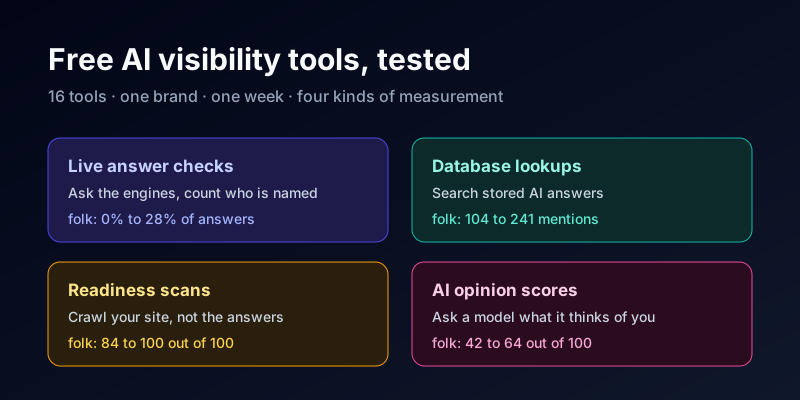
Free AI visibility tools tell you, without paying, whether AI engines such as ChatGPT, Google AI Overviews, Google AI Mode, Gemini and Perplexity mention your brand. They come in four kinds that all use the same name: live answer checks that ask the engines questions and count who gets named, database lookups that search a vendor's stored answers, readiness scans that inspect your website, and AI opinion scores that ask a model what it thinks of you. Which kind you run decides the number you get.
We ran 16 of them on the same brand in the same week of November 2026. The brand was folk, a CRM for small teams: big enough to have a footprint, small enough not to be a default answer, and with a name that is also a common word, which turned out to matter. The results ran from "named in 0 of 20 answers" to "100/100, Excellent". This page explains why, tool by tool, with every gate we hit on the way.
We make one of these tools, the RankScope free AI visibility checker. It is in the results below as one row and was tested the same way. Where it loses, the table says so.
The Short Answer
| If you want to know... | Use | Why |
|---|---|---|
| Does AI recommend me today, with no signup? | RankScope | ChatGPT, Google AI Overviews, Google AI Mode and Perplexity answer your buyer questions live; you see every answer, who was named instead and the pages each answer was built from, in about two minutes |
| A quick look at one engine | Honeyb | Live Gemini answers to five editable questions in about 25 seconds |
| A large competitive audit, if you can wait a day | Verticality | 43 questions, three engines, three runs each: 387 answers, every one shown, sent by email |
| How a big, unambiguous brand trends across many engines | Ahrefs or Semrush | Large stored-answer databases with monthly trends; weak on small or ambiguously named brands |
| Can AI crawlers read my site, and is it marked up well? | Arobis or amivisibleonai | Readiness scans; they say nothing about whether AI actually names you |
| Is Google's AI Overview citing me for my keywords? | An AI Overview checker | A different question from brand visibility; see the section on other free tools |
How We Tested
One brand, every tool, in the same week of November 2026, in a normal Chrome browser. Reports that arrive by email were read when they came, up to a day later.
- The brand: folk. Where a tool asked for a domain we typed
folk.app; where it asked for a brand name we typedfolk; where it asked what the company sells we typed "CRM for small teams". Where a tool insisted on a city we gave one and say which. - What we recorded: the inputs, every gate before the full result, time to result, the headline numbers, which engines actually ran, and whether the tool showed the questions and the answers behind its number.
- Gates: where a tool required an email we used a real inbox. Where it required a name we used a placeholder test name. We did not give a phone number to any tool, and we say where that stopped us.
- What one run means: each tool ran once on the inputs it suggested. RankScope's entry was re-run later the same week, after our checker moved from five questions asked once to ten questions asked twice; the reading below is from that run. AI answers change between runs; in our own 15-run ChatGPT test the brands named were stable but the cited sources churned. Treat every live reading below as one sample, not a verdict on folk.
- Location: every test ran from a browser in California. Live answers can depend on where the question is asked from, and most tools did not say which market they used. Depra set its market to India without asking, even though we were in the US. Searchable asked for a location and we gave New York.
Nobody paid to be included. Every tool was run the same way, and no vendor saw or changed its entry before publication.
Four Kinds of Tool Share One Name
This is the part most comparison pages skip, and it explains nearly every disagreement in the results table.
| Kind | What it actually does | Answers the question | folk's reading |
|---|---|---|---|
| Live answer check | Asks AI engines buyer questions now and counts the answers that name you | "Does AI recommend us?" | 0 of 5 (Honeyb), 0 of 20 (Depra), 6.9% (Amplitude), 10% (Searchable), 4 of 78 (RankScope), 10 of 45 (ProStar SEO), 109 of 387 (Verticality) |
| Database lookup | Searches answers the vendor collected earlier, across millions of stored prompts | "How often does our name appear in AI answers at large?" | 241 mentions (Ahrefs, typed as folk.app); 104 mentions, score 25 (Semrush) |
| Readiness scan | Crawls your site: robots.txt, schema, headings, content | "Could AI read and quote us?" | 100/100 (Arobis), 84/100 (amivisibleonai) |
| AI opinion score | Asks a model to rate your brand from what it already knows | "What does a model think of us?" | 42/100 (SEOcrawl), 50 to 64 (HubSpot) |
The readiness scans were not wrong. folk's site really is easy for crawlers to read. They answer a different question. If you are trying to find out whether ChatGPT or Gemini recommends you to a buyer, only the first kind measures it directly, and the database kind measures it indirectly, from prompts you did not choose.
Results: 16 Free AI Visibility Tools
All readings are for folk, from the same week of November 2026. "Answers shown" means the tool showed what the AI actually said, as opposed to a count.
| Tool | Kind | Engines in the free result | Gate before the full result | Time | Questions shown? | Answers shown? | folk's reading |
|---|---|---|---|---|---|---|---|
| RankScope | Live | ChatGPT, AI Overviews, AI Mode, Perplexity | None | ~2 min | Yes, editable | Yes, full text | Named in 4 of 78 answers |
| Verticality | Live | ChatGPT, AI Overviews, Perplexity, 3 runs each | Work email; report by email | Next day | Yes, all 43 | Yes, every answer | Named in 109 of 387 answers |
| ProStar SEO | Live | ChatGPT, ChatGPT Search, AI Overviews | Name, email and business details; report by email | Next day | Yes | Names only | Named in 10 of 45 answers |
| Honeyb | Live | Gemini (with Google Search) | None | ~25 s | Yes, editable | Names only | Named in 0 of 5 |
| Amplitude | Live | ChatGPT, Google AI Overviews | Email (on-screen run stalled for 6+ min) | Yes | No | Mentioned in 6.9% of responses | |
| Searchable | Live | ChatGPT, Google AI Overviews, Perplexity | Name, email, location, emailed code; creates an account | ~2 min after code | In the app | In the app | 10% visibility, 8th of 20 brands |
| Depra | Live | ChatGPT, Gemini, AI Overviews, Perplexity | Email; phone number for everything past the headline | ~7 min | Yes | Behind phone gate | Named in 0 of 20 answers |
| Frase | Live (citations) | ChatGPT, then Perplexity and Gemini | Email for Perplexity and Gemini | ~1 min | Yes | No | Cited by 0 of 3 engines, 2 questions |
| Meev | Live | ChatGPT, Gemini | None for the score; prompts need a paid plan | ~40 s | No (hidden) | No | 6/100, cited in 1 of 10 responses |
| Most AI Labs | Live + readiness | Results said 3 AI tools | City required | ~3.5 min | Partly | No | 37/100 |
| Ahrefs | Database | ChatGPT, Gemini, Perplexity, Copilot, AI Overviews, AI Mode, Grok | None | ~10 s | No | No | 241 mentions (folk.app) |
| Semrush | Database | ChatGPT, Gemini, AI Mode, AI Overviews | None; a "3/3" daily counter | ~10 s | No | No | Score 25 "Low", 104 mentions |
| Arobis | Readiness | Scores labelled for 4 engines, "not live queries" | Terms-of-service checkbox | ~30 s | n/a | n/a | 100/100 "Excellent" |
| amivisibleonai | Readiness | n/a (site crawl) | None | ~20 s | n/a | n/a | 84 average across 5 pages |
| SEOcrawl | AI opinion | ChatGPT, Perplexity, Gemini, Claude, "not a live count" | None | ~45 s | No | No | 42/100 "Fair" |
| HubSpot AI Search Grader | AI opinion | OpenAI, Perplexity, Gemini, "based on their training data" | Four required fields, no account | ~30 s | No | No | 50, 64, 51 "on the right track" |
Live Answer Checks
These ask AI engines questions on the spot and count the answers that name you. They are the only kind that measures the outcome directly, and they are also the slowest and the most likely to put a form in front of the result.
RankScope: four engines, every answer, no signup
RankScope's free checker (ours) takes a domain, reads the homepage and proposes the brand name, the other names that count as the brand (Folk CRM, folk.app), a country and ten buyer questions: four about the category, four built from use cases the site claims, and two asking for alternatives to a well-known competitor. All of them can be edited before anything runs. It then asks ChatGPT, Google AI Overviews, Google AI Mode and Perplexity each question twice: 80 answers in about two minutes, with no form and no account.
folk was named in 4 of 78 answers (two AI Overview answers didn't load and are left out of the count). Perplexity named it three times: second and third for managing partnership teams, once in each run, and twelfth of twelve for Outlook. Google AI Mode named it once, fourth, on the partnership question. ChatGPT and AI Overviews named it in none, and only one question-and-engine pair named folk in both runs. HubSpot was named in 70 of the 78 answers, Pipedrive in 57, Zoho CRM in 54, Salesforce in 41, and Microsoft and Freshsales in 25 each.
Every answer opens in full, with the brands in the order the engine listed them and the sources it cited. The report then opens the pages the answers drew on most and checks who is on them (hubspot.com fed 19 answers, salesforce.com 13), and checks whether the AI crawlers can reach the site. A head-to-head view sets folk against any brand the answers named: against HubSpot, 66 answers named only HubSpot, 4 named both and none named only folk. It also flagged three Perplexity answers that read folk's own Gmail and Outlook CRM guides and then recommended other brands.
What it doesn't do: ten questions asked twice is still one day's sample. The emailed reports below asked 43 and 15 questions, and Verticality asked each one three times. It is also slower than Honeyb's one-engine check.
Best for: finding out whether ChatGPT, Google's two AI surfaces and Perplexity recommend you today, without giving an email.
Verticality: the biggest report, by email
Verticality's checker asks for a website, the brand, what you sell and a work email, and promises the report within 24 hours. It came the next morning as a personal email from one of the team, with a link to a report page: 43 questions in eight buyer groups, each asked three times on ChatGPT, Google AI Overviews and Perplexity, 387 answers in all.
folk was named in 109 of the 387: ChatGPT 35 of 129, Google AI Overviews 19 of 129, Perplexity 55 of 129. HubSpot was named in 304, Pipedrive in 247, Zoho in 166 and Salesforce in 130; folk came fifth. The report shows every question and every answer and splits the result by buyer group: folk was strong on LinkedIn outreach and nearly absent from questions about Gmail and Outlook. It also reports that Google showed no AI Overview for 44 of the 129 searches, and counts 10 answers that used a folk page without naming folk.
What to know: this is a service's report more than a self-serve tool. It needs an email address and a wait until the next day, and the sender follows up with questions. The landing page promised ChatGPT and AI Overviews; the report added Perplexity.
Best for: a deep one-off audit, if you are happy to hear from their team.
ProStar SEO: an emailed report with noisy names
ProStar SEO's free audit asks for the website, the business name, what you sell, your name and an email, and sends the report within a business day; ours came the next day. It asked 15 buyer questions of ChatGPT, ChatGPT Search and Google AI Overviews: 45 answers, with folk named in 10.
The report shows who each engine named for each question, a share-of-voice table (Pipedrive and Salesforce in 33 answers each, Zoho 24, HubSpot 21, folk 10), and the domains the engines cited with the kinds of page behind them.
What went wrong: the share-of-voice table says software is left out, then counts Gmail (16) and Outlook (14) as competitors to a CRM, and some cells name product features (Einstein, Copilot) as businesses. The summary email and the report listed different competitors for the same question. And plain ChatGPT, without search, was shown citing folk's site, although the report's own sources section says only ChatGPT Search and AI Overviews list sources.
Best for: a second opinion from an agency, if you can wait a day.
Honeyb: the fastest live check
Honeyb read folk's homepage, wrote five buyer questions ("Who are the best AI CRM providers for sales teams?" and four more), asked Gemini with Google Search live, and streamed the answers in about 25 seconds. folk was named in none of the five. Pipedrive was named in four, Zoho CRM in three, HubSpot in two. It listed the sources Gemini leaned on (monday.com in three answers) and turned two of them into specific suggestions: folk is missing from a page Gemini cited twice.
You can change the questions and run again, which is the feature most free tools lack.
What went wrong: the competitor count treated product features as brands. Einstein, Agentforce, Breeze AI, Zia, Copilot and Freddy AI all appear as "competitors"; they are AI features inside Salesforce, HubSpot, Zoho, Microsoft and Freshworks. The listing advice ("services, location, contact details and reviews") reads as written for local businesses. And the free check uses Gemini only; the paid plan adds seven more engines.
Best for: a fast, honest first look at one engine, with the questions in your control.
Amplitude: the most transparent numbers, by email
Amplitude's free report asks only for a company name. The on-screen run moved from "Identifying relevant topics" to "Finding top queries" and then sat there for more than six minutes, so we used the optional "email me the dashboard" box. The link arrived later that afternoon and opened without a login.
The report measured ChatGPT and Google AI Overviews. HubSpot was mentioned in 76.5% of responses, Salesforce in 59.8%, Pipedrive in 57%, folk in 6.9%. What sets it apart is that every topic shows its denominator: "Relationship Intelligence, 6 mentions in 28 responses". That is the only way to tell a real share from a small-sample accident, and Amplitude did it for every topic.
What went wrong: the banner on a first-ever report read "You're gaining ground in AI visibility", with no earlier reading to gain from. "Zoho" and "Zoho CRM" were counted as two competitors, and Outlook (9%) appeared as a CRM competitor.
Best for: a competitive snapshot you can defend in a meeting, if you can wait for the email.
Searchable: a full product, behind the longest form
Searchable's free report took seven steps: website, first and last name, work email, brand location, reach, "how did you find us", and competitors (it suggested Attio, Pipedrive and Close, which were sensible). Then it emailed a six-digit code. Entering it created an account and a workspace, with a prompt to set a password and a free-trial checklist.
The report itself was good: 30 responses from ChatGPT, Google AI Overviews and Perplexity (the engines named in the email that followed), folk visible in 10% of them and eighth of twenty brands, behind Pipedrive (40%), HubSpot (37%), Salesforce (23%) and Zoho CRM (17%), with share of voice and sentiment per brand. It was also the only live tool that asked where the brand sells.
What went wrong: the gate. "Free report" here means an account. The brand list also had a long tail of unrelated names (KADO Networks, LeafLink at 3% each), and the trend chart showed "Last 7 days" for a report generated that day.
Best for: teams that are already shopping for a paid tool and do not mind the signup.
Depra: four engines, then a phone number
Depra's page says "No signup, no card". The button leads to a form that asks for a work email. The report page then read folk's homepage, wrote five questions and asked ChatGPT, Gemini, Google AI Overviews and Perplexity: 20 checks in about seven minutes. It set the market to India without asking, although we ran it from California, and there was no way to change it.
The headline is free: folk was named in 0 of 20 answers. Everything after it, including who was named instead and the per-question answers, sits behind a phone number, with a note that the team "may call or message you". We stopped there.
Best for: the four-engine headline, if you are happy to stop at the headline.
Frase: citations, not mentions
Frase's checker asks ChatGPT one question built from your domain and shows the result without a form: for "What's the best AI-powered CRM for sales teams that automates prospecting and outreach in 2026?", ChatGPT did not cite folk.app. A second step adds Perplexity and Gemini; its button says "No email to wait for" and the box that opens asks for a work email.
The full result: 0 of 3 engines citing folk.app, from 2 questions. Note what it counts. A citation is a link to your domain in the answer's sources, not your name in the text, so a brand can be recommended by name and still score zero here.
What went wrong: the results disagreed with themselves. The card at the top said ChatGPT "Not cited"; the engine table below it said ChatGPT "Not checked".
Best for: checking whether AI engines link to your site, as distinct from naming you.
Meev: a score without its questions
Meev took a domain and returned a score in about 40 seconds: 6 out of 100, "Effectively invisible in AI search", cited in 1 of 10 responses, at position 9 when cited, on ChatGPT and Gemini. The section headed "The 5 prompts we tested" was a list of five blank lines; the page says the exact prompts come with a paid plan.
A visibility number is only as good as the questions behind it, and here you cannot see them. folk's reading was in line with the other live checks, so we have no reason to think it is wrong; we just cannot check it.
Best for: a quick second opinion, not a number to report.
Most AI Labs: built for local businesses
Most AI Labs was third in Google's US results for "ai visibility checker" when we checked. It asks for a business name, a full URL (a bare domain was rejected), a city (required) and an optional one-line description. With folk, Paris and "CRM for small teams", the scan took about three and a half minutes.
It returned 37 out of 100. The AI Overview queries it ran were "best service business in Paris", "how to choose a service business in Paris" and "folk reviews": the description we typed did not reach the questions. The page promises ChatGPT, Claude, Gemini and Perplexity; the result said "None of the 3 AI tools we tested". The schema check scored folk down for missing an address, phone number and opening hours.
Best for: a local service business with a storefront. Not a software company.
Database Lookups
These search answers the vendor has already collected, across very large prompt sets. They are instant and need nothing from you, and they show trends you cannot get from a one-off live check. Their weakness is that the prompts are theirs, not your buyers', and that they match on text.
Ahrefs: type your domain, not your name
Ahrefs' free checker takes a brand name and answers in about ten seconds from its Brand Radar data. For folk it returned 6.3 million mentions. The top topics were harmonica, acoustic guitar, folk clothing and mandolin, and the most cited page was Wikipedia's article on folk costume. For folk.app it returned 241 mentions: ChatGPT 10, Gemini 8, Copilot 55, AI Overviews 121 plus 8 in a newer index, AI Mode 20 plus 12, Grok 7. The top topic was "folk crm".
Same tool, same company, a factor of about 26,000 from how the name was typed. AmICited reported the same trap with Notion (notion.so returned zero, notion.com did not) in its own roundup. Competitor data is behind the paid plan; the free view shows the top five of each section.
Best for: brands with a distinctive name, and anyone who wants a monthly trend for free.
Semrush: a score, and what drives it
Semrush's free tool takes a domain and showed a "3/3" counter beside the button. For folk.app: AI Visibility Score 25 ("Low", up 9% over three months), 104 mentions (ChatGPT 7, Gemini 29, AI Mode 22, AI Overviews 46), 597 citations, and a comparison with a competitor it picked itself, streak.com.
The useful part was the top-cited pages. folk's most cited pages were articles on how to tell if someone blocked you on WhatsApp (184 citations), how to find contacts in Gmail (165) and how to record WhatsApp video calls (97). Those citations are real, but they come from how-to content, not from anyone asking which CRM to buy. A citation count can be high while buyer visibility is low.
Ahrefs and Semrush disagreed on the same domain on the same evening (ChatGPT 10 against 7; Gemini 8 against 29). Two databases, two pictures. Neither showed an answer's text.
Best for: Semrush users, and anyone curious which of their pages AI engines cite most.
Readiness Scans
These crawl your website and score it against signals that help AI systems read and quote it. They are fast and genuinely useful for finding technical problems. They do not ask any AI engine anything.
Arobis
Arobis requires you to tick a terms-of-service box, then scans the domain in about 30 seconds. folk.app scored 100 out of 100, "Excellent", with 100 for each of ChatGPT, Gemini, Claude and Perplexity. The footnote is clear about what that means: "Estimated readiness derived from your site's signals, not live queries to each model."
On the same evening three live checks found folk in none of their answers. Both readings are accurate. folk's site is easy to read; that has not, on its own, made engines recommend it.
amivisibleonai
amivisibleonai.com crawled five folk pages in about 20 seconds and averaged 84, with "AI Visibility" sub-scores of 100 on the help centre and blog and 88 on the homepage, plus six suggested improvements. No form, and an optional email copy. Like Arobis, it scores the site, not the answers.
Best for both: a technical checklist before you work on content and mentions. Run a live check alongside to see whether it is the bottleneck.
AI Opinion Scores
These ask a language model what it knows about your brand and turn the reply into a score. That is a real signal (it reflects what a model learned in training), but it is not what a buyer sees when they ask ChatGPT a question with search turned on.
SEOcrawl
SEOcrawl took about 45 seconds and returned 42 out of 100, "Fair", with a written rationale per engine: "Rarely named" for ChatGPT, Gemini and Claude, "Sometimes named" for Perplexity. Below the engine rows the page says it is an "estimated likelihood each engine names you for your category queries, not a live count". It offers a free PDF and publishes each report at its own URL on its site.
HubSpot AI Search Grader
HubSpot's grader asks for a company, location, product and industry, and describes itself as showing what ChatGPT, Perplexity and Gemini "say about you based on their training data". folk scored 50, 64 and 51, each labelled "You're on the right track", with brand recognition at 5 to 9 out of 20.
Best for both: a read on brand perception. Not a substitute for asking the engines.
Other Free Tools for AI Visibility
Brand visibility checkers are one job. These free tools cover the jobs next to it.
- Google Search Console's Generative AI report. Shows impressions your site earned in AI Overviews and AI Mode, combined, from Google's own data. It does not show queries or positions, and it counts impressions, not mentions. It is the only first-party number on this page. On our own site AI features were about a third of web impressions over 28 days in October.
- AI Overview checkers. Brand checkers ask buyer questions; an AI Overview checker takes your keywords and shows whether Google's AI Overview cites you for each one, and who it cites instead. Ours is the free AI Overview checker, which also shows AI Mode and the top 100 organic results for each keyword, up to 10 keywords per check.
- Crawler access checks. Whether GPTBot, OAI-SearchBot, ClaudeBot, PerplexityBot and Googlebot can fetch your pages. Several readiness scans above include this. Our AI crawler checker reads your robots.txt for 17 AI crawlers and shows the rule that decides each one.
- llms.txt generators. A short guide to your site for AI agents. Our llms.txt generator builds and validates one in the browser. Google has said its Search features, AI Overviews and AI Mode included, ignore the file, so do not expect it to change your visibility there.
How to Read Your Result
Check what kind of tool you ran. A readiness score of 100 and a live mention rate of 0 can both be true. If the question is "does AI recommend us", only a live answer check answers it.
Type the domain. If your brand is also a common word, a database lookup will count the word. Ahrefs' 6.3 million versus 241 is the extreme case, and AmICited's Notion example is the same trap from the other side.
Look for the denominator. "Named in 3 of 30 answers" tells you how much to trust the number. "Visibility 10%" on its own does not. RankScope, Verticality, Amplitude and Depra show the denominator; Meev hides the questions entirely.
Mentions, citations and readiness are different numbers. A mention is your name in the answer text. A citation is a link to your site in the sources. Frase counts citations, most live checks count mentions, and readiness scans count neither.
One run is one sample. The questions a tool writes, the country it asks from and the day it asks all move the result. Run the same check again on another day before you act on it, or use a tool that re-checks for you.
Location matters. If a tool does not let you pick a country, you do not know which market's answers you got. One tool in our test did not ask, and chose India for a test run from California.
A Free Setup That Covers the Four Questions
You can get a usable picture without paying anything:
- A live check with questions you control for "do engines recommend us": our checker for ChatGPT, both Google AI surfaces and Perplexity, or Honeyb for a quick look at Gemini. Re-run it a week later.
- Ahrefs or Semrush for a trend line on how often your domain appears in AI answers at large.
- One readiness scan to rule out technical blocks.
- Google Search Console's Generative AI report for Google's own count of your AI Overview and AI Mode impressions.
When you need the same questions asked every day, across engines, with history and competitors, that is a paid tracker. Our comparison of AI search visibility tools prices eight of them per answer, and AI visibility tool pricing covers what each plan includes.
Frequently Asked Questions
What is the best free AI visibility tool?
It depends on the question. To find out whether AI engines recommend you right now, without a signup, RankScope's checker was the most complete we ran: ChatGPT, Google AI Overviews, Google AI Mode and Perplexity, with every answer shown. Honeyb is the fastest look at Gemini alone. For a large one-off audit by email, Verticality. For a trend on a well-known brand, Ahrefs or Semrush. For a technical check of your site, Arobis or amivisibleonai.
Are free AI visibility tools accurate?
Most are accurate about what they measure; the problem is that they measure different things. Readiness scans score your website, opinion scores ask a model about you, database lookups search stored answers, and live checks ask engines questions now. On one brand in one week those four kinds gave readings from 0% to 100%.
Why did different tools give my brand completely different scores?
Because they ran different tests. Check whether the tool asked live questions, searched a database, crawled your site or asked a model's opinion. Then check the input: a brand name that is also a common word can inflate a database count by orders of magnitude.
Do free AI visibility tools need a signup?
The no-signup ones we ran were Honeyb, Ahrefs, Semrush, Meev (score only), Most AI Labs, amivisibleonai, SEOcrawl, HubSpot and RankScope. Arobis needs a terms checkbox. Amplitude, Frase and Depra needed an email for the full result, Verticality and ProStar SEO emailed their reports the next day, Depra wanted a phone number for the detail, and Searchable created an account.
How often should I check my AI visibility?
AI answers change between runs, so a single check is a starting point. Re-run the same questions at least weekly while you are working on visibility, or use a tracker that asks them daily.