Generative Engine Optimization Companies: Who's Leading GEO in 2026
Generative engine optimization is past the "what is it?" stage. In 2026, it's a real discipline with a growing ecosystem of companies built around it — some making software, some running client campaigns, some doing both.
If you're evaluating your options — whether you're buying a tool, hiring an agency, or just trying to understand who the players are — this post maps the full landscape. We've broken it into three categories: GEO software platforms, GEO agencies, and what to look for in a GEO consultant. We'll be honest about where companies are strong and where they fall short.
Before getting into specifics: if you're newer to the concept, what generative engine optimization actually is and how it works is worth reading first. The short version: GEO is the practice of structuring content and managing online presence so that AI engines — ChatGPT, Google AI Overviews, Perplexity, Google AI Mode — cite your brand in their responses. It's different from SEO, which targets keyword rankings in traditional search results.
The Three Types of GEO Companies
The companies doing generative engine optimization work fall cleanly into three buckets:
1. GEO software platforms — SaaS tools that measure and track AI citation data. You buy a subscription, connect your brand and competitors, and the platform tracks how often you appear in AI-generated answers. Some also include content optimization features.
2. GEO agencies — marketing agencies that offer GEO as a managed service. They handle strategy, content creation, and optimization on your behalf. Most use third-party GEO tools for measurement.
3. GEO consultants — individual practitioners or small firms working directly with brands to improve citation rates. Often former SEO or content strategists who've moved into the GEO space.
Many brands end up using more than one category — a GEO tool for ongoing measurement, an agency or in-house team for execution.
Category 1: GEO Software Platforms
These are the companies building the infrastructure that GEO runs on. They're the ones who have figured out how to actually query ChatGPT and Google AI Overviews at scale, extract citation data, and build dashboards that make the information actionable.
RankScope — Best Overall GEO Platform
RankScope is the most purpose-built GEO tracking platform available right now. It tracks brand citations across four AI engines — ChatGPT, Google AI Overviews, Perplexity, and Google AI Mode — with one feature that genuinely differentiates it from everything else: real browser responses.
Most GEO tools query AI engines via API. The problem is that API responses for Google AI Overviews and Google AI Mode aren't the same as what users actually see in their browser. RankScope uses actual browser sessions to capture responses, which means the data for AI Overviews and AI Mode actually reflects real user experience — not a sanitized API output.
What RankScope measures:
- Citation rate (how often your brand appears in AI responses to relevant queries)
- Share of voice (your citations vs. competitors across the same query set)
- Mention sentiment (positive, neutral, or negative framing)
- Citation source tracking (which of your pages are being pulled into AI responses)
- Forensic diff detection (alerting you when AI responses change and showing exactly what changed)
Pricing: Starter $49/mo · Pro $149/mo · Agency $399/mo · 20% off annual. Self-serve, no sales call.
Best for: Growth-stage companies, agencies managing multiple clients, and any brand that needs accurate Google AI Overviews data specifically.
Limitations: Four engines only (ChatGPT, AI Overviews, Perplexity, AI Mode) — doesn't cover Bing Copilot or Claude. No content optimization recommendations built in.
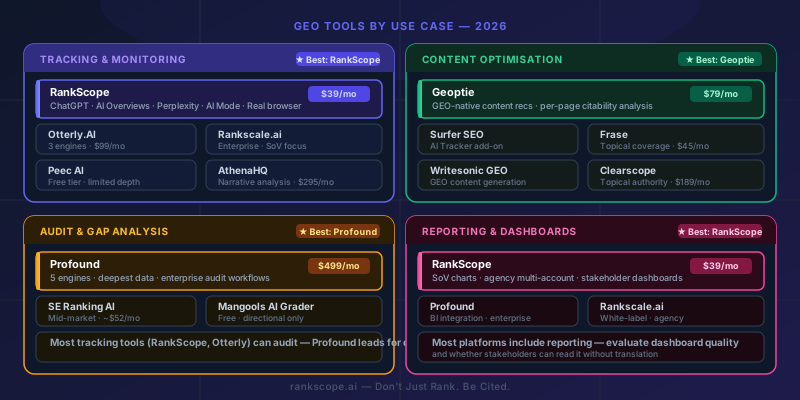
For a deeper comparison of RankScope against the field, the complete GEO tools comparison breaks down every platform by use case with detailed pricing.
Otterly.AI — Strong All-Rounder
Otterly.AI is one of the more established GEO tracking platforms. It covers a broader range of AI engines than most (including Bing Copilot and Claude in some tiers), and its UI is clean and easy to onboard.
The platform tracks brand mentions, citation frequency, and competitor share of voice. It doesn't match RankScope's real-browser approach for AI Overviews data, but for teams primarily tracking ChatGPT and Perplexity, the data quality is solid.
Pricing: Mid-market, public pricing on their site. Starts lower than RankScope's Pro tier.
Best for: Teams who want broader engine coverage or who find RankScope's interface less intuitive.
Limitations: API-based responses for some engines means slightly less accurate AI Overviews data. Fewer competitive benchmarking features at entry-level pricing.
Profound — Enterprise Depth
Profound is the enterprise option in the GEO tools space. It goes significantly deeper on data — more queries, more competitive benchmarking, more granular reporting — but the pricing reflects that: starting at $499/mo and requiring a sales call.
For a Fortune 500 brand or a large agency managing dozens of clients simultaneously, Profound's infrastructure can justify the cost. For anyone else, it's overkill.
Best for: Enterprise brands and large agencies running high query volumes.
Limitations: Pricing is enterprise-only. You can't just sign up and start — there's a demo and sales process involved.
Geoptie — Best for Content Teams
Geoptie ($79/mo) takes a slightly different angle than pure tracking platforms. It combines AI citation data with per-page content recommendations — showing you not just whether you're being cited, but suggesting what changes to your existing pages might improve citation rates.
This makes it the strongest GEO tool for content teams who are actively rewriting and publishing pages specifically to improve AI visibility. If your primary use case is "I want to know what to fix," Geoptie is worth evaluating.
Limitations: Less depth on the competitive share-of-voice side. Better as a content optimization layer than a competitive intelligence platform.
Rankscale.ai — Share of Voice Focus
Rankscale.ai is built primarily around competitive benchmarking and share-of-voice analysis at scale. It's particularly useful for brands in competitive markets where knowing exactly how you compare to 10–15 competitors across AI engines is the core question.
It requires a sales demo and is positioned more toward enterprise and agency accounts. Less ideal as a first GEO tool for a growth-stage company.
AthenaHQ — Mid-Market Option
AthenaHQ ($295/mo) sits in the mid-market tier — more feature depth than Starter-tier tools, less comprehensive than Profound's enterprise stack. It covers multiple engines and includes reporting features suited to teams that need to share AI visibility data with stakeholders.
The price point is the main friction. At $295/mo, you're paying significantly more than RankScope's Pro tier without a proportional jump in capability for most use cases.
Peec AI — Free Entry Point
Peec AI has a permanent free tier, which makes it the default recommendation for anyone who wants to start tracking GEO without any financial commitment. The free plan is limited — you'll hit query limits quickly, and competitive benchmarking is restricted.
It's a useful tool for early experimentation. Once you need reliable ongoing data, the paid tiers of RankScope or Otterly.AI are a more practical choice.
Category 2: GEO Agencies
GEO agencies offer something GEO tools don't: execution. They have teams who write content, optimize existing pages, build entity presence, and handle the ongoing work of improving citation rates. That said, the quality and approach varies significantly across the agencies now calling themselves "GEO specialists."
A few things worth knowing about how agencies work in this space:
Most use third-party tools for measurement. The agencies listed below don't build their own GEO tracking infrastructure. They use platforms like RankScope, Profound, or Otterly.AI to measure client results. When an agency talks about "proprietary GEO methodology," they usually mean their process for content strategy and optimization — not their data infrastructure.
GEO is frequently bundled with existing SEO retainers. Many of these agencies offer GEO as an add-on to traditional SEO services, not as a standalone offering. That can be efficient or it can mean GEO gets less attention than it should — ask specifically how much of the retainer is dedicated to GEO work.
Results take time. AI training cycles and response patterns don't shift in 30 days. Reasonable agencies will tell you to expect a 3–6 month horizon before citation rates move meaningfully.
Power Digital Marketing
Power Digital is one of the larger full-service digital agencies to formally launch a GEO practice. Their GEO offering focuses on structured content, entity optimization, and schema implementation — the core levers that influence what AI engines pull from a site.
They work primarily with mid-market and enterprise clients. If you're a smaller brand, their minimum engagement sizes may be prohibitive.
Best for: Mid-market to enterprise brands wanting a large, established agency with GEO capability.
Go Fish Digital
Go Fish Digital has been in digital marketing for over 15 years and added GEO services as AI search became significant. Their GEO work focuses on content structuring, AI citation auditing, and improving the factual density of existing content so AI engines are more likely to pull from it.
They're transparent about methodology and have published useful frameworks for how they approach GEO. Worth considering if you want an agency with a credible track record before GEO became a trendy service.
First Page Sage
First Page Sage publishes regular research on GEO agency performance and runs their own managed GEO service. Their approach is heavily content-led — they write high-quality, entity-rich content designed to be cited by AI engines.
Their model is closer to a content-as-a-service agency than a pure optimization firm. If your main GEO bottleneck is producing enough quality content to be cited, they're worth evaluating.
Silverback Strategies
Silverback Strategies appeared in Clutch's roundup of top GEO companies and has been offering structured GEO services through 2026. They're a mid-size agency that covers both traditional SEO and GEO, which can be an advantage if you want one team managing both disciplines and tracking how they interact.
Stellar Rising
Stellar Rising has positioned GEO (which they call "Generative Search Optimization") as one of their core service offerings. They tend to work with growth-stage companies and SaaS brands — a slightly different ICP than the larger agencies above.
Best for: SaaS and tech brands wanting a GEO-focused boutique rather than a full-service agency.
SEOProfy
SEOProfy has published one of the more detailed roundups of GEO agency comparisons and offers GEO consulting and execution services. Their team skews technical — if your GEO challenges are partly infrastructure-related (schema, site structure, crawlability), they're worth talking to.
Victorious
Victorious focuses on content-led GEO strategy with a clear emphasis on building topical authority. They've been serving SEO clients for years and have applied the same authority-building framework to GEO — the theory being that AI engines favor sources that demonstrate consistent expertise on a topic over time.
Category 3: GEO Consultants
Independent GEO consultants are the third category — individual practitioners or very small firms working directly with brands, typically on a retainer basis. This market has grown quickly since 2025 as experienced SEO and content strategists have moved into GEO.
The quality range is enormous. Because "GEO consultant" requires no certification and the discipline is less than three years old, you'll find genuine experts alongside people who've read a few blog posts.
What separates good GEO consultants:
- They can explain how specific AI engines decide what to cite (not just vague "optimize for AI" advice)
- They use real measurement tools (RankScope, Otterly.AI, or Profound) rather than manual spot-checking
- They have a clear process for establishing a citation baseline before making content changes — otherwise there's no way to know if the work is working
- They understand that different AI engines behave differently (ChatGPT and Perplexity handle citations differently than Google AI Overviews)
How to find them: The GEO communities that have emerged on LinkedIn and in SEO forums are the best current source. Look for practitioners who are sharing specific, technical insights rather than general "AI is changing search" commentary.
Typical pricing: $150–$400/hr or $2,000–$8,000/mo depending on experience and scope.
How to Choose: Tool vs Agency vs Both
The decision between a GEO tool, an agency, and a consultant isn't mutually exclusive. Here's how to think about it:
Start with a tool if: You have an in-house content or marketing team who can execute on GEO strategy. You need ongoing citation data and competitive benchmarking. You want visibility into what's changing in AI responses before deciding whether to bring in outside help. RankScope's platform is the right starting point — it gives you the measurement layer you need regardless of who's doing the execution.
Bring in an agency if: You don't have internal capacity for content production and optimization at the pace GEO requires. You need someone to own the GEO program end-to-end. You're a large brand where the ROI of faster citation growth justifies agency fees.
Consider a consultant if: You want strategic guidance and a GEO audit without committing to an agency retainer. You have an existing content team who can execute but need someone to build the framework. You want an objective second opinion before hiring an agency.
The most common setup for growth-stage companies: A self-serve GEO tool (typically RankScope at Pro tier) plus an in-house content writer who's been given a clear GEO brief. This is usually the most cost-efficient path for companies in the $1M–$20M ARR range.
For companies above $20M ARR, or where AI visibility is a board-level priority, adding an agency layer makes sense — but keep the measurement tool regardless, so you can verify the agency's work.
The GEO Software Comparison Table
| Platform | Pricing | Engines Covered | Real Browser | Free Tier | Best For |
|---|---|---|---|---|---|
| RankScope | From $49/mo | ChatGPT, AI Overviews, Perplexity, AI Mode | ✅ Yes | ❌ No | Best overall tracking |
| Otterly.AI | Mid-market | ChatGPT, Perplexity, Bing Copilot, Claude | ❌ No | ✅ Limited | Broader engine coverage |
| Profound | $499+/mo | Multiple | Varies | ❌ No | Enterprise depth |
| Geoptie | $79/mo | ChatGPT, Perplexity | ❌ No | ❌ No | Content optimization |
| Rankscale.ai | Enterprise, demo | Multiple | Varies | ❌ No | Competitive SoV |
| AthenaHQ | $295/mo | Multiple | Varies | ❌ No | Mid-market teams |
| Peec AI | Free + paid tiers | ChatGPT, Perplexity | ❌ No | ✅ Yes | Free experimentation |
For a deeper dive into each tool's feature set and how they compare by use case, the full GEO tools breakdown covers all seven platforms in detail.
What Good GEO Work Actually Looks Like
Whether you're evaluating a tool, an agency, or a consultant, it's worth knowing what the actual work of GEO involves. This gives you a basis for asking sharp questions.
Establishing a citation baseline. Before any optimization work, you need to know where you stand. That means running a set of queries relevant to your brand across multiple AI engines and documenting how often you appear, at what position, and with what framing. This baseline is what lets you measure whether subsequent work is having any effect.
Identifying content gaps. AI engines tend to cite content that is factually dense, clearly structured, and authoritative on specific topics. A gap analysis looks at the queries where competitors are getting cited and you're not — and identifies which of your existing content could be strengthened, or what new content is needed.
Content structuring and entity optimization. This is where most of the actual work happens. Content needs to answer specific questions directly, at the top of sections. Entities (brand names, people, product names) need to be mentioned consistently and accurately. Schema markup helps AI engines understand what a page is about. The complete GEO guide covers these pillars in detail.
Measurement and iteration. GEO requires ongoing tracking to know what's working. Citation rates shift as AI engines update, as competitors publish new content, and as your own content ages. This is where a dedicated tool becomes non-negotiable — you can't manually query ChatGPT for 50 topics across four engines every week. The GEO metrics guide explains what to track and how to interpret the numbers.
Why This Market Is Still Maturing
The GEO landscape in 2026 is genuinely in early innings. A few things worth keeping in mind:
The agency side is crowded with opportunists. Every SEO agency is adding "GEO" to their services page right now. Some are genuinely building the methodology; most are applying existing SEO frameworks with minor adjustments and calling it GEO. The ones worth working with have a clear explanation of how they establish baselines and measure results — not just vague claims about "AI visibility."
The tool side is consolidating. There were probably 20+ GEO tracking tools launched in 2024–2025. The field is narrowing to the companies that built serious infrastructure (real data pipelines, not just API wrappers) and have enough customers to invest in product development. RankScope, Otterly.AI, Profound, and Geoptie are the names that keep coming up in serious discussions.
Measurement is still the hardest part. AI engine behavior varies by user location, device, query phrasing, and (especially for Google AI Overviews) whether the feature appears at all. Any company claiming to give you 100% accurate citation data should be asked how they handle these variables. Real browser responses — the approach RankScope uses — are the most reliable method currently available.
Frequently Asked Questions
What is a generative engine optimization company?
A generative engine optimization company is any business that helps brands improve their visibility in AI-generated answers from platforms like ChatGPT, Google AI Overviews, Perplexity, and Google AI Mode. This category includes dedicated GEO software platforms (like RankScope), GEO agencies that execute strategy for clients (like Power Digital Marketing or Go Fish Digital), and independent GEO consultants.
Who are the leading GEO companies in 2026?
In the tools category, RankScope, Otterly.AI, and Profound are the leading platforms. In the agency category, Power Digital Marketing, Go Fish Digital, First Page Sage, and Silverback Strategies are the most-cited names. The consultant market is highly fragmented, but practitioners with deep SEO backgrounds who've published original thinking on GEO methodology are typically the strongest options.
Do I need a GEO company or can I do it myself?
GEO measurement requires dedicated software — you can't manually track citation data at scale. But the strategic and content work of GEO is learnable. Many in-house teams use RankScope for measurement and handle optimization themselves using the data the platform surfaces. An agency makes sense when you need execution capacity beyond what your internal team can provide, or when AI visibility is a strategic priority that warrants specialist investment.
How is a GEO company different from an SEO company?
Traditional SEO companies optimize for keyword rankings in Google's standard search results. GEO companies optimize for citations in AI-generated answers. The underlying levers are different — GEO focuses on content structure, entity authority, factual density, and prompt matching rather than keyword placement and backlink acquisition. Some SEO agencies have added GEO capability; dedicated GEO companies have built their methodology specifically for AI search from the start.
What should I ask a GEO agency before hiring them?
Ask how they establish a citation baseline before starting work. Ask which tool they use to track citations (and whether you'll get access to the data). Ask what a realistic timeline looks like for seeing citation rate improvements. Ask for a specific example of how they've improved a client's AI visibility — not a case study with vague metrics, but a concrete before/after on citation rate or share of voice.
The GEO company landscape will look different in 18 months than it does today. The tools are getting more sophisticated, the agencies are developing more rigorous methodologies, and more brands are treating AI visibility as a distinct metric worth tracking. The companies that are serious about this space — whether building software or delivering services — are the ones that have invested in measurement infrastructure first. Without the ability to accurately track what AI engines are saying about your brand, everything else is guesswork.
If you're starting from zero, the practical first step is establishing where you stand. RankScope's platform gives you that baseline — and from there, you'll have the data to decide whether you need an agency, a consultant, or just a content strategy that targets the gaps your citations are showing.
Want to see pricing or explore whether the Agency plan is the right fit for managing multiple brands? Both pages have what you need to make the call.