AI Brand Tracker: How to Monitor Your Brand Across AI Search Engines
A rank tracker tells you where a page sits on a Google results page. It doesn't tell you whether ChatGPT mentioned your brand when someone asked for a recommendation in your category, or whether the AI Overview above those results named a competitor instead. That's a different signal, and most companies have no tool that captures it.
An AI brand tracker fills that gap — it runs the questions your buyers actually ask through AI search engines and records what comes back.
What Is an AI Brand Tracker?
An AI brand tracker is a process or tool that systematically checks how AI search engines mention, describe, and recommend a brand in response to buyer-relevant queries. Concretely, it means:
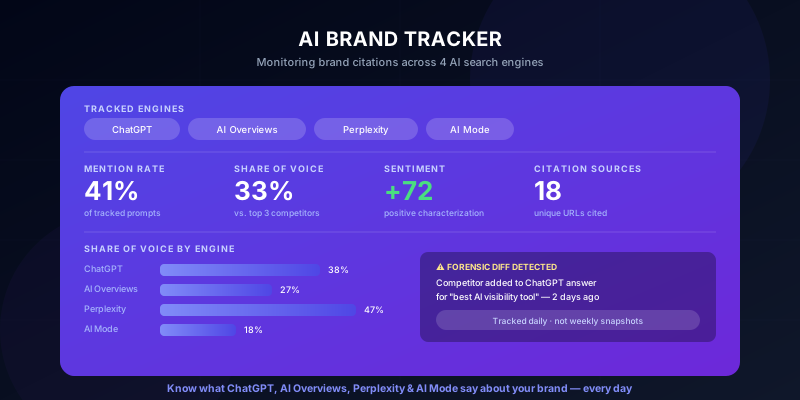
- Running a fixed set of prompts (the questions your buyers ask) through ChatGPT, Google AI Overviews, Perplexity, and Google AI Mode
- Recording whether the brand is mentioned in each response
- Capturing how the brand is described — not just whether it's named
- Noting which sources the AI cites when it mentions the brand
- Repeating this on a schedule so changes over time are visible
The distinguishing feature is that it's probing the model's output directly, not scanning the public web for mentions. What ChatGPT says in response to a prompt often doesn't exist as a published page anywhere — it's generated at the moment someone asks. An AI brand tracker is the only way to see that generated content.
Why This Is a Different Problem Than Rank Tracking
Rank tracking and AI brand tracking look similar on the surface — both involve running queries and recording results. The mechanics underneath are not the same.
Rank tracking measures position in a list. Google returns ten (or however many) ranked links for a keyword. Your rank tracker records where your page sits: 3, 12, 47. The list is deterministic in structure even if it fluctuates over time.
AI brand tracking measures presence inside a generated answer. There's no fixed list — the AI constructs a response, and it may name zero brands, one brand, or several, depending entirely on what the model decided was relevant. A brand doesn't have "a position" in an AI answer the way it has a rank on a SERP. It's either part of the response or it isn't, and if it is, the question becomes how it's characterized.
This distinction has a practical consequence: strong Google rankings do not predict AI mentions. A page ranking #1 for a competitive keyword can be completely absent from the AI Overview sitting above that same result. AI engines weight different signals — third-party corroboration, structured extractable claims, training data presence — that don't always correlate with organic ranking strength. Tracking one tells you nothing reliable about the other.
The Four Metrics an AI Brand Tracker Should Measure
1. Mention Rate
The percentage of tracked prompts where the brand appears in the AI-generated answer. Track 50 prompts, appear in 14 of them, and mention rate is 28%. This is the baseline number — most brands, on first audit, discover their mention rate is lower than they assumed, often under 20%.
2. Share of Voice
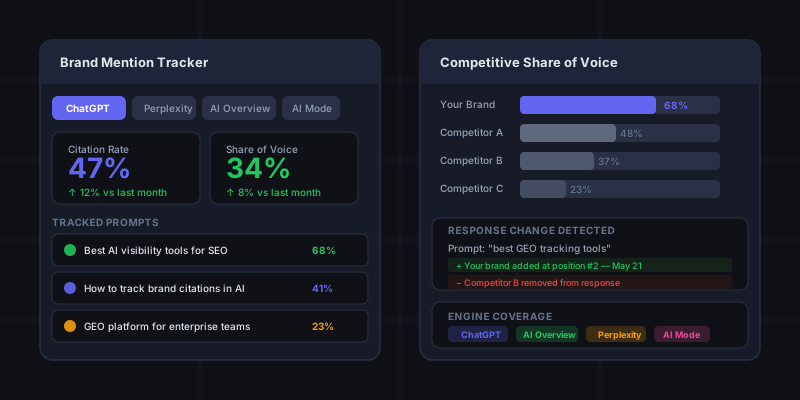
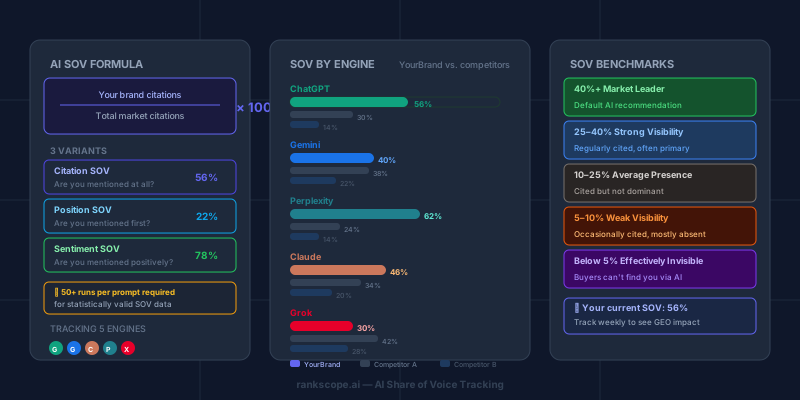
Mention rate tells you how often you show up. Share of voice tells you how you compare. If a category has six brands getting mentioned across a prompt set and yours accounts for 30% of the total mentions, that's your AI share of voice. It's the competitive number — a 15% mention rate in a two-brand category is a leadership position; the same 15% in a fifteen-brand category is a problem. For a full walkthrough of the calculation, see how to calculate share of voice in AI search.
3. Sentiment and Characterization
Being named isn't enough if the AI gets the framing wrong. Common failure patterns: outdated pricing, a mismatched positioning ("good for beginners" when the product is enterprise-grade), or being listed only as an "alternative to" a competitor when the brand should be leading the conversation. A tracker that only counts mentions misses this entirely — you need to read what the AI actually says, not just whether it says anything.
4. Citation Sources
Which URLs does the AI lean on to justify the mention? If ChatGPT keeps citing a specific G2 listing, a comparison article, and a Reddit thread whenever it names a brand, those three sources are the highest-leverage content to improve or correct. Citation sources turn an abstract "we're not visible enough" problem into a concrete list of pages worth fixing.
Why Engine-by-Engine Tracking Matters
Each AI engine builds its answers differently, which means a single aggregate "AI visibility" number obscures more than it reveals.
ChatGPT leans on Bing-indexed pages, third-party reviews (G2, Capterra, Reddit), and — depending on the tier — training data with a fixed knowledge cutoff. A brand that's strong on Reddit and G2 tends to do well here.
Perplexity does a near-real-time web crawl on almost every query and shows explicit source citations. Clean, extraction-friendly content structure matters more here than brand history.
Google AI Overviews draws from Google's live index — largely pages already ranking on page one for related terms. If you're not visible in organic Google results for a query, you're unlikely to be visible in the AI Overview for it either.
Google AI Mode behaves similarly to AI Overviews but handles longer, more complex queries with deeper synthesis across sources, which puts more weight on content depth than on any single ranking signal.
The practical implication: a brand can have a 45% mention rate in Perplexity and 8% in Google AI Overviews for the same category of query. Averaging those into one score tells you nothing useful about where the actual gap is. An AI brand tracker needs to report per-engine, not just in aggregate.
Setting Up AI Brand Tracking: The Manual Version
You don't need a tool to start. Here's the process at small scale:
Build a prompt list. Start with 20-30 questions across three buckets: discovery ("what's the best tool for X"), comparison ("[brand] vs [competitor]", "alternatives to [competitor]"), and use-case ("best tool for [specific job]"). Use the actual phrasing your buyers would use, not internal terminology.
Pick your engines. ChatGPT and Google AI Overviews first — they cover the largest share of AI search volume. Add Perplexity if your category is research-heavy.
Run and log. Open each engine, run each prompt, and record: mentioned (yes/no), how you're described, and what URLs got cited, if visible. A spreadsheet is fine at this scale.
Repeat weekly. A single check is a snapshot; a repeated check is a trend. AI answers shift as models update and sources get re-indexed, so one-time audits go stale fast. For a detailed guide on scan cadence, alert thresholds, and how to turn monitoring data into action, see AI search monitoring: how to track your brand across AI engines.
This works up to a point. At 30 prompts × 3 engines × weekly, you're already at roughly 400 data points a month, entered by hand. Push past 50 prompts and 4 engines and manual tracking stops being a reasonable use of anyone's time.
Setting Up AI Brand Tracking: The Automated Version
Past a certain scale, a dedicated tool earns its cost back in time saved alone, separate from the quality of the data.
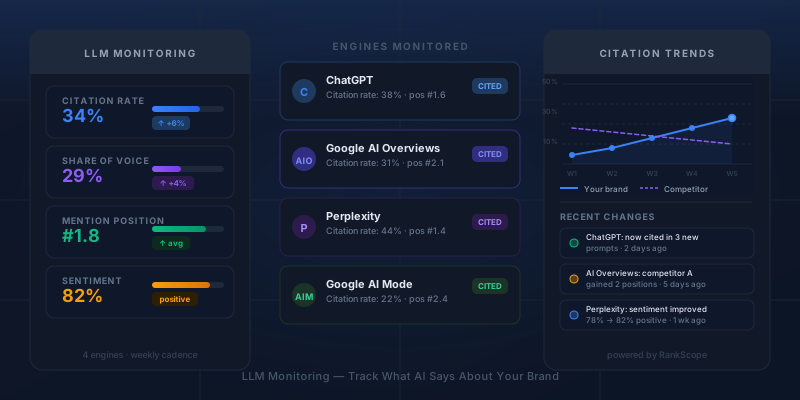
RankScope is built specifically for this — tracking brand citations across Perplexity, ChatGPT, Google AI Overviews and Google AI Mode using real browser sessions rather than API calls. That distinction matters most for Google's AI surfaces: API responses and what a real user's browser actually renders can diverge, since Google personalizes and continuously updates these answers. Tracking via real browser sessions means the data reflects what buyers actually see.
What an automated tracker adds beyond the manual version:
- Daily tracking instead of a weekly manual check, so changes surface faster
- Forensic diffs — word-level tracking of exactly what changed in an AI answer between checks, so you can see the moment a competitor got added or your characterization shifted
- Share of Voice calculated automatically against a configured competitor set, per engine
- A prompt library that scales past what's practical to run and log by hand
None of this replaces the strategy work — deciding which prompts matter, acting on what the data shows — but it removes the manual bottleneck that caps most in-house tracking efforts at a handful of prompts.
AI Brand Tracking vs. Social Listening
A common mistake is assuming an existing social listening tool already covers this. It doesn't, structurally.
Social listening tools scan published content — tweets, articles, forum posts — for mentions that already exist somewhere public. An AI brand tracker probes generated output — a model's answer to a specific prompt, which frequently doesn't exist as a document anywhere else. ChatGPT's response to "best tool for X" isn't sitting on a webpage a listening tool can crawl; it's constructed at the moment of the query.
That means the two are complementary, not overlapping. Social listening tells you what's been said about you publicly. AI brand tracking tells you what an AI will say about you right now, before a buyer even asks.
What to Do With Tracking Data Once You Have It
Tracking without action just produces a report nobody reads. Here's how the four metrics map to next steps:
- Low mention rate on a specific query type → build content that directly answers those queries, and get it into the sources the relevant engine trusts (G2/Capterra for ChatGPT, well-structured pages for Perplexity, organic-ranking pages for Google's AI surfaces).
- Decent mention rate, weak characterization → fix the third-party listings the AI is citing — an outdated G2 profile or a stale comparison page is often the root cause.
- Strong in one engine, invisible in another → that's a source-strategy gap specific to that engine, not a general "AI visibility" problem. Treat each engine as a separate campaign.
- A citation source appears repeatedly → that page is your highest-leverage target. Improving or correcting it has outsized effect on your citation rate.
Frequently Asked Questions
What is an AI brand tracker?
An AI brand tracker is a tool or process that monitors how AI search engines — ChatGPT, Google AI Overviews, Perplexity, and Google AI Mode — mention, describe, and cite a brand in response to buyer-relevant queries. It captures whether the brand appears, how it's characterized, and which sources the AI references.
How is an AI brand tracker different from a rank tracker?
A rank tracker measures a page's position in traditional Google search results. An AI brand tracker measures whether a brand is mentioned inside a generated AI answer, which has no fixed position structure. The two don't correlate reliably — strong Google rankings don't guarantee AI mentions.
What metrics matter most?
Mention rate, share of voice, sentiment/characterization, and citation sources. Mention rate and share of voice tell you how often and how competitively you show up; characterization tells you if the framing is accurate; citation sources tell you which specific pages to act on.
Which engines should I track?
ChatGPT and Google AI Overviews at minimum — they cover the largest share of AI search interactions. Add Perplexity for research-heavy categories and Google AI Mode for complex B2B buying queries.
Can I do this manually?
Yes, up to roughly 20-30 prompts across 2-3 engines checked weekly. Past that scale, manual tracking becomes impractical, and a dedicated tool becomes worth the cost in time saved alone.
How long until changes show up in tracking data?
It varies by engine. Perplexity's near-real-time crawl can reflect changes within 1-2 weeks. Google AI Overviews typically takes 2-4 weeks, tied to organic re-ranking. ChatGPT via Bing retrieval is usually 2-6 weeks. Training-data-driven mentions only shift with the next model update, which can be 6-18 months out — so near-term efforts should focus on the retrieval-based engines.
Getting Started
The fastest way to get a baseline is to run your top 15-20 category queries through ChatGPT, Perplexity, and Google right now and count how many times your brand comes up. That single hour of manual checking tells you more about your actual AI visibility than any traffic dashboard.
For ongoing tracking across all four major engines with automated Share of Voice and forensic diffs, that's what RankScope is built for.