AI Citations vs Backlinks: What They Are, How They Differ, and Why You Need Both
Your SEO team tracks domain authority and backlink growth. Your content team is hearing about AI citations. Your CMO wants to know if citations "replace" backlinks. The answer is no — but the reasoning matters, and most explanations of it are frustratingly vague.
Backlinks and AI citations are fundamentally different instruments measuring different outcomes. A backlink is a hyperlink from another website to yours — Google's crawler finds it, logs it in its link graph, and uses it to infer which pages are authoritative. An AI citation is a reference to your brand, content, or product inside an AI-generated response — it influences whether ChatGPT, Perplexity, Google AI Overviews, or Google AI Mode mentions you when your customers ask questions.
Both matter. They're earned differently, measured with different tools, and optimized through different tactics. This guide covers exactly how each one works, where they overlap, and what you need to do to track both.
What Is a Backlink?
A backlink is a hyperlink from domain A to domain B. When another website links to yours, Google's crawler finds that link, records it in the link graph, and uses it as a signal of authority. The more high-quality sites link to you, the more Google trusts your domain.
This is the core of PageRank — Google's original ranking algorithm, first described by Larry Page and Sergey Brin in 1998 and still one of the strongest ranking signals in 2026. The underlying logic: if many reputable sites link to a page, that page is probably reputable. A link from the New York Times carries more weight than a link from a newly-registered blog, because the Times itself has many links from reputable sources.
Several factors determine how much authority a given backlink passes:
- Referring domain authority — a link from a high-DR domain (Ahrefs' Domain Rating) passes more link equity than one from a low-DR domain
- Anchor text — the clickable text of the link signals context and relevance for the destination page
- Link placement — editorial links within body content carry more weight than footer or sidebar links
- Topical relevance — a link from a site in your industry is generally more valuable than one from an unrelated niche
You can audit your full backlink profile right now using Ahrefs, Semrush, or Moz — all three crawl the web continuously and maintain searchable link databases. Your Domain Rating (DR) or Domain Authority (DA) is a proxy score for your overall backlink profile quality, normalized on a 0–100 scale.
Backlinks are deterministic. Either a link exists at a given URL or it doesn't. If Ahrefs crawls TechCrunch and finds a link to your site, that link is recorded. It persists in the database until TechCrunch removes it or the page 404s. This makes backlink data reliable, auditable, and historically trackable.
What Is an AI Citation?
An AI citation is a reference — with or without a URL — to your brand, product, or content inside an AI-generated response. When ChatGPT, Perplexity, Google AI Overviews, or Google AI Mode generates an answer, it sometimes names specific companies, products, or sources. Those named references are citations, and being cited means your brand appeared in that AI response.
AI engines generate citations when they determine your content is the most relevant, specific, or authoritative source for a given claim or answer. The mechanisms differ by engine:
- Google AI Overviews cite from pages already ranking in Google's top-10 organic results, with visible source links
- Perplexity runs live web searches and cites sources inline with URLs — similar to a citation-heavy research assistant
- ChatGPT with web browsing fetches real-time sources and can cite specific pages inline
- ChatGPT without web browsing (knowledge cutoff mode) generates implicit brand mentions without URLs — your brand may appear but there's no clickable link
This is a critical difference from backlinks: AI citations are non-deterministic. Run the same query twice and you may get different citations, or no citations at all. The AI engines use stochastic sampling in their output generation — they don't return the same response for every identical query. A competitor cited this morning may not be cited this afternoon. This is why you cannot spot-check AI citations manually with any reliability.
The core metric for AI citations is citation rate: the percentage of relevant queries for which your brand is cited. If you have 50 target queries and your brand appears in AI responses to 18 of them, your citation rate is 36%. This is the AI visibility metric that matters — not whether you showed up once in a manual check, but what percentage of the time you appear across your full query set.
For a deeper look at how AI citation optimization works across all major engines, see our guide on Generative Engine Optimization (GEO).
Backlinks vs AI Citations: Key Differences
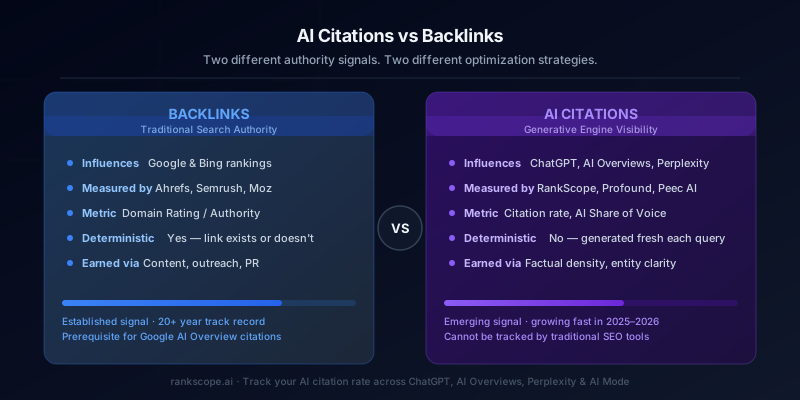
The cleanest way to see how these two signals differ is side by side:
| Backlinks | AI Citations | |
|---|---|---|
| What it is | Hyperlink from another site to yours | Reference to your brand/content in an AI response |
| How it's earned | Publishing linkable content, outreach, PR | Factual density, entity clarity, content structure, training exposure |
| How it's measured | Link graph databases (Ahrefs, Semrush, Moz) | Direct AI engine querying (RankScope, Profound, Peec AI) |
| Deterministic? | Yes — a link either exists or it doesn't | No — generated fresh each session |
| Influence on | Google/Bing traditional rankings | ChatGPT, AI Overviews, Perplexity, AI Mode answers |
| Can you buy it? | Technically yes (grey/black hat) | No — AI citations can't be purchased |
| Time to impact | Weeks to months after link is indexed | Weeks to months after content is indexed by AI bots |
| Primary metric | Domain Rating / Domain Authority | Citation rate, AI Share of Voice |
The "can you buy it?" row is worth dwelling on. Paid link schemes exist and some brands pursue them despite Google's guidelines. But AI citations don't have a paid mechanism at all — no AI engine accepts payment for inclusion in generated answers. You earn them through content quality, entity clarity, and structural signals, or you don't earn them.
Do AI Citations Replace Backlinks?
No. The most common version of this question assumes these are competing systems where one might make the other obsolete. They're not competing — they're layered.
Here's the structural reason they can't replace each other:
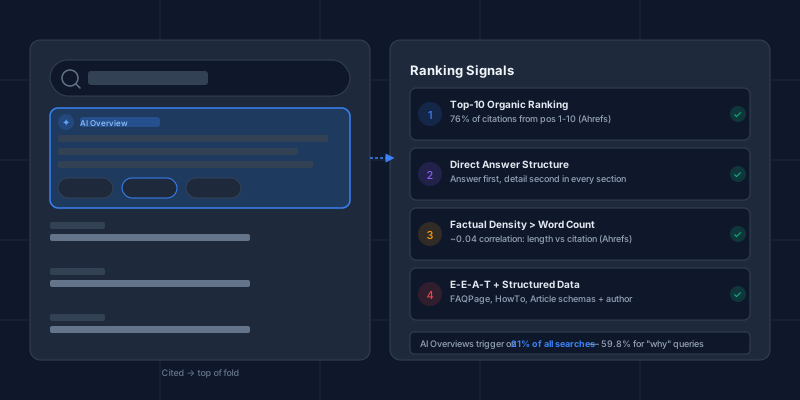
Google AI Overviews cite from top-10 organic results. Ahrefs' analysis of 1.9 million AI Overview citations found that 76% come from pages already ranking in Google's top 10 for the query. The median cited position is #2. If you're not in the top 10 organically, you're almost certainly not getting cited in AI Overviews — regardless of how well-structured your content is. That means strong backlinks (which support top-10 rankings) are a prerequisite for Google AI Overview citations, not an alternative to them.
ChatGPT and Perplexity have their own logic, but backlinks matter indirectly. ChatGPT's training data skews heavily toward web content that was widely linked to and frequently indexed — high-authority domains with strong backlink profiles show up in training corpora more often. This isn't a direct causal mechanism, but there's a meaningful correlation: brands with strong SEO track records tend to have higher AI citation rates, in part because they appeared more frequently in the training data those models were built on.
The relationship is reinforcing, not competing. Strong backlink profile → better organic rankings → more AI Overview citation opportunities. Publishing content that earns AI citations (high factual density, structured answers) → more organic traffic → more opportunities to earn backlinks.
The brands that will have the highest AI visibility in 2027 are the ones building both systems right now, not the ones treating them as alternatives.
How AI Citations Are Actually Earned
Unlike backlinks — where you can directly ask another site to link to you — AI citations can't be solicited. They're a byproduct of content that AI engines find trustworthy, citable, and well-structured. Here's what actually moves citation rate:
1. Factual Density
AI engines prefer citable facts over vague claims. A sentence that says "most brands see improved visibility with structured content" is not something an AI engine can cite with confidence. A sentence that says "76% of Google AI Overview citations come from top-10 ranking pages (Ahrefs, 1.9M citations analyzed)" is.
Audit your content for vague approximations — "many," "often," "some studies show" — and replace them with specific numbers, named sources, and exact dates wherever possible. Every vague claim is a missed citation opportunity.
2. Direct-Answer Structure
AI engines extract the opening 40–80 words of a section most reliably. If your answer is buried in paragraph three, after two sentences of context-setting, it won't be extracted cleanly. Lead every section with the direct answer. Then explain, qualify, and detail.
This is the single highest-leverage structural change you can make. It works for traditional SEO featured snippets too, which is why it's also foundational in our GEO checklist.
3. Entity Clarity
Be unambiguous about what your brand is, what it does, and what category it belongs to. Every page on your site should consistently describe RankScope (for example) as an "AI citation tracking tool" or "GEO monitoring platform" — not a different framing on each page. AI engines build entity models by cross-referencing how you're described across many pages. Inconsistent naming fragments your entity signal.
This applies to your homepage, about page, product descriptions, and every blog post where you mention your brand. Consistent, specific entity language across all pages strengthens how AI models understand and represent you.
4. FAQ and Schema Markup
FAQPage and HowTo structured data help AI engines identify extractable Q&A pairs. Google's AI extraction layer specifically looks for these schema types when surfacing answers for question-based queries. A FAQ section with JSON-LD markup signals "this content is formatted as questions and answers" — which is exactly the format AI Overview generation is trying to produce.
Add FAQPage schema to any page with a Q&A section. Add HowTo schema to step-based content. The implementation reference is in our GEO checklist.
5. AI Crawlability
Allow GPTBot, ClaudeBot, PerplexityBot, and Google-Extended in your robots.txt. Block them and you opt out of their training data and live retrieval pools. This is more common than you'd think — many sites inherited robots.txt rules written years ago that block "unknown bots," which now inadvertently blocks every major AI crawler.
Check your robots.txt file. If any of these bots are blocked (or if a broad wildcard block isn't explicitly excepted for them), fix it. It's a five-minute change with potentially significant citation rate impact.
6. Third-Party Corroboration
When other sites describe your brand accurately — directories, review platforms, press mentions, industry listicles — AI engines cross-reference these descriptions to validate citations. If your website calls you an "AI visibility platform" and five independent sources also describe you the same way, AI models treat that description as confirmed. If only your own site makes the claim, it's weighted less.
This is where directory listings, press mentions, and niche publication features have compounding value. They don't just drive referral traffic — they build the corroboration signal that makes AI engines confident enough to cite you.
How to Track AI Citations
You can't track AI citations with Ahrefs or Semrush. Those tools crawl the web to find hyperlinks. AI citations are generated inside AI engine responses — there's no web crawl that can capture them. This is the most important distinction between the two data layers: different phenomenon, fundamentally different measurement infrastructure.
Manual tracking works at small scale. Open an incognito browser window, run 10–20 brand and category queries in ChatGPT, Perplexity, and Google, and note which brands are cited. This is free and gives you a directional sense of where you stand. The limitation: it's non-deterministic. A single check is statistically meaningless — you need to run the same queries across multiple sessions, multiple days, to see signal above the noise. At 50+ queries, manual tracking becomes impractical.
Automated tracking is the practical solution for serious monitoring. RankScope runs real browser sessions against your target query set, measures citation rate over time, tracks competitor citations, and alerts on changes. Unlike API-based tools that query AI engines through developer access (which often returns different responses than consumer-facing interfaces), RankScope captures real browser-rendered responses — the same answers your customers actually see.
Key metrics to track systematically:
- Citation rate (%): what percentage of your target queries result in your brand being cited
- AI Share of Voice: your citation count versus competitors' across the same query set
- Prompt coverage: how many of your target queries trigger a citation of your brand at all (distinct from citation rate because some queries may never produce citations for anyone)
- Citation position: are you the primary source cited, or mentioned fourth in a list of five?
For a broader view of AI brand monitoring across all engines, see our AI brand monitoring guide.
The Bottom Line: Track Both
Backlinks and AI citations are different data layers, different optimization levers, and different toolsets. A brand that only tracks its backlink profile in 2026 is measuring half its search visibility. A brand that only chases AI citations while ignoring traditional rankings will find itself without the top-10 positions that are the prerequisite for Google AI Overview citations.
The brands winning in search right now are running both playbooks simultaneously: building backlink profiles through quality content and digital PR, while structuring that same content for AI extractability, maintaining consistent entity signals, and tracking citation rate across engines.
Neither replaces the other. Together, they're the full picture of search visibility in 2026. If you're ready to see where your AI citation rate stands today, the AI Visibility Checker shows you your current citation rate across ChatGPT, Perplexity, and Google AI Overviews in minutes.
Frequently Asked Questions
Do backlinks help with AI citations?
Indirectly, yes. Strong backlinks improve organic rankings, and Google AI Overviews primarily cite top-10 organic pages — 76% of citations come from the top 10 according to Ahrefs data from 1.9 million citations. But backlinks don't directly cause AI citations. Content structure, factual density, and entity clarity are the direct levers. The backlink's job is to get you to page one; once you're there, content quality determines whether you get cited.
Can AI citations improve my SEO?
AI citations don't directly influence Google's PageRank algorithm. But being cited in AI Overviews can drive clicks to your site, increase branded search queries (which is a behavioral signal Google tracks), and build brand authority that leads to more earned backlinks over time. The relationship works: better AI visibility → more brand awareness → more people searching your brand name → more people linking to you. It's not a direct SEO input, but it feeds the ecosystem.
What is AI Share of Voice?
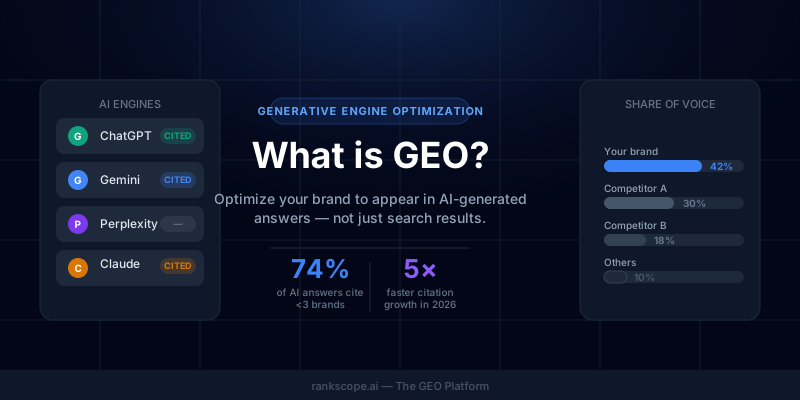
AI Share of Voice measures what percentage of AI-generated responses in your category mention your brand versus competitors. It's the AI equivalent of Share of Voice in traditional media measurement. If 3 out of 10 relevant AI answers cite you and 5 cite a competitor, your AI SOV is 30% and theirs is 50%. It's the clearest competitive benchmark for AI visibility — more meaningful than a binary "did we get cited or not."
How long does it take to build AI citations?
Content changes that improve structure and factual density typically show citation rate improvements within 4–12 weeks, depending on how frequently AI engines re-crawl and update their knowledge bases. Technical fixes — unblocking AI crawlers in robots.txt, adding FAQPage schema — can show results faster because they affect how AI bots access and classify content on the next crawl. There's no shortcut equivalent to buying a link; citation rate builds through accumulated content quality and entity clarity signals.
What tools track AI citations?
Tools purpose-built for AI citation tracking include RankScope (covers ChatGPT, Google AI Overviews, Perplexity, and AI Mode using real browser-rendered responses), Profound (enterprise-tier, strong on brand monitoring at scale), and Peec AI (lighter-weight entry point for smaller teams). Traditional SEO tools — Ahrefs, Semrush, Moz — track backlinks and organic rankings but do not query AI engines and cannot measure citation rate. They're measuring fundamentally different things and you need both categories.