How Often Do AI Citations Change? We Re-Asked 50 Questions on 4 Engines
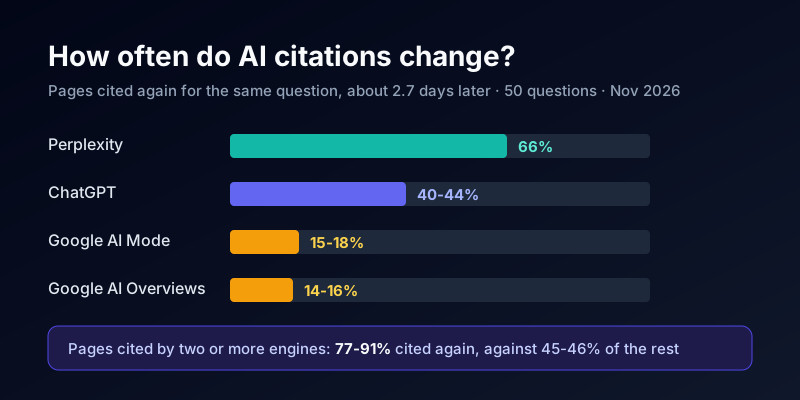
AI citations change fast, and how fast depends on the engine. We asked 50 buyer questions on ChatGPT, Google AI Overviews, Google AI Mode and Perplexity, then asked them again 3 hours later and about 2.7 days later. By the third run, only 14-18% of the pages Google's two AI surfaces cited for a question were cited again for the same question. ChatGPT repeated 40-44% of its pages and Perplexity 66%.
One group of pages held up: the ones cited by two or more engines at once. 77-91% of those were cited again days later.
This page sets out what we ran, what moved, what didn't, and what it means if you are trying to get cited. Every number comes from our own runs, and the limits of a 50-question test are listed below with the results.
The Short Version
| Engine | Pages cited again, same question, 3 hours later | Pages cited again, about 2.7 days later | Domains cited again, about 2.7 days later |
|---|---|---|---|
| Perplexity | 94% | 66% | 71% |
| ChatGPT | 47% | 40-44% | 51-54% |
| Google AI Mode | 40% | 15-18% | 23-25% |
| Google AI Overviews | 32% | 14-16% | 21-23% |
Read a row this way: of the pages Google AI Overviews cited for a question in the first run, 14-16% were cited by AI Overviews for that same question about 2.7 days later. The two figures in the later columns come from comparing the third run with each of the first two.
Three things stand out:
- Google's AI surfaces barely repeat themselves. Even at the domain level, fewer than a quarter of the sites Google's AI cited for a question came back for it days later.
- The engines differ by a factor of four. Perplexity kept two thirds of its sources over the same gap in which Google kept about one in six.
- The change isn't only about time. At 3 hours, too soon for most of the web to have changed, AI Overviews had already swapped out two thirds of its pages.
What We Ran
- Questions: 50 buyer questions, five for each of 10 brands in 10 categories: sustainable sneakers, everyday socks, outbound sales CRMs, small-business CRMs, team workspace apps, meditation apps, startup business banking, emergency plumbing, content marketing agencies and AI visibility software. Each set had two category questions ("What is the best online business banking solution for startups?"), two built from a use case on the brand's site, and one asking for alternatives to a well-known competitor. No question named the brand it was written for.
- Engines: ChatGPT with web search on, Google AI Overviews and Google AI Mode (desktop, US) and Perplexity. That is 200 answers per run.
- Runs: run 1 on 2 November 2026 at 21:25 Pacific; run 2 three hours later; run 3 on 5 November at 15:45 Pacific, 63 hours after run 2 and 66 hours after run 1.
- What we compared: for each question and engine, the set of page URLs the answer cited in one run against the set it cited in another. URLs were compared without query strings, fragments or a trailing slash, so
example.com/page?utm=x#sectionandexample.com/page/count as the same page. - What we left out: answers that failed to load, and Google questions where no AI Overview appeared in one of the two runs being compared. For the per-engine figures, a question only counts when both runs returned an answer with at least one citation. For the pooled figures in Result 3, an engine that answered without citations in the later run counts as not citing the page.
The questions, engines and settings were identical in every run. The only thing that changed was when we asked.
Result 1: Google's AI Surfaces Repeat Fewer Than One Page in Five
Days apart, Google AI Overviews cited the same page again for the same question 14-16% of the time, and Google AI Mode 15-18%. In raw counts, AI Overviews repeated 32 of 227 pages between runs 2 and 3, and AI Mode 14 of 78. AI Mode cites fewer pages per answer (a median of 4, against about 10 for the other three engines), which is why its counts are smaller.
The typical case was starker than the average. For AI Mode, about two thirds of the questions (25 of 35, and 23 of 37) shared no cited page at all between the two runs.
It is not one category pulling the average down. Split by brand, the best AI Overviews category kept 35-40% of its pages, and in each comparison one or two kept none. AI Mode looked the same.
Domains did only a little better. 21-25% of the sites Google's AI cited for a question came back for it. When Google's AI changes its sources, it mostly moves to a different site, not to a different page on the same one.
Result 2: ChatGPT Sits in the Middle, Perplexity Holds Steady
ChatGPT repeated 40-44% of its cited pages days apart (199 of 453 between runs 2 and 3) and 51-54% of its domains. That is far steadier than Google's AI, but still means more than half of what ChatGPT cited for a question was different the next time.
Perplexity was the most consistent engine by a wide margin. Three hours apart it repeated 94% of its pages, nearly the same list. Days apart it repeated 66%. If you track only one engine and want a stable signal, Perplexity gives the steadiest one, and Google's AI the least.
Result 3: Pages Two Engines Cite Are the Ones That Last
This is the result most worth acting on.
For each question we pooled the four engines and counted how many of them cited each page. Then we checked whether the page was cited again, by any engine, for the same question in the later run.
| Page cited in run 1 or 2 by | Cited again, same question, about 2.7 days later |
|---|---|
| One engine | 45-46% (506 of 1,091 and 517 of 1,154) |
| Two or more engines | 77-91% (40 of 52 and 51 of 56) |
A page that two engines chose independently came back most of the time. A page only one engine chose was a coin toss.
The catch is how few there are. Only about 1 in 20 cited pages was cited by more than one engine for the same question. Most of what any single check shows you is the volatile part.
For someone trying to get cited, that changes where to look. A page that both ChatGPT and Perplexity cite for your buyer question is a durable fixture of the answer. Getting listed on it, or building a better version of it, is likely to pay for longer than chasing a page that appeared once in one engine. This is also why our free AI citation tracker sorts cited pages by how many engines cite them, before how many questions.
Brands Hold Better Than Sources on Google
We also checked the brands each answer named, alongside the pages it cited. On Google's two surfaces the brand names held up better than the pages behind them. Days apart, 36-43% of the brands an AI Overview or AI Mode answer named were named again in the same question's answer, against 14-18% of its cited pages. ChatGPT showed the same gap, smaller (55-57% against 40-44%). On Perplexity the two moved together, at about two thirds each.
Treat this comparison as approximate. Brand names were extracted from the answer text by a language model and matched as plain text, so "HubSpot CRM" and "HubSpot" in two runs count as different brands. That makes brand repeat look lower than it is, so the real gap on Google may be larger. The direction matches what we saw in an earlier 15-run ChatGPT test, written up in our AI rank tracker guide: the brands named stayed put while the cited sources churned.
The practical reading: whether an engine names you is a steadier measurement than which page it cited when it did.
How This Compares With the Largest Published Study
The largest published measurement we know of is GetMentions' AI citation volatility study: 2,398 queries run through four engines once a day for seven days in June 2026, 530,875 citations in all. It reported a median day-over-day citation churn of 82% on ChatGPT, 92% on Gemini, 78% on Google AI Mode and 43% on Perplexity.
The two studies measure differently, so the numbers don't line up one for one. GetMentions reports the median churn per query from one day to the next. We report the pooled share of pages that came back after 3 hours and after about 2.7 days. Read with that in mind:
- Google AI Mode agrees. About 4 in 5 of its pages changed in both studies.
- Perplexity agrees on the ranking. It was the steadiest engine in both.
- ChatGPT differs. GetMentions measured 82% daily churn; our ChatGPT kept 40-44% of its pages over almost three days. We don't know why. The difference in metric explains some of it, and the studies may also collect ChatGPT differently: our answers come from ChatGPT's web interface with search on. We haven't tested either explanation, so we are not claiming ours is the better number.
Both studies point the same way. A single reading of the sources an AI engine cites is a sample of a moving list.
What This Means if You Want to Be Cited
- Don't treat one check as the list. If a free tool, or your own manual check, shows the 20 pages ChatGPT or Google's AI cited for your question, most of those on Google's side won't be there in a few days. Before you spend a week on outreach to a page, check that it is still being cited.
- Prioritise pages several engines cite. They are the minority, and they are the ones that last. Getting onto a list that ChatGPT and Perplexity both cite for your category question is the most durable citation win available.
- Re-check after a gap, not in a loop. Our 3-hour re-run already changed most of Google's sources, so a quick re-run mostly shows you the engine's randomness. Re-running the same questions days or a week later is a better test of what persists. That is why our free checkers offer a re-check of the same questions after 7 and 14 days.
- Track domains as well as pages. Domains repeated more often than pages on every engine. If a site keeps appearing with different pages, the site has the engine's trust in your category, and any good page on it is a target.
- Measure mentions over citations when you report to a boss. Whether an engine names your brand is steadier than which URL it cited. For a trend line, mention rate across a fixed set of questions is the more reliable number. We cover the measurement side in AI citation tracking.
Limits of This Test
- 50 questions, 10 categories, one market. All runs were US English. Other markets and other kinds of question may behave differently.
- Three runs. We have one 3-hour gap and one gap of about 2.7 days. We can't say whether repeat rates keep falling over a week or level off.
- Small Google samples. AI Overviews didn't appear, or the answer didn't load, for a share of questions, so the AI Overviews comparisons rest on 19 to 36 question pairs. No brand's AI Overviews repeat rate was above 40%, but the exact percentages could move by several points with more questions.
- The two-engine group is small. 52 and 56 pages. The finding that they last is clear; the exact 77-91% is not precise.
- How we collected answers. ChatGPT answers come from its web interface with web search on. Google AI Overviews and AI Mode are Google's desktop answers for the US. Perplexity answers come from its Sonar API, which isn't set to a country.
If you run a similar test and get different numbers, we would like to hear about it.
Run It on Your Own Questions
The cheapest way to see this for your category is to check the same questions twice, a few days apart. Our free AI citation tracker lists every page ChatGPT, Google AI Overviews, Google AI Mode and Perplexity cite for up to three of your buyer questions, counts the ones cited by two or more engines, and can email you a re-check of the same questions after 7 and 14 days. It needs no account. To see whether those answers name your brand, use the free AI visibility checker.
For daily tracking of a fixed set of questions, which is what you need to separate a trend from this churn, RankScope plans start at $49/month, or $39/month billed annually.
Frequently Asked Questions
How often do AI citations change?
Often, and it depends on the engine. In our test of 50 questions, about 2.7 days later only 14-16% of the pages Google AI Overviews cited for a question were cited again, 15-18% for Google AI Mode, 40-44% for ChatGPT and 66% for Perplexity. Even 3 hours later, Google AI Overviews repeated only 32% of its pages.
Which AI engine has the most stable citations?
Perplexity. It repeated 94% of its cited pages for the same question 3 hours later and 66% about 2.7 days later. Google AI Overviews and Google AI Mode were the least stable, and ChatGPT sat in between.
Which cited pages are most likely to stay cited?
Pages cited by two or more engines for the same question. In our test, 77-91% of them were cited again about 2.7 days later, against 45-46% of pages only one engine cited. They are rare: about 1 in 20 cited pages.
Should I optimise for a page that AI cited once?
Check it again first. Most pages Google's AI cited in one run were not cited for the same question days later. A page that keeps appearing across re-checks, or that several engines cite, is a much safer target.
Are brand mentions more stable than citations?
In our data, yes, on Google's AI surfaces and ChatGPT. Days apart, 36-43% of the brands Google's AI named for a question were named again, against 14-18% of its cited pages. Brand matching was approximate, so treat the exact gap as a rough figure.


