Perplexity Competitors: 8 Best Alternatives Compared (2026)
Perplexity AI has had a good run. Founded in 2022, it hit a $20 billion valuation in 2025, crossed 100 million daily queries, and carved out a real user base of people who want answers with citations rather than links to click through. It's a genuinely useful product.
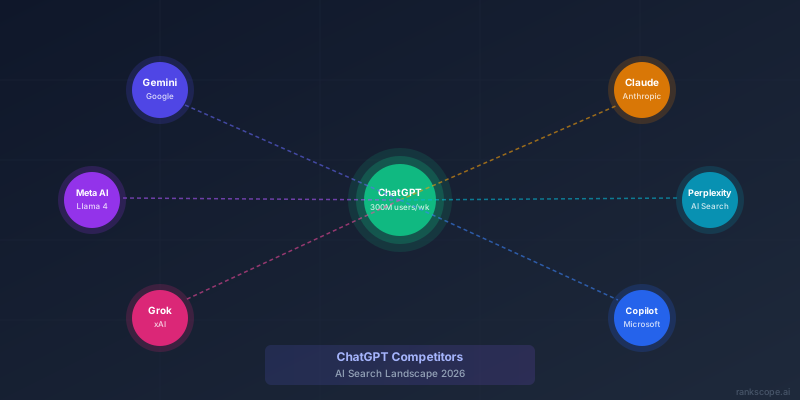
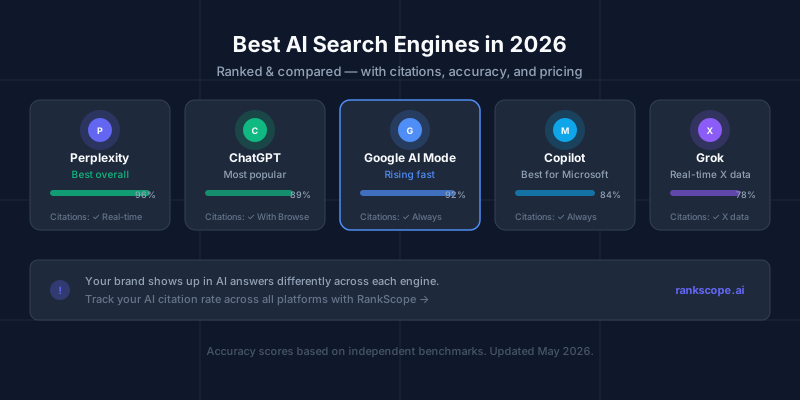
But the market it created — AI-powered search with cited answers — has attracted serious competition. ChatGPT added Browse. Google built AI Overviews and then AI Mode. Microsoft integrated GPT-4o into Bing. Claude, Grok, and a handful of specialist research tools have all added real-time web retrieval.
In 2026, Perplexity is no longer the only option. Here's a clear-eyed look at who's competing, where each rival is stronger, and where Perplexity still holds an edge.
What Makes Perplexity Distinct
Before comparing, it's worth being precise about what Perplexity actually is — because the competitive picture depends on which part of its value proposition you're evaluating.
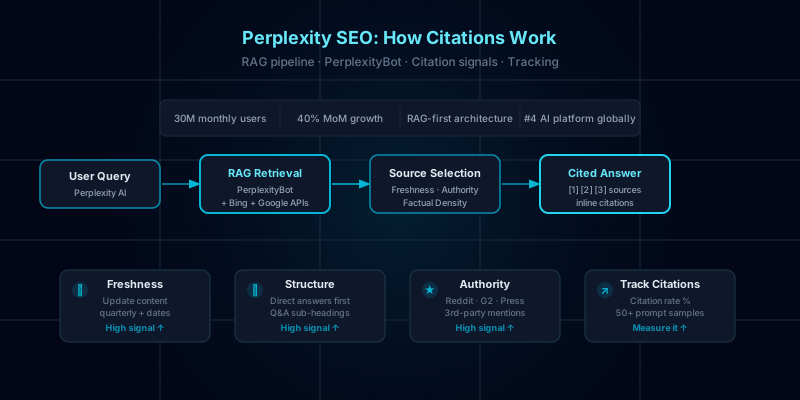
Perplexity is a dedicated AI answer engine with three core properties:
- Always-on real-time retrieval. Every query pulls live web data. There's no "knowledge cutoff" mode — retrieval isn't optional or behind a toggle.
- Inline citations on every claim. Each sentence that references an external source is numbered and sourced. You can verify any claim without leaving the interface.
- Multi-model flexibility. Perplexity runs multiple foundation models (its own Sonar model, GPT-4o, Claude 3.7, Grok 3) under the same interface. You pick the model; Perplexity handles retrieval.
The core pitch is: search-quality accuracy + AI-quality synthesis + verifiability. That's a more specific proposition than "AI chatbot," and it's what defines which competitors are actually threatening it.
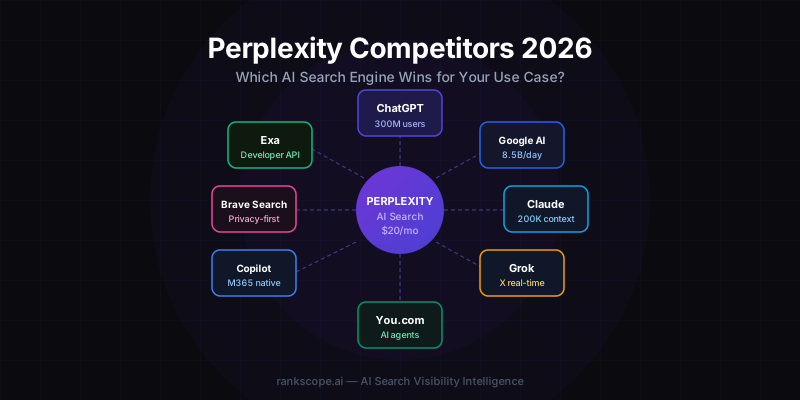
Quick Comparison: Perplexity vs. Its Main Competitors
| Platform | Best For | Real-Time Web | Inline Citations | Free Tier | Paid Plan |
|---|---|---|---|---|---|
| Perplexity AI | Cited AI search, research | ✅ Always on | ✅ Always | ✅ Yes | $20/mo Pro |
| ChatGPT (Browse) | Reasoning + general AI | ✅ Browse / Search mode | ⚠️ Partial | ✅ Yes | $20/mo Plus |
| Google AI Mode | AI-native Google search | ✅ Google index | ✅ Yes | ✅ Yes | Free / AI Pro |
| Claude | Document analysis, long-form reasoning | ✅ With web search | ⚠️ When sourced | ✅ Yes | $20/mo Pro |
| Microsoft Copilot | Microsoft 365 workflows | ✅ Always (Bing) | ✅ Yes | ✅ Yes | $20/mo Pro |
| Grok (xAI) | Social data, breaking news | ✅ Real-time X + web | ⚠️ Partial | Limited | $8/mo X Premium |
| You.com | Research agents, cited answers | ✅ Yes | ✅ Yes | ✅ Yes | $15/mo Pro |
| Exa | Developer/API semantic search | ✅ Neural web index | ✅ Via API | ❌ API only | Usage-based |
| Brave Search | Privacy-first AI answers | ✅ Independent index | ✅ Yes | ✅ Yes | $3/mo Premium |
1. ChatGPT (with Browse / Search Mode)
The closest mass-market rival
ChatGPT's core strength has always been reasoning quality — it handles ambiguous, multi-step problems better than any pure search tool. For a long time, though, it had a real weakness for current events: the knowledge cutoff meant anything after the training date was a blind spot.
OpenAI closed that gap with Browse mode and, more recently, with a dedicated ChatGPT Search experience that works more like Perplexity — real-time retrieval, cited sources, a cleaner search interface. The product isn't identical to Perplexity (citations are less systematic, and Browse needs to be active rather than being always-on), but for most research tasks, the gap has narrowed considerably.
Where ChatGPT beats Perplexity:
- Raw reasoning depth — multi-step analysis, coding, document synthesis
- Plugin and workflow ecosystem (Custom GPTs, integrations)
- Memory across sessions
- 300M+ weekly users means more resources, faster iteration
Where Perplexity still leads:
- Citation density — every claim is sourced inline, not just occasional references
- Interface optimized for search (not conversation)
- Multi-model choice under one roof (GPT-4o, Claude, Grok, Sonar)
Best for: Users who need both search and reasoning in one tool and don't mind toggling Browse on.
2. Google AI Mode + AI Overviews
The biggest structural threat
Google is Perplexity's most dangerous competitor by a wide margin — not because Google AI Mode is a better product today, but because of distribution. Google processes roughly 8.5 billion searches per day. AI Overviews now appear on a significant share of informational queries in the US. Google AI Mode, a full conversational search experience powered by Gemini, began rolling out in 2026.
When Google makes AI-powered synthesis the default experience inside Google.com, Perplexity's core value proposition — cited AI answers — faces a distribution problem that no product improvement can fully solve.
Where Google AI Mode beats Perplexity:
- Google's index is the deepest and most authoritative in the world
- Zero switching cost — it's where 8.5 billion daily searches already happen
- Ecosystem integration (Google Shopping, Maps, Knowledge Graph, Gmail)
- AI Overviews handle informational queries at scale with high accuracy
Where Perplexity still leads:
- More flexible multi-model interface
- Follow-up dialogue and research threads are more natural
- No SEO filter — Perplexity surfaces pages beyond Google's top 10
- Pro features for power researchers are more developed
Best for: For most everyday users, Google AI Mode is becoming "good enough" — the people sticking with Perplexity are power researchers and those who want model choice.
A note for brands: Google AI Overviews and Perplexity use different source-selection logic. A brand cited in Perplexity answers may not appear in AI Overviews, and vice versa. The two engines need to be tracked independently. You can learn more about this in our guide to Perplexity SEO and our post on how to rank in AI Overviews.
3. Anthropic Claude
Best for document-heavy research
Claude is a different product from Perplexity, but the lines blur for users doing research-heavy work. Claude 3.7 Sonnet and Claude Opus 4 are the strongest models available for processing large documents, running nuanced analysis, and writing outputs that don't sound like AI. Claude added web search in 2025, so it's no longer blind to current events — it can retrieve and cite web sources when needed.
The honest comparison: Perplexity is search-first; Claude is reasoning-first. If you're doing literature reviews, analyzing contracts, or processing PDFs, Claude has a clear edge. If you're doing live research that requires constantly pulling current web sources, Perplexity is more purpose-built.
Where Claude beats Perplexity:
- 200K token context window — process entire books, codebases, legal documents
- Nuanced reasoning on complex, multi-variable problems
- Less likely to hallucinate with false confidence
- Document upload and analysis (PDFs, spreadsheets, code)
Where Perplexity still leads:
- Always-on retrieval — Claude's web search is capable but not Perplexity's focus
- Citation format — Perplexity's inline citations on every claim are cleaner for fact-checking
- Research-optimized interface
Best for: Analysts, researchers, and enterprise teams that need to reason over large documents rather than just retrieve current web content.
4. Microsoft Copilot
Best for Microsoft 365 users
Copilot runs GPT-4o under the hood and routes search through Bing's index — which means it has always-on real-time web access and does cite its sources. For pure search quality, Copilot and Perplexity are roughly comparable. Where Copilot pulls ahead is integration: if you live in Microsoft 365, Copilot connects directly to your emails, calendar, Word documents, and Teams conversations.
That integration isn't relevant to most Perplexity users, but for enterprise environments where Microsoft controls the stack, Copilot has a distribution advantage Perplexity can't easily match.
Where Copilot beats Perplexity:
- Deep Microsoft 365 integration (Word, Excel, Teams, Outlook)
- Enterprise security and compliance posture
- Windows-native access (Copilot key on keyboards)
- Bing's index + GPT-4o citations are reliable
Where Perplexity still leads:
- Better multi-model choice (Claude, Grok, Sonar, GPT-4o all in one UI)
- Research interface is more purpose-built for long search sessions
- More flexible follow-up dialogue
Best for: Teams already in the Microsoft ecosystem who want AI-powered search without switching tools.
5. xAI Grok
Best for real-time social and news data
Grok has one thing nobody else has: direct real-time access to the full X (formerly Twitter) firehose. For queries about breaking news, trending topics, social sentiment, and market-moving events, Grok surfaces data that Perplexity simply can't — because the primary source is the X platform itself.
Beyond that edge, Grok 3 is a strong general-purpose model with web retrieval. It's available to X Premium subscribers and via grok.com. The citation format is less systematic than Perplexity's, and the interface is less research-focused.
Where Grok beats Perplexity:
- Real-time X/Twitter data — unmatched for social trends and breaking news
- Strong reasoning on Grok 3 model
- Useful for market research, PR monitoring, and social listening
Where Perplexity still leads:
- More systematic inline citations across all web sources
- Better multi-model flexibility
- Research interface — Perplexity's UX is more purpose-built for focused research sessions
Best for: Journalists, traders, social media managers, and anyone who needs AI-powered synthesis of real-time social data.
6. You.com
Best dedicated Perplexity alternative for researchers
You.com is the closest product to Perplexity in philosophy: a dedicated AI search engine with cited answers, no ChatGPT or Google branding, and real-time web retrieval at its core. You.com has added AI agents (YouAgent) that can run multi-step research tasks — searching, reading multiple pages, and synthesizing a structured report — which goes beyond what Perplexity's standard search mode does.
If you're looking for a pure Perplexity alternative that isn't a general AI platform, You.com is the most direct swap. It lacks Perplexity's multi-model flexibility and the brand recognition, but the core product is strong.
Where You.com beats Perplexity:
- Agentic research mode (multi-step, automated research reports)
- Privacy options — can search without personalization
- Lower price ($15/mo vs $20/mo for Pro tiers)
Where Perplexity still leads:
- Brand recognition and user base (30M MAU vs You.com's undisclosed base)
- Model selection (GPT-4o, Claude, Grok inside one interface)
- Citation quality and inline formatting
Best for: Users who want a Perplexity-like experience but prefer a Google-independent alternative.
7. Exa
Best for developers and programmatic search
Exa (formerly Metaphor) is a neural search API rather than a consumer product — it's designed for developers who want to query the live web semantically and get structured, citation-ready results programmatically. Perplexity has an API too, but Exa's retrieval quality and developer tooling are purpose-built for integration use cases.
If you're building an AI application that needs real-time web data, Exa is a serious competitor to Perplexity's API. As a consumer product, they don't compete directly.
Where Exa beats Perplexity:
- Developer-first API design with cleaner data structures
- Neural (semantic) search — finds relevant pages that keyword search misses
- Faster and cheaper per-query for API use cases
Where Perplexity still leads:
- Consumer product with UI — Exa has no end-user interface
- Multi-model choice and Pro Search features
- General-purpose research for non-developers
Best for: Engineering teams building AI search features into their own products.
8. Brave Search
Best for privacy-conscious users
Brave Search is one of the few search engines with an independent index — it doesn't rely on Google or Bing. That means Brave's AI summaries (called "AI Answer" and "Leo AI") pull from sources that large-platform search engines might not surface. For privacy-focused users who don't want Google tracking their queries, it's a legitimate alternative.
The AI capabilities aren't as strong as Perplexity's Pro mode, but the free tier is capable, and the privacy proposition is real.
Where Brave Search beats Perplexity:
- True independence from Google/Bing indexing
- Privacy by default — no query logging, no personalization
- Free tier is more capable than Perplexity's free tier for basic queries
- Surfaces independent voices that Google's index might bury
Where Perplexity still leads:
- Better reasoning depth (access to GPT-4o, Claude)
- More systematic citations
- Pro Search mode for complex multi-step research
Best for: Privacy-conscious users and researchers who want access to sources outside the Google/Bing mainstream.
Where Perplexity Still Wins
Despite stronger competition across the board, Perplexity has real, defensible advantages in 2026:
1. The cleanest citation interface. Inline numbered citations on every factual claim is Perplexity's signature feature — and nobody does it as consistently. ChatGPT Search sometimes cites, sometimes doesn't. Google AI Mode buries sources in a collapsed panel. Perplexity keeps them front and center.
2. Multi-model flexibility. Running GPT-4o, Claude 3.7, Grok 3, and its own Sonar model under one interface means users aren't locked into one company's model quality. When one model is better for a specific task, they can switch without leaving.
3. Speed. Perplexity's interface is fast. Pro Search (multi-step deep research) runs quickly. No bloat.
4. Search-native UX. Perplexity was built as a search engine, not a chatbot that added search. That design origin still shows in how the interface handles research sessions, follow-up threads, and output formatting.
Perplexity's Vulnerabilities
Distribution. Google processes 8.5 billion searches daily. Perplexity does about 100 million daily queries. Even if Perplexity captures a meaningful share of AI search users, Google's default position in browsers, mobile phones, and apps is an almost insurmountable distribution barrier.
Model dependency. Perplexity's multi-model strategy is a strength but also a risk — if OpenAI, Anthropic, or xAI decide to restrict Perplexity's access to their models, the product's value proposition weakens overnight.
Monetization pressure. At $20B valuation, Perplexity is under real pressure to grow revenue. Ads on AI answers (which Perplexity has started testing) create tension with the "objective citations" brand promise.
What This Means for Brand Visibility
This competitive landscape has a direct implication for any brand trying to appear in AI search results. Each platform has its own retrieval system, its own source selection logic, and its own citation patterns. A brand that ranks prominently in Perplexity answers is not guaranteed to appear in ChatGPT responses, Google AI Overviews, or Grok's outputs — and vice versa.
The platforms covered in this guide are all tracked by RankScope — a GEO (generative engine optimization) platform that monitors brand citations across ChatGPT, Google AI Overviews, Perplexity, and Google AI Mode. If you want to know where your brand actually appears when people search your category across these engines, that's what RankScope is built for.
Understanding each engine's citation logic is also important for content strategy. Our best AI search engines guide covers how to think about optimizing for each platform, and our Perplexity SEO guide goes deep on Perplexity-specific citation signals.
The Bottom Line
Perplexity built the market for cited AI search. Its competitors have mostly validated that market by copying the core idea — and in some cases (Google AI Mode, ChatGPT Search) built it into products with far greater distribution.
The honest ranking for most users in 2026:
- For research with citations: Perplexity is still the most purpose-built option
- For general AI use + search: ChatGPT or Claude depending on your reasoning needs
- For default daily search: Google AI Mode is increasingly capable and has zero switching cost
- For Microsoft environments: Copilot is the natural choice
- For breaking news + social: Grok is unmatched
- For privacy: Brave Search is the most principled option
- For developers: Exa is the API search layer to build on
- For a direct Perplexity swap: You.com is the closest alternative
Perplexity isn't going away — it's a real product with a real user base. But the comfortable gap it had in 2023 and 2024 has closed significantly. The next 12 months will determine whether its multi-model strategy and research-focused UX are enough to hold ground against platforms with billions of existing users.
Want to know whether your brand appears in Perplexity, ChatGPT, and Google AI Overviews? RankScope tracks your AI citation rate across all four major engines — so you can see exactly where you're visible and where you're not.