Crayon has a legitimate reputation in competitive intelligence. It crawls competitor websites continuously — pricing pages, product pages, blog posts, ads, careers pages — and surfaces changes as a feed your team can act on. Product marketers and CI teams use it to keep battlecards fresh, track competitor messaging shifts, and feed competitive context into sales workflows. For web-based competitive monitoring, it does the job.
But in 2026, there's a dimension of competitive intelligence that Crayon doesn't touch at all — and it's the one that directly influences how buyers discover and shortlist vendors before your sales team ever enters the picture.
When a B2B buyer asks ChatGPT "what are the best competitive intelligence tools in 2026?", Crayon cannot see that response. It cannot tell you which competitors were named, in what order, or how your brand was framed — or whether you appeared at all. When Google AI Overviews surfaces a summary at the top of a high-intent search for your category, Crayon has no data on who led that response. When Perplexity cites four vendors in a vendor comparison query that represents exactly your ICP, Crayon cannot tell you which four.
That's the gap this post is about.
What Crayon Actually Does Well
Before diving into alternatives, it's worth being specific about Crayon's actual strengths — because the tool has real capabilities that aren't the problem here.
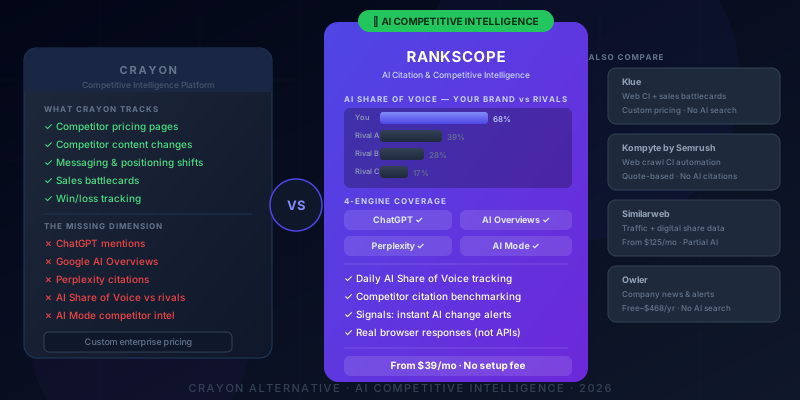
Crayon is a competitive intelligence platform built around monitoring the publicly accessible web footprint of your competitors. The core use cases:
- Pricing page tracking — Crayon alerts you when competitors change their pricing structure, introduce new tiers, or alter pricing page messaging. For pricing-sensitive categories, this is genuinely useful.
- Content and messaging changes — When a competitor rewrites their homepage headline, ships a new product page, or pivots their positioning, Crayon catches it. This feeds directly into battlecard maintenance.
- Ad intelligence — Crayon aggregates competitor ad creative and copy, giving you visibility into what they're testing in paid channels.
- Sales battlecards — The output of Crayon's monitoring feeds into battlecard creation tools, with integrations into Salesforce, HubSpot, Slack, and Gong for sales team consumption.
- Win/loss analysis — Crayon includes tools for capturing and analyzing win/loss data from deals to build a feedback loop between field intelligence and competitive positioning.
This is a solid feature set for teams whose competitive intelligence program centers on knowing what competitors are doing on the web and getting that intelligence into sales hands quickly.
The limitation isn't a weakness in Crayon's core product. It's a structural constraint: Crayon's architecture is built to crawl and monitor published, indexed web content. AI-generated answers aren't published web content. They don't exist as pages with URLs. They're synthesized in real time, exist only in the moment someone asks, and are invisible to any crawling or indexing approach.
The AI Dimension Crayon Misses
Here's what's changed in competitive intelligence in the past two years.
Buyers — particularly B2B buyers — have integrated AI research tools into their vendor evaluation process. Not as a novelty, but as a habitual starting point. When a VP of Marketing needs to shortlist competitive intelligence platforms, they're likely to open ChatGPT or Perplexity and ask something like: "What are the leading competitive intelligence tools for product marketing teams?" The names that appear in that response form the initial shortlist. Everything that follows — demo requests, vendor calls, proposals — flows from it.
This is a different kind of competitive intelligence problem than Crayon is built to solve. It's not about what competitors publish on their websites. It's about how AI engines recommend your category to buyers who are actively researching.
The metrics that matter here are distinct from traditional CI:
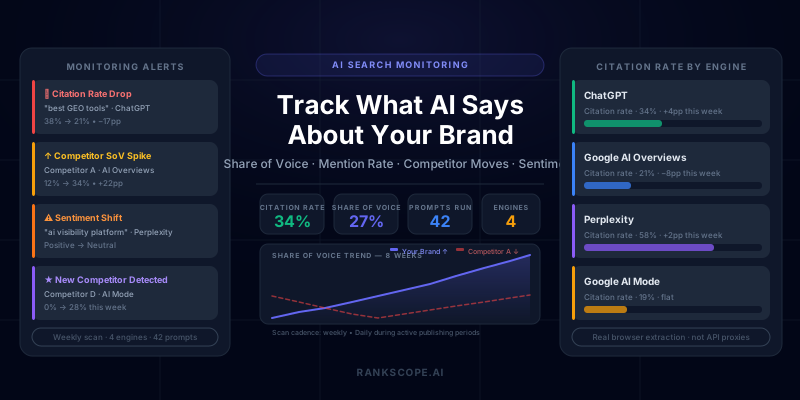
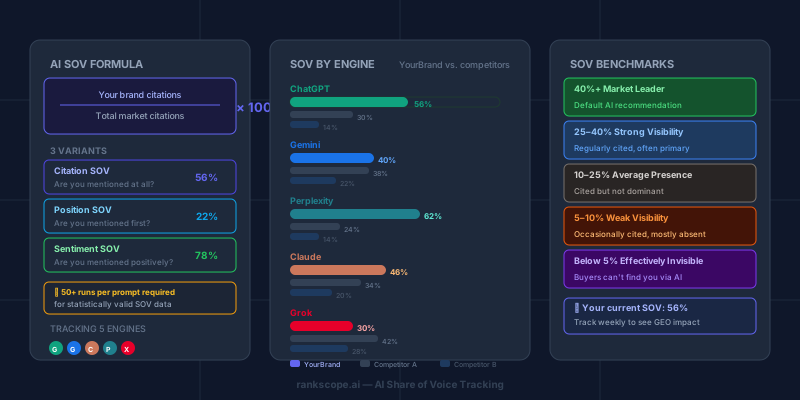
Citation Rate — the percentage of relevant queries across your tracked prompt set where your brand appears in AI responses. Your baseline measure of AI search presence.
Share of Voice in AI search — your citation rate compared to competitors across the same prompt set. This is the competitive view. If your citation rate is 45% but a key competitor's is 68% on the same set of buyer-intent queries, you're losing the AI search competitive battle even if your web presence is strong.
Position in AI responses — whether your brand is mentioned first (leading recommendation), middle (one of several), or last (passing reference) in a given AI response. The order matters for buyer perception.
Competitor benchmarking — not just your own metrics, but how each named competitor performs across the same prompts. AI competitive intelligence is a relative game.
Change detection — when AI responses shift, what changed? Did a competitor replace you in a response? Did the framing of your brand change from positive to qualified? These shifts are intelligence signals that your CI program needs to catch.
Crayon can tell you if a competitor changed their pricing page. It cannot tell you if that competitor is now being recommended ahead of you in ChatGPT responses to your highest-intent buyer queries. Both are competitive intelligence. Only one of them is visible to Crayon.
Why This Matters for CI-Focused Marketing Teams
The teams searching for Crayon alternatives tend to be product marketing managers and competitive intelligence leads at B2B SaaS companies — exactly the profile most likely to feel this gap acutely.
Here's a concrete scenario. A mid-market B2B SaaS company has a well-functioning CI program powered by Crayon. They know within hours when a competitor changes their pricing. Their battlecards are current. Sales is armed with the right objection-handling content. By traditional CI standards, they're ahead of the curve.
But their VP of Sales comes back from a deal with news: the prospect built their initial shortlist by asking ChatGPT for vendor recommendations. The company wasn't on it. A competitor they consider lower-quality was listed first, with a confident endorsement. The prospect had already scheduled calls with the AI-recommended vendors before even running a Google search.
That's the competitive intelligence gap Crayon can't close, because the data that would close it doesn't live on any web page Crayon can crawl.
AI search visibility — how your brand appears in AI-generated answers — has become a foundational competitive metric. Not a nice-to-have supplement to traditional CI. A separate data layer that feeds a different set of strategic decisions.
Best Crayon Alternative for AI Competitive Intelligence: RankScope
For CI-focused marketing teams who need visibility into the AI-generated answer layer, RankScope is the purpose-built tool for that dimension.
What RankScope tracks
RankScope monitors brand citations and competitive Share of Voice across four major AI engines:
- ChatGPT — the most widely used AI research tool for B2B vendor evaluation
- Google AI Overviews — now appearing in more than 11% of all Google searches, dominant in commercial-intent queries
- Perplexity — disproportionately used by analysts, researchers, and technical buyers
- Google AI Mode — Google's full AI search interface, expanding its presence rapidly in 2026
For competitive intelligence purposes, the most important metric RankScope surfaces is Share of Voice — not just your own citation rate, but how you compare to the specific competitors you're tracking across the same buyer-intent queries.
You define a prompt library — the queries that represent how buyers in your category actually research vendor decisions. Category-level prompts ("best competitive intelligence tools for B2B SaaS"), comparison prompts ("Crayon vs alternatives for product marketing teams"), use-case prompts ("how to track competitor pricing changes in real time"). RankScope runs those prompts systematically across all four AI engines and reports back your Share of Voice relative to each tracked competitor.
The daily monitoring cadence is important here. AI competitive intelligence isn't useful as a one-time snapshot — it's a longitudinal signal. Are you gaining or losing Share of Voice in ChatGPT over time? Did a competitor's AI citation rate spike after a product launch or a major piece of content? Are Google AI Overviews now featuring a competitor that was invisible three months ago? Those trend lines are where the CI value lives.
Signals: competitive alerts when AI changes
One feature that maps directly to CI workflows is Signals — RankScope's alert system for changes in AI responses.
When an AI engine changes how it responds to one of your tracked prompts — a competitor enters a response they previously didn't appear in, your brand drops from a recommendation, the framing of your product changes — Signals fires an alert. This is the AI equivalent of Crayon's web monitoring alerts, applied to AI-generated answers.
For a CI team that's used to being notified when a competitor changes their pricing page, Signals delivers the same immediate-notification experience for the AI layer. You don't have to check dashboards manually to discover that a competitor is now being recommended ahead of you in a critical buyer-intent query.
Real browser responses: why it matters for accuracy
One technical distinction worth understanding for CI teams evaluating AI monitoring tools: not all platforms retrieve AI responses using the same method.
Google AI Overviews and Google AI Mode are only accessible through actual browser interaction with Google Search. They are not available via Google's search API, which returns classic organic results. A tool claiming to track AI Overviews via API is not tracking the real thing.
RankScope uses real browser-rendered responses — what a buyer actually sees when they open Chrome and run a search. For competitive intelligence purposes, this accuracy matters. You need to know what buyers are actually seeing, not an API approximation.
RankScope pricing
The Starter plan at $49/mo handles solo practitioners and single-brand use cases. Pro at $149/mo is the right fit for most marketing teams — full competitor benchmarking, larger prompt libraries, multi-engine Share of Voice reporting. Agency at $399/mo covers teams managing multiple brands or client accounts.
All plans: no setup fee, no annual contract required, cancel anytime.
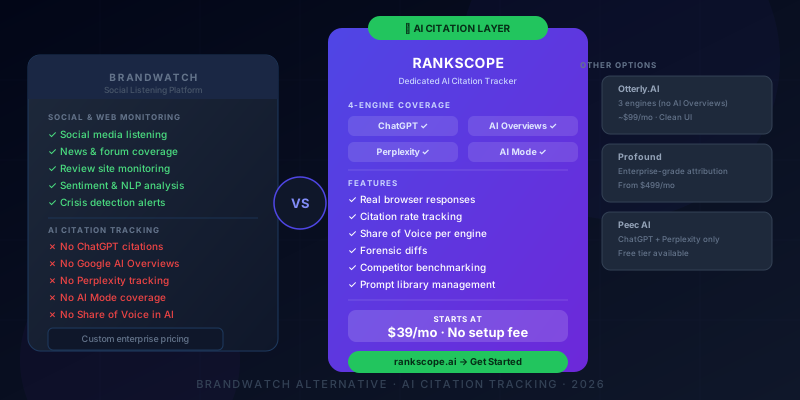
Full Comparison: Crayon vs. RankScope
| Capability | Crayon | RankScope |
|---|---|---|
| Competitor website monitoring | ✅ | ✗ |
| Pricing page change alerts | ✅ | ✗ |
| Competitor content & messaging tracking | ✅ | ✗ |
| Sales battlecard creation | ✅ | ✗ |
| Win/loss analysis | ✅ | ✗ |
| CRM integrations (Salesforce, HubSpot, Gong) | ✅ | ✗ |
| ChatGPT citation tracking | ✗ | ✅ |
| Google AI Overviews tracking | ✗ | ✅ |
| Perplexity citation tracking | ✗ | ✅ |
| Google AI Mode tracking | ✗ | ✅ |
| Competitor Share of Voice in AI search | ✗ | ✅ |
| AI response change alerts (Signals) | ✗ | ✅ |
| Real browser-rendered responses | ✗ | ✅ |
| Prompt library management | ✗ | ✅ |
| Pricing | Custom enterprise | From $49/mo |
The table makes the relationship clear: Crayon and RankScope are monitoring different competitive layers. They don't compete — they're complementary. Crayon owns the web-based CI layer; RankScope owns the AI-generated answer layer. A complete competitive intelligence program in 2026 eventually needs both.
Other Crayon Alternatives Worth Considering
For teams where the primary driver is replacing Crayon's web-based CI capabilities — not adding AI coverage — here are the strongest alternatives in each niche.
Klue — best for sales-led competitive enablement
Klue is the closest direct competitor to Crayon for sales-driven CI programs. It monitors competitor web content and messaging, curates intelligence into battlecards, and pushes them into Salesforce, HubSpot, Slack, and Gong — wherever your reps actually work. The platform also includes an Ask Klue assistant that sellers can query in-flow for deal-specific competitive guidance.
Where Klue beats Crayon: stronger CRM-native battlecard delivery, Salesforce and Gong integrations, and — by many accounts — a more modern AI-native architecture. G2 shows Klue at 4.7/5 from 443+ reviews, slightly ahead of Crayon.
Where Crayon still has an edge: broader cross-functional CI tooling (market intelligence capture, not just sales enablement), and generally faster implementation time on G2 benchmarks.
Like Crayon, Klue has no AI citation tracking. It's a web-based CI tool with strong sales activation. Custom pricing, no public rates.
Kompyte by Semrush — best for Semrush-adjacent teams
Kompyte (acquired by Semrush in 2022) is the most transparent mid-market alternative to Crayon. Unlike Crayon and Klue, it publishes plan packaging — three tiers based on number of competitors tracked and user counts — even if the dollar pricing remains quote-based.
Kompyte's advantage: faster time-to-value (typically 24–48 hours to first insights, 1–2 weeks for full deployment, vs. Crayon's longer enterprise setup cycle), and natural integration with Semrush's traffic and keyword data if your team is already in that ecosystem. If your CI program needs web competitor monitoring with less implementation friction than Crayon, Kompyte is worth evaluating.
No AI citation tracking. Web monitoring only.
Similarweb — best for digital share and traffic data
Similarweb is a different kind of competitive intelligence tool — focused on traffic data, channel breakdowns, audience insights, and digital market share. It's not a Crayon replacement for content or messaging monitoring, but it's a common addition to CI stacks that need competitive traffic benchmarks.
The relevant note for 2026: Similarweb has started incorporating some AI search visibility data into its higher-tier plans (from $335/mo for CI+SEO). It's not a dedicated AI citation tracker — the depth doesn't compare to RankScope — but it's the only traditional CI-adjacent tool with any meaningful AI search data layer.
If your primary CI need is digital market share and traffic intelligence, Similarweb is strong. If your need is AI citation competitive benchmarking, it's not the right tool.
Owler — best for free company monitoring
Owler is the budget end of the competitive monitoring spectrum: free for basic company news and executive alerts, $468/year for Pro. It doesn't do content or messaging CI at Crayon's depth, but for teams that just want to be notified about competitor funding announcements, executive changes, and major news, it fills the need without a five-figure contract.
No AI citation capability. A starting point, not a Crayon replacement.
How to Add AI Competitive Intelligence Alongside an Existing CI Stack
For teams already running Crayon who want to add the AI coverage layer, the practical approach is straightforward.
Step 1: Build a competitive prompt library. Start with 20–40 prompts that represent your highest-stakes buyer research scenarios:
- Category queries: "best [your category] tools for [your ICP] teams"
- Comparison queries: "[your brand] vs [Competitor A] vs [Competitor B]"
- Use-case queries: "how to [primary job your product does] in 2026"
- Problem-aware queries: "[pain point your product solves] solutions"
These are the prompts your buyers are likely running before they ever hit your website.
Step 2: Run an AI competitive baseline. Connect RankScope and run your prompt library across all four engines. The initial results show your current Share of Voice vs. each tracked competitor — which engines cite you, where you rank relative to competitors, and which prompts you're missing entirely.
Step 3: Cross-reference with Crayon data. The two datasets complement each other. If a competitor just launched a major product update (caught by Crayon) and their AI citation rate is climbing (caught by RankScope), those signals together tell you something important: their content and positioning changes are working, and you need to respond. If their web changes are significant but AI citations aren't moving, the market isn't validating the positioning yet.
For a structured framework on tracking competitive metrics across both layers, see our AI search monitoring guide and how to calculate Share of Voice in AI search.
Step 4: Set Signals alerts for key competitor queries. Configure Signals for the prompts where competitive position matters most — your highest-intent category queries and direct comparison queries. When a competitor starts appearing in a response where they previously didn't, you'll know within 24 hours.
Step 5: Report Share of Voice as a CI metric. The most impactful change for most CI-focused teams is simply adding AI Share of Voice to the competitive metrics they already report. Alongside traditional metrics — share of voice in earned media, website traffic vs. competitors, ad spend benchmarks — AI Share of Voice becomes a leading indicator of how the competitive landscape is shifting in the AI-driven discovery layer.
Understanding generative engine optimization gives useful context for why AI citations behave differently from traditional ranking signals and what the optimization levers actually are.
Who Is This Post Actually For?
If you're evaluating Crayon alternatives because you want to replace its web-based competitive monitoring at a lower price point, the tools in the comparison section above — particularly Klue and Kompyte — are your best starting points. Both address Crayon's core use cases with different trade-offs on pricing transparency and sales workflow integration.
But if the question is whether your competitive intelligence program has a blind spot on AI-generated answers — what ChatGPT recommends when buyers research your category, how your Share of Voice compares to competitors in Perplexity, whether Google AI Overviews are featuring a newer competitor ahead of you — that's a gap Crayon, Klue, Kompyte, and Similarweb all share. It's not a gap any of them are roadmapping around.
RankScope is purpose-built for that layer. It doesn't replace Crayon — it adds the AI dimension of competitive intelligence that no traditional CI platform currently covers.
The competitive intelligence teams who figure this out first will have a structural advantage in their categories. They'll know which AI engines their competitors are winning, how their Share of Voice is trending before it shows up in pipeline data, and when AI responses shift in ways that require a competitive response.
That's a new kind of intelligence. Get started at app.rankscope.ai — no setup fee, cancel anytime.
Setting Up Your AI CI Stack: A Quick Checklist
Getting the AI competitive intelligence layer running alongside Crayon doesn't require a large project. Here's the minimal viable approach:
- Define 20–30 prompts representing how your buyers research your category in AI tools
- Connect RankScope and run a baseline across ChatGPT, AI Overviews, Perplexity, AI Mode
- Add your top 3–5 competitors to the Share of Voice tracking
- Set Signals alerts for your highest-priority buyer-intent queries
- Review the GEO checklist at rankscope.ai/resources/geo-checklist for content optimization gaps your competitors may be exploiting
The baseline run gives you an immediate answer to the most important AI CI question: where do you stand vs. competitors in the channel your buyers are increasingly using to build their shortlists?
Frequently Asked Questions
Can I use Crayon and RankScope together?
Yes, and this is the recommended approach for teams serious about competitive intelligence in 2026. They monitor completely different channels with no functional overlap. Crayon handles web-based competitor monitoring — pricing pages, content, messaging, ads. RankScope handles AI-generated answer competitive intelligence — Share of Voice in ChatGPT, AI Overviews, Perplexity, and AI Mode. Running both gives you a comprehensive view of the competitive landscape across the channels that matter most.
How often does RankScope check AI responses?
RankScope runs your tracked prompt library on a daily basis across all four engines, surfacing Share of Voice trends and flagging response changes via Signals. This daily cadence captures shifts that happen at the model update and content indexing level — the most common drivers of AI response changes.
Is Crayon worth the cost for a mid-market company?
Crayon is priced for enterprise buyers with established CI programs and sales enablement workflows. For mid-market companies who need web-based competitor monitoring without the full Crayon investment, Kompyte by Semrush offers similar functionality with more transparent packaging and faster time-to-value. Klue is worth evaluating if your primary use case is sales battlecard delivery. For the AI competitive intelligence layer specifically, RankScope's $149/mo Pro plan covers most mid-market needs without the enterprise price tag.
What's the fastest way to see if competitors are outperforming you in AI search?
Start on RankScope's Starter plan, build a 15-prompt library of your most important category and comparison queries, and run an initial scan. The Share of Voice results will show exactly which competitors are being cited ahead of you and on which engines. Most teams find at least one significant AI competitive insight in their first baseline — a competitor appearing consistently in AI responses to queries where the team assumed they were well-positioned.
Does Crayon have any AI search features on its roadmap?
Crayon hasn't announced dedicated AI citation tracking as of August 2026. The company's roadmap has historically focused on expanding web monitoring breadth and deepening sales enablement integrations. Given that AI-generated answers require fundamentally different retrieval infrastructure than web crawling, adding meaningful AI citation tracking to Crayon's architecture would be a significant product shift — not a feature addition.