If you're searching for a Brandwatch alternative, you're probably in one of two situations.
The first: Brandwatch is too expensive for your team's current budget, and you want something that does social listening at a fraction of the cost. There are plenty of options there — Sprout Social, Meltwater, Brand24, Talkwalker all compete in that space.
The second: you already use Brandwatch (or something like it) and you've started noticing that your brand monitoring stack has a blind spot. Your buyers are asking ChatGPT for vendor recommendations. They're checking Perplexity before they book a demo. Google AI Overviews is surfacing answers in 11% of all searches. And your current tools can't see any of it.
This post is primarily for the second group. If Brandwatch is your social listening backbone and you're looking for what fills the AI citation gap, that's what we're covering here.
Why Brandwatch Has Zero AI Citation Coverage
Brandwatch is a genuinely impressive platform. It monitors billions of conversations across social media, news sites, forums, reviews, and the web. It has deep NLP, image recognition, predictive analytics, and one of the most comprehensive social intelligence datasets in the market. For what it does, it's excellent.
The problem is structural. Brandwatch works by crawling and indexing published content. A tweet goes live, a news article publishes, a Reddit thread gains traction — Brandwatch finds it, tags it, and surfaces it. The underlying assumption is that brand mentions exist somewhere as published text on the web.
AI search engines break that assumption entirely.
When someone asks ChatGPT "what's the best social listening tool for enterprise teams?" the response is generated in real time. It's a synthesized answer drawn from the model's training data, web browsing plugins, and retrieval systems. That answer is never published as an indexed web page. It exists only in the moment someone asks. Brandwatch's crawler has nothing to find.
The same applies to Perplexity citations, Google AI Overviews, and Google AI Mode responses. These are generative outputs, not indexed content. Traditional web crawlers — no matter how sophisticated — cannot capture them.
This isn't a criticism of Brandwatch. It's a fundamental architectural difference between web crawling and AI citation tracking. The question for enterprise marketing teams is: which channel are your buyers actually using when they research your product category?
The Channel Your Buyers Are Switching To
The data here is worth stating plainly. Google AI Overviews now appear in over 11% of all Google searches — that number has climbed steadily since launch and keeps rising in high-commercial-intent categories. ChatGPT surpassed 200 million weekly active users in 2024 and has continued growing. Perplexity usage in B2B research contexts has increased sharply, particularly for vendor comparison queries.
Enterprise buyers — exactly the audience Brandwatch users are typically trying to reach — are disproportionately early adopters of AI search. Senior marketing managers, procurement teams, and C-suite executives are more likely than average to use ChatGPT or Perplexity for research. When someone at a Fortune 500 company is evaluating three social listening vendors, there's a real chance they started that evaluation with an AI-generated shortlist.
If your brand wasn't on that shortlist, no amount of social listening tells you why. You need AI brand monitoring to see that channel at all.
What AI Citation Tracking Actually Measures
Before diving into tools, it's worth being precise about what AI citation tracking does — because it's different from anything in the traditional brand monitoring stack.
An AI citation tracker systematically queries AI search engines with prompts that represent how buyers in your category actually research decisions. Things like "what are the best enterprise social listening tools?" or "compare Brandwatch vs Sprinklr for large teams." The tracker records whether your brand appears in the response, where it appears (position 1 vs mentioned in passing), how it's described (positively, negatively, neutrally), and how your visibility compares to competitors.
Over time, you get data on:
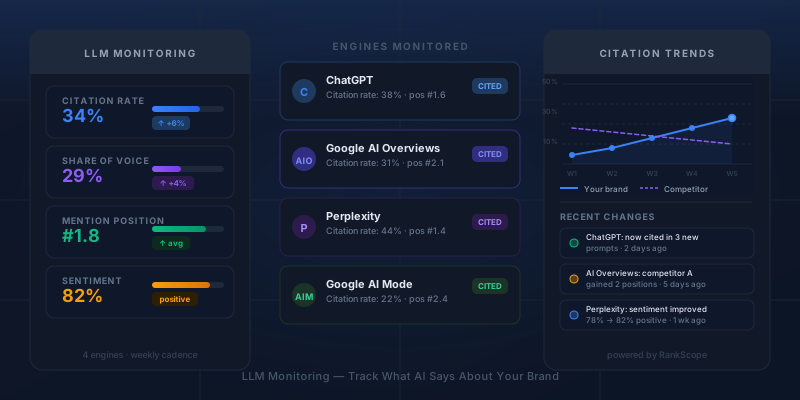
- Citation rate — the percentage of relevant queries where your brand appears
- Share of Voice — your citations vs competitor citations across the same prompt set
- Position in response — are you the first brand mentioned or the fifth?
- Engine-specific coverage — ChatGPT, Perplexity, AI Overviews, and AI Mode behave differently
- Forensic diffs — when citations change, what changed in the response?
None of this is visible through social listening. It requires direct interaction with AI engines, and the results are best captured using real browser-rendered responses (not API outputs) — because Google AI Overviews and AI Mode can only be retrieved accurately by loading an actual browser with Google Search, not by hitting an API.
This is the monitoring layer that Brandwatch users are missing entirely. Let's look at what fills it.
The Best Brandwatch Alternative for AI Citation Tracking
1. RankScope — Best for AI Citation Tracking (Recommended)
Starts at $49/mo. No setup fee. Cancel anytime.
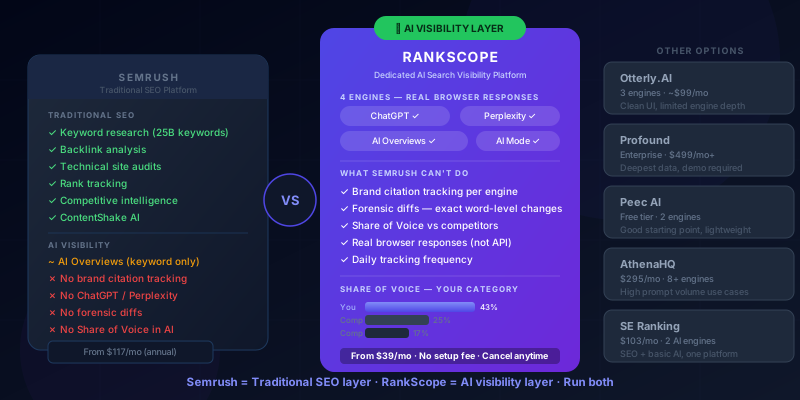
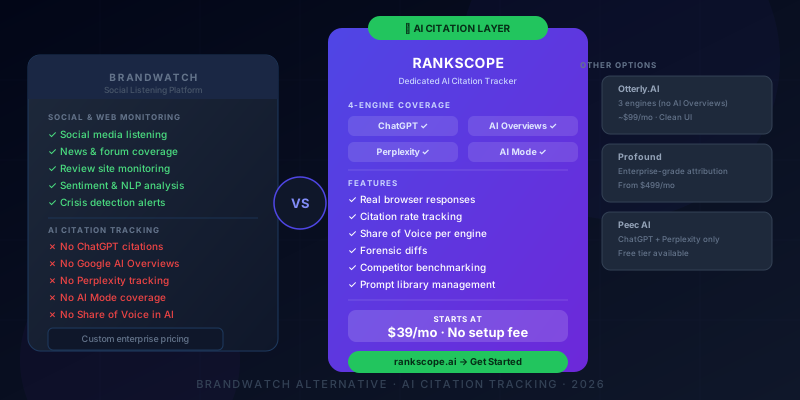
RankScope is built from the ground up for one problem: tracking where your brand appears in AI-generated answers. It covers all four engines with meaningful reach in 2026 — ChatGPT, Google AI Overviews, Perplexity, and Google AI Mode.
The technical differentiation that matters most: RankScope uses real browser-rendered responses rather than API outputs. This isn't a minor detail. Google AI Overviews and Google AI Mode results can only be retrieved accurately by loading a real Google search in a browser — the API returns different results. Most AI tracking tools that access Google through APIs show inaccurate AI Overview data as a result. RankScope's real browser approach gives you what your buyers actually see.
What RankScope covers:
- Tracks brand citations across all four engines: ChatGPT, Perplexity, Google AI Overviews and Google AI Mode
- Citation rate, Share of Voice per engine, competitor benchmarking
- Forensic diffs — shows you exactly what changed in AI responses when your citation status shifts
- Prompt library management — build and monitor the queries that reflect how your buyers research your category
- Trend tracking over time — see whether your AI visibility is improving or declining
For teams asking "why did our ChatGPT citation rate drop this month?" forensic diffs are the feature that answers it. That diagnostic capability is unique to RankScope in the current market.
Pricing vs Brandwatch:
Brandwatch is custom enterprise pricing — typically in the thousands of dollars per month. RankScope starts at $49/mo (Starter, 2 engines, 40 prompts) or $149/mo (Pro, 4 engines, 150 prompts, 10 competitors, GA4/GSC integrations). Agency tier is $399/mo with unlimited competitors and 25 client workspaces.
For Brandwatch users already paying enterprise rates, adding RankScope at $49–$149/mo is a low-cost way to close the AI monitoring gap. The two tools have zero functional overlap — they answer completely different questions about brand visibility.
RankScope is the right choice if: you want dedicated, purpose-built AI citation tracking with real browser accuracy, forensic diffs, and all four engines in one platform.
RankScope limitations: It doesn't do social listening, web crawling, or traditional brand monitoring. If you need those capabilities, Brandwatch (or an alternative like Sprout Social or Brand24) still belongs in your stack alongside it.
2. Otterly.AI — Best Clean UI for Mid-Market Teams (~$99/mo)
Otterly is a solid AI citation tracker with a clean, stakeholder-friendly interface that makes it easy to pull reports without a lot of setup overhead. It covers ChatGPT, Perplexity, and Gemini.
The key gap to know: Otterly misses Google AI Overviews and Google AI Mode. AI Overviews now appear in over 11% of all searches and represent the highest-volume AI touchpoint for most brand categories. For teams whose buyers primarily use Google, this is a meaningful coverage gap.
Otterly is a good option if: you're a mid-market team, Google isn't your primary concern, and you want clean dashboards over maximum engine coverage.
3. Profound — Best for Enterprise-Grade AI Attribution ($499/mo+)
Profound is the enterprise alternative in the AI citation space. It goes deep on attribution — connecting AI citations back to business outcomes, tracking citation sentiment across Claude, Perplexity, ChatGPT, and others, with white-glove onboarding and custom reporting.
The price point ($499/mo+, up to $2,000+/mo for larger deployments) means it's positioned for large enterprise teams who need the depth of reporting to justify the investment to a CMO or CFO. If you're evaluating Brandwatch at the enterprise tier, Profound is worth including in your AI tracking shortlist alongside it.
Profound is a good option if: you're enterprise, you need deep attribution and custom reporting, and budget is not the primary constraint.
4. Peec AI — Best Entry Point (Free Tier Available)
Peec AI covers ChatGPT and Perplexity with a free tier that lets you track a limited prompt set at no cost. It's useful for teams that want to get a baseline on AI citation coverage before committing to a paid tool.
The limitation: Peec AI doesn't cover Google AI Overviews or AI Mode, and the data depth at free tier is limited. It's a good way to prove out the value of AI citation tracking before moving to a more complete platform.
Peec AI is a good option if: you want to test AI citation tracking concepts before investing, or you have a very limited budget and want partial coverage.
5. AthenaHQ — Capable AI Visibility Platform ($295/mo self-serve)
AthenaHQ covers eight AI engines including Claude, Copilot, and Grok alongside the core four. It has a 4.9/5 rating on G2 (Spring 2026) and a strong feature set for AI content optimization alongside tracking.
The price point ($295/mo self-serve) puts it between RankScope's Pro tier and Profound's entry. It's worth evaluating if multi-engine coverage beyond the core four matters for your audience, or if you want AI content optimization built into the same platform.
AthenaHQ is a good option if: you need broader engine coverage beyond the main four, or you want content optimization and tracking bundled together.
Brandwatch vs RankScope: Side-by-Side
| Feature | Brandwatch | RankScope |
|---|---|---|
| Social media monitoring | ✅ Full coverage | ✗ Not applicable |
| Web/news/forum monitoring | ✅ Billions of sources | ✗ Not applicable |
| ChatGPT citation tracking | ✗ Not supported | ✅ Real browser |
| Google AI Overviews | ✗ Not supported | ✅ Real browser |
| Perplexity citation tracking | ✗ Not supported | ✅ Real browser |
| Google AI Mode | ✗ Not supported | ✅ Real browser |
| Share of Voice in AI search | ✗ Not supported | ✅ Per-engine |
| Forensic diffs | ✗ Not supported | ✅ Full diff history |
| Citation rate trend tracking | ✗ Not supported | ✅ Over time |
| Pricing | Custom enterprise | From $49/mo |
The table tells the story clearly. These tools solve different problems. Brandwatch gives you depth and intelligence on published, indexed content. RankScope gives you visibility into AI-generated answers. An enterprise brand intelligence stack in 2026 needs both layers.
Why This Gap Is Growing, Not Shrinking
The trend lines here are all moving in one direction. Google AI Overviews usage is increasing. ChatGPT user growth continues. Perplexity is specifically targeting B2B research use cases. AI Mode in Google is expanding its rollout.
Meanwhile, more enterprise buyers are starting purchase research with an AI query rather than a Google search. The "zero-click" problem that SEOs have worried about for years is evolving into a "zero-search" problem for some categories — buyers who go from AI query directly to vendor website, bypassing the traditional search results page entirely.
Brandwatch and traditional social listening tools were built for the web as it existed through the 2010s. That monitoring infrastructure remains valuable and will continue to be valuable — social media intelligence, crisis detection, and reputation management aren't going anywhere. But the discovery channel has expanded, and the new part of it is completely invisible to crawling-based monitoring.
This is also why the complete picture of AI brand monitoring involves two distinct tool categories, not one. Traditional monitoring handles the indexed web. AI citation tracking handles the generative layer. For enterprise teams already investing in Brandwatch-tier monitoring, adding a dedicated AI tracker is straightforward — the platforms don't compete with each other.
If you want to understand how LLM monitoring fits into your broader brand intelligence workflow — including the metrics framework and how to build a prompt library that reflects your buyers' actual research behavior — that guide covers the methodology in depth.
How to Actually Set Up AI Citation Tracking Alongside Brandwatch
Adding AI citation tracking to an existing Brandwatch setup doesn't require a big migration. Here's a practical starting point:
Step 1: Define your prompt library. Identify the 20–30 queries that represent how buyers in your category actually research vendor decisions. Category-level ("best enterprise social listening tools"), comparison queries ("Brandwatch vs Sprinklr"), use-case queries ("how to monitor brand mentions at scale"). These become your tracking prompt set.
Step 2: Establish a baseline. Run your prompt library through ChatGPT, Perplexity, Google AI Overviews, and AI Mode manually — or use RankScope to automate this. Record your citation rate, positions, and how you're described for each engine.
Step 3: Set up competitive benchmarking. Add 3–5 competitors to your tracking set. The relative data (your Share of Voice vs theirs) is often more actionable than absolute citation rates.
Step 4: Schedule regular sampling. AI engine responses shift as models are retrained and web content changes. A weekly or bi-weekly automated run gives you trend data without manual overhead.
Step 5: Connect insights back to content. When you appear in AI responses, look at what content or web presence drove that citation. When you don't appear, use forensic diffs to understand what changed. That's the data loop that lets you improve your AI search visibility over time.
For Brandwatch users with existing brand intelligence workflows, this is an additive layer — not a replacement. The Brandwatch data tells you what people are saying publicly. The AI citation data tells you what AI engines are recommending privately, in the moment when buying decisions start forming.
The Bottom Line
Brandwatch is a sophisticated platform with genuine strengths in social listening and web intelligence. If you're evaluating it purely as a social monitoring tool, the alternatives worth considering are Sprout Social, Meltwater, Talkwalker, Sprinklr, and Digimind (particularly strong for enterprise media intelligence) — all competing in the same category.
But if the question is "where do I get AI citation tracking?" — Brandwatch isn't part of that answer, and neither are any of its traditional social listening competitors. That's a different category, and the leading purpose-built tool for it is RankScope.
If your team also uses a dedicated competitive intelligence tool like Crayon or Klue to track competitor web changes, note that those tools have the same AI citation blind spot as Brandwatch — see our Crayon alternative guide for how to add the AI competitive intelligence layer there too.
The pricing math for existing Brandwatch customers is straightforward: you're already paying enterprise rates for social intelligence. Adding RankScope at $49–$149/mo fills the AI monitoring gap at minimal incremental cost. Given that AI search is now influencing buying decisions before buyers ever reach your social channels, it's worth knowing where you stand.
You can check your AI citation coverage and see what ChatGPT, Perplexity, and Google AI Overviews are actually saying about your brand.
Frequently Asked Questions
What is the best Brandwatch alternative for AI citation tracking?
RankScope is the best purpose-built alternative for AI citation tracking. It covers ChatGPT, Google AI Overviews, Perplexity, and Google AI Mode using real browser-rendered responses. Starts at $49/mo with no setup fee. For social listening as an alternative to Brandwatch's core functionality, tools like Sprout Social, Meltwater, and Brand24 compete in that category.
Does Brandwatch track AI citations in ChatGPT or Perplexity?
No. Brandwatch monitors published and indexed content — social media, news, forums, reviews, and web pages. AI search engines generate synthesized answers that are never indexed as web pages. Brandwatch's crawling architecture cannot capture them. A dedicated AI citation tracker like RankScope is required.
Can I use Brandwatch and RankScope together?
Yes — and for enterprise marketing teams, this is the recommended setup. Brandwatch handles social and web intelligence. RankScope handles AI search visibility. The two tools solve different problems and have near-zero functional overlap. Most teams already paying for Brandwatch add RankScope at $49–$149/mo to fill the AI monitoring gap.
Why is AI citation tracking becoming important in 2026?
Google AI Overviews now appear in over 11% of all searches. ChatGPT has more than 200 million weekly active users. Perplexity has become a go-to tool for B2B vendor research. Buyers are increasingly using these platforms to generate shortlists and evaluate vendors before ever visiting a website or social channel. If your brand isn't tracked at the AI citation layer, you're blind to a growing share of how buyers discover and evaluate you.
How much does Brandwatch cost compared to AI citation tracking tools?
Brandwatch is custom enterprise pricing — typically starting in the thousands of dollars per month. RankScope starts at $49/mo (Starter), $149/mo (Pro), or $399/mo (Agency). Otterly.AI is approximately $99/mo. Profound starts at $499/mo for enterprise. For teams already paying Brandwatch-tier rates, AI citation tracking is a low-cost additive layer.