There is a version of brand monitoring most marketing teams understand: set up Google Alerts, point Brand24 at your company name, maybe run a social listening dashboard. Someone mentions you online, you know about it.
That version is incomplete now.
When someone opens ChatGPT and asks "what's the best tool for [your category]?" — your Google Alert doesn't fire. Brand24 doesn't see it. The AI generates an answer, recommends competitors, and your brand never appears in the conversation. And you have no idea.
That gap is what LLM monitoring is built to close.
What LLM Monitoring Is
LLM monitoring (also called LLM tracking) is the practice of systematically querying large language models to measure how your brand appears in their responses — how often you're cited, where you appear, and how you're described.
Think of it as the AI search equivalent of rank tracking. Traditional rank tracking tells you where you sit in Google's blue links. LLM monitoring tells you whether AI engines recommend you at all — and if so, in what context.
The mechanics are straightforward: you run a set of relevant queries through an AI engine, check whether your brand appears in the response, and record what it said. Do that repeatedly, across multiple engines, and you build a data picture of your AI visibility.
The word "repeatedly" is doing real work in that sentence. We'll come back to why.
LLM Monitoring vs LLM Tracking
You'll see both terms used interchangeably. "LLM monitoring" tends to emphasize the ongoing observation aspect — are my AI citations stable, declining, improving? "LLM tracking" often gets used for the measurement side — what are my numbers right now?
In practice, a functional setup does both. You track current state and monitor for change over time. The distinction matters less than having a system that does it consistently.
Why This Is Different From Traditional Brand Monitoring
Traditional brand monitoring tools — Brand24, Mention, Brandwatch, Sprout Social — work by crawling the web. They index published content and scan it for your brand name. You publish something, someone tweets about you, a review goes live: they find it.
That model assumes the information you care about exists as indexed text somewhere. AI-generated responses don't work that way.
When ChatGPT answers a question, it synthesizes a response using its training data and real-time retrieval. That response isn't indexed anywhere. It exists for that session and then disappears. There's no web page to crawl, no text to scan. The only way to know what an AI said about your brand is to ask it yourself.
This creates a monitoring gap that most brands haven't fully reckoned with yet. A company could have strong social media presence, great review scores, and clean Google coverage — and still be completely absent from AI-generated recommendations in their category. The AI doesn't know, or doesn't cite them.
Understanding what LLM visibility actually means is the foundation: it's not about being mentioned online, it's about being synthesized into AI answers.
The Four AI Engines That Matter
For brand monitoring purposes in 2026, the four engines with meaningful reach are:
ChatGPT (OpenAI) — The largest installed base. Browsing mode is the variant that matters for monitoring, since it performs live web retrieval and your recently published content can appear within days.
Google AI Overviews: appears directly in Google search results on a large and growing share of queries. It draws on Google's index, but synthesizes from a much wider source set than a single #1 result would suggest.
Perplexity — Aggressively freshness-weighted, tends to surface recent content faster than other engines. A strong early signal of content resonance.
Google AI Mode — A newer, more conversational interface layered on Google's full index. Growing in usage and increasingly a place where purchase decisions get made.
A monitoring program that covers only one or two of these has significant blind spots. Brands are often surprised to find they perform differently across engines — strong in Perplexity, absent in AI Overviews, cited but misattributed in ChatGPT.
The Four Metrics That Actually Matter
Not all LLM monitoring metrics are equally useful. Here's what to actually track.
1. Citation Rate
Definition: The percentage of AI responses (for a given prompt) that mention your brand.
How to calculate: Run a prompt 50 times. Count how many responses include your brand name. Divide by 50. That's your citation rate for that prompt.
A 40% citation rate means you appeared in 20 of 50 runs. An 8% citation rate means you appeared in 4.
Why it's the most important metric: Citation rate captures whether you exist in an AI engine's understanding of your category. Everything else — sentiment, position, share of voice — is downstream of whether you're cited at all.
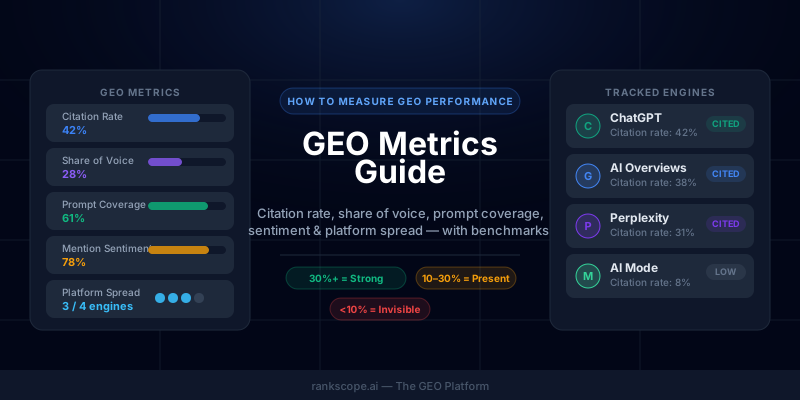
On benchmarks: there is no published citation-rate benchmark we trust, and a good rate depends on how many brands compete for the same prompts. Compare against named competitors on a fixed prompt set. For what drives these numbers across each engine, see our guide to AI search visibility.
2. Share of Voice
Definition: Your brand citations as a percentage of all brand citations across your tracked competitor set.
How to calculate: For a given prompt run, count total brand citations across all responses (your brand + all competitors mentioned). Your share of voice = your citations ÷ total citations × 100.
Why it matters: Citation rate alone doesn't tell you whether you're winning or losing relative to your category. A 30% citation rate sounds decent until you learn a competitor has 70%. Share of voice provides the competitive context that raw citation rate misses.
For a deeper look at the formula and per-engine variations, see our guide to calculating share of voice in AI search.
3. Mention Position
Definition: Where your brand appears within a multi-item AI response — first, second, third, or later.
Why it matters: AI engines typically recommend multiple brands in response to "best tool for X" queries. Position one gets disproportionate attention. A brand cited consistently in positions 4–6 has a very different commercial impact than one cited in positions 1–2, even if the raw citation rate is similar.
Track average mention position alongside citation rate to get the full picture.
4. Mention Sentiment
Definition: The framing of your brand within the AI response — positive, neutral, or negative.
Examples of sentiment variants:
- Positive: "[Brand] is widely regarded as the most comprehensive tool for..."
- Neutral: "[Brand] is one option in this space..."
- Negative: "[Brand] has faced criticism for its pricing..."
Sentiment matters because AI engines synthesize recommendations, not just mentions. A citation with negative framing can actively work against you. Monitoring sentiment lets you detect when AI engines are drawing on negative source material and address it at the content level.
The LLM Monitoring Workflow
Here's how to build a functional LLM monitoring setup from scratch.
Step 1: Build Your Prompt Library
Your prompt library is the set of queries you'll run through AI engines to measure your visibility. These should represent how buyers in your category actually discover and evaluate products via AI.
Strong prompt formats:
- Category queries: "what are the best tools for [specific use case]?"
- Problem queries: "how do I [problem your product solves]?"
- Comparison queries: "what's the difference between [your category tools]?"
- Use-case queries: "how to [task] without [traditional approach]?"
Prompts to avoid for citation rate measurement:
- Branded queries ("tell me about [your brand]") — these measure awareness, not discovery
- Queries so narrow they'd only name you — they inflate citation rate without reflecting real buyer behavior
Aim for 20–50 prompts that represent genuine buyer research in your category. These are the queries where you want to appear, where winning means a buyer considering your product.
For more on building an effective prompt library, the guide to tracking brand mentions in AI search covers the methodology in depth.
Step 2: Run Prompts With Sufficient Sample Sizes
This is where manual monitoring breaks down, and it's worth understanding why.
AI engines don't return the same response to the same prompt every time. ChatGPT varies by session context, browsing state, model version, and geography. Perplexity's real-time retrieval means responses shift as new content gets indexed. A single run of a prompt tells you almost nothing about your actual citation rate.
To get statistically meaningful data, you need multiple runs per prompt. The practical minimum is 10 runs; 20–50 gives you real confidence. At 50 prompts × 4 engines × 20 runs each, that's 4,000 checks per monitoring cycle. Manual execution takes days and introduces human inconsistency.
This is the core scaling problem that automated LLM monitoring solves.
Step 3: Record and Normalize Your Data
For each prompt run, capture:
- Which engine
- Date and time
- Whether your brand was cited (yes/no)
- Position in response (1st, 2nd, 3rd, etc.)
- Sentiment (positive/neutral/negative)
- Which competitors were cited alongside you
Normalize this into citation rate, share of voice, and sentiment scores per prompt, per engine, and per time period. You want to be able to answer: "Did my citation rate in ChatGPT for 'best [category] tool' prompts improve after I published [content] last month?"
Step 4: Monitor for Drift
AI citation patterns shift over time. A competitor publishes a major guide, earns a bunch of backlinks, and their citation rate jumps. A new model update changes how ChatGPT weights certain sources. You publish a new structured comparison page and your mention position improves.
Weekly monitoring is the recommended baseline for most brands. Daily monitoring is worth running in the first two weeks after publishing new content, since citation changes can materialize quickly once AI engines re-index.
The goal isn't just measuring your current state — it's detecting when things change, so you can understand what caused the shift and replicate or counteract it.
Where Manual Monitoring Breaks Down
Manual LLM monitoring is viable for initial baselines. Run your prompts by hand, note what comes back, build a starting picture of where you stand. This takes maybe a day for a small prompt library.
It stops being viable quickly for three reasons:
Response variability. As covered above, a single check per prompt per engine tells you little. You need multiple runs per prompt to tell a consistent citation from occasional noise, and doing that by hand multiplies the time cost many times over.
Competitive coverage. You don't just want to know if you appear — you want to know who else appears, in what position, with what framing. Recording full competitive context across dozens of prompts per engine makes manual tracking a part-time job.
Change detection. Even if you do a thorough manual baseline, the question becomes: when do you check again? Once a week? That's hundreds of manual checks per cycle for a 50-prompt library. Any cadence shorter than monthly becomes impractical without automation.
This is the same transition that happened in traditional SEO when rank tracking moved from manual Google checks to automated tools. The data volume isn't manageable by hand.
The Tools Layer: What Automated LLM Monitoring Does
Automated LLM monitoring tools solve the manual scaling problem by running your prompt library systematically across AI engines, recording full citation data, and surfacing changes without human effort per check.
What a good LLM tracking platform does:
Scheduled sampling. Runs your full prompt library across each configured AI engine on a set cadence (daily, weekly), so you always have current data without manual effort.
Multi-run averaging. Executes each prompt multiple times per cycle and averages citation rates, eliminating response variability as a confounding factor.
Competitive tracking. Records which competitors appear in each response, giving you share of voice data automatically.
Change detection. Flags when citation patterns shift — you appear in a response where you used to be absent, or a competitor enters a prompt where they weren't before.
Forensic diffs. Shows you exactly what changed in an AI response between monitoring cycles, so you can identify what content update or competitor move triggered the shift.
Per-engine breakdown. Separates results by engine so you can see that you're strong in Perplexity, weak in AI Overviews, and absent from AI Mode — and allocate optimization effort accordingly.
This connects directly to understanding GEO metrics — LLM monitoring is how you populate the metrics that GEO performance tracking depends on.
How RankScope Handles LLM Monitoring
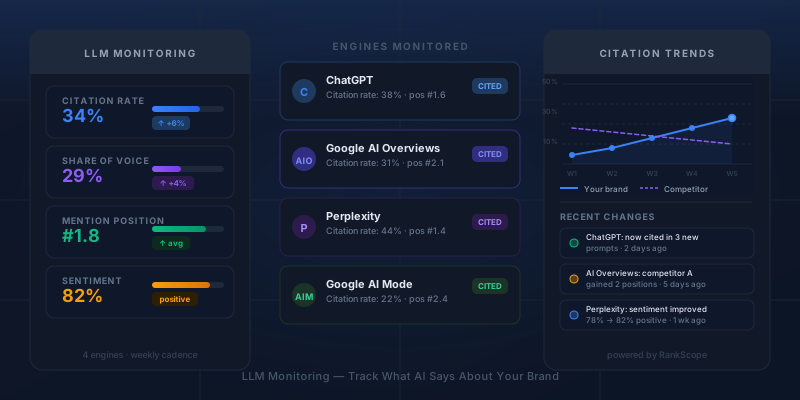
RankScope was built specifically for this problem. It monitors your brand across the four major AI engines — ChatGPT, Google AI Overviews, Perplexity, and Google AI Mode — running your configured prompt library on an automated schedule.
The key differentiator worth knowing: RankScope uses real browser extraction for Google AI Overviews and Google AI Mode, rather than API proxies. This matters because the API doesn't surface AI Overviews. A tool that relies on Google's API reports zero AI Overviews data — which can make it appear you're being cited when you're simply not being measured. Real browser extraction is the only way to get accurate data for those two engines.
What you can track in RankScope:
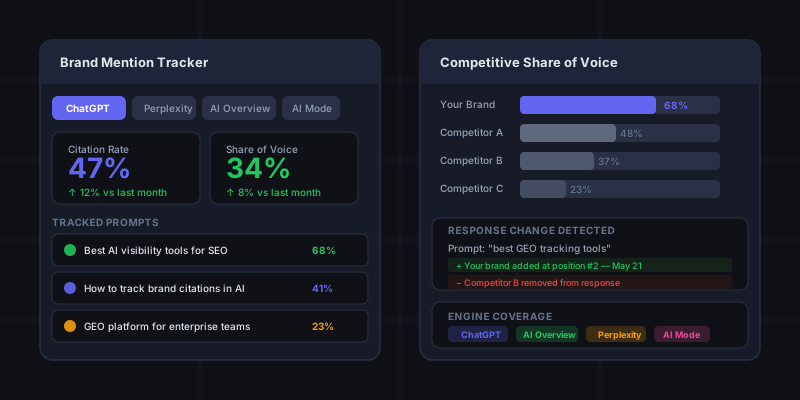
- Citation rate per prompt, per engine — how often you appear, broken down by query and platform
- Share of voice — your citations vs competitors across your tracked prompt set
- Mention position — where in the response you appear when cited
- Competitor movements — who's gaining and losing citations in your category over time
- Response diffs — exactly what changed in an AI response between monitoring cycles
Plans start at $49/month (Starter: 2 engines, 40 prompts) with Pro at $149/month covering all 4 engines with 150 prompts and competitor tracking. The platform overview has full feature details, and pricing breaks down what's included at each tier.
LLM Monitoring vs Brand Monitoring: What You Actually Need Both For
A question that comes up: should LLM monitoring replace traditional brand monitoring, or complement it?
The honest answer is: complement. They measure different things.
Traditional brand monitoring tells you:
- What's published about you on the web
- Social media sentiment and volume
- News coverage and press mentions
- Review site ratings
LLM monitoring tells you:
- What AI engines synthesize and recommend about you
- Whether you're cited in AI-generated buyer research
- How your brand is framed in AI responses vs competitors
- Whether your citation rate is improving after content changes
A brand that only does traditional monitoring is blind to AI-generated recommendations. A brand that only does LLM monitoring is blind to the underlying web content that shapes AI perceptions. The full picture of AI brand monitoring requires both lenses.
That said, if you're starting from scratch with limited budget, LLM monitoring is the higher-priority investment right now. ChatGPT reached 900 million weekly active users in February 2026 (OpenAI, via TechCrunch), and Google says AI Overviews has over 1.5 billion users a month. Your traditional monitoring infrastructure already exists; what's missing is the AI layer.
Setting Up LLM Monitoring: A Practical Checklist
Here's what a first-pass LLM monitoring setup looks like in practice:
[ ] Define your monitoring scope
- Which AI engines (at minimum: ChatGPT, Google AI Overviews, Perplexity)
- Which category queries represent real buyer discovery
- Which competitors to include in share of voice tracking
[ ] Build your prompt library (start with 20–30 prompts)
- Category queries: "best [your category] tools"
- Use-case queries: "how to [primary use case]"
- Problem queries: "how do I [problem you solve]"
- Comparison queries: "[competitor] vs [category]"
[ ] Establish your baseline
- Run your full prompt library through each engine (manually or automated)
- Record citation rate, position, sentiment for each prompt × engine combination
- Document which competitors appear and in what context
[ ] Set your monitoring cadence
- Weekly for ongoing tracking
- Daily for the first 2 weeks after major content changes
- For a full breakdown of scan cadence, threshold-based alerts, and how to act on each signal type, see the guide to AI search monitoring
[ ] Connect monitoring to action
- Map low-citation-rate prompts to content gaps
- Identify prompts where competitors appear but you don't
- Prioritize content improvements for the highest-traffic, lowest-citation queries
This checklist connects directly to a broader generative engine optimization strategy — monitoring is the measurement layer that tells you whether your GEO efforts are working.
The Shift From "Did Anyone Mention Me?" to "What Is AI Saying About Me?"
The frame most brand monitoring programs operate in is reactive: something happens, you find out. A tweet gets traction, you see it. A negative review goes live, you respond.
LLM monitoring requires a more proactive frame. AI engines aren't documenting what happened — they're synthesizing recommendations in real time for buyers actively researching your category. By the time you'd notice a problem the traditional way, thousands of buyers may have already received an AI recommendation that named your competitors and left you out.
That's the practical case for treating LLM monitoring not as a nice-to-have analytics capability, but as a core component of how modern brands track their market presence.
The tools to do it properly — at scale, with statistical rigor, across the engines that matter — are available now. The brands building this infrastructure early have a measurement advantage that compounds over time: they know what's working, they detect shifts before competitors do, and they can connect content investments to actual citation outcomes. For a comprehensive comparison of every major platform in this category, see our LLM SEO tools guide.
The brands that haven't started are optimizing for a search landscape that's rapidly changing shape around them.
RankScope monitors your brand in ChatGPT, Perplexity, Google AI Overviews and Google AI Mode — automated LLM tracking with per-engine citation rates, share of voice, and competitor movements. See how the platform works or explore pricing to get started.