If you're looking for a Talkwalker alternative in 2026, you're likely in one of two camps.
The first: Talkwalker's pricing ($13K–$100K+ annually) or its post-Hootsuite acquisition trajectory doesn't fit where your team is headed. You want something that does social and web monitoring at a more manageable cost or with a clearer long-term roadmap.
The second — and this is the group this post is really written for — you're already running enterprise-grade brand monitoring with Talkwalker or something like it, and you've started noticing a gap. Your buyers are asking ChatGPT for vendor shortlists. Procurement is running Perplexity queries before they send an RFP. Google AI Overviews is showing up in searches your brand appears in — or should appear in. And none of your current monitoring tools can see any of it.
If you're in that second camp, the Talkwalker alternatives everyone else recommends (Brandwatch, Sprinklr, Meltwater, Synthesio) won't close the gap. They all have the same blind spot.
What Talkwalker Does — and Where It Stops
Talkwalker is a serious platform. Before its 2024 acquisition by Hootsuite, it was one of the most capable standalone enterprise social intelligence tools on the market. It monitored 150 million+ sources across social, news, forums, reviews, and web. It had image and logo recognition, Blue Silk AI for trend detection, predictive analytics, and one of the deepest NLP stacks in the category. Consumer goods companies, large agencies, and global brands used it for strategic market research, not just daily monitoring.
The Hootsuite acquisition changed the positioning. Talkwalker became part of a broader social media management suite, which raised questions for enterprise insights teams who wanted it for strategic consumer intelligence rather than content scheduling. Some have used the transition as a moment to re-evaluate their full stack.
But regardless of what you think about the acquisition, Talkwalker has a limitation that predates Hootsuite and remains unchanged: it monitors published, indexed content. It can find every tweet, news article, Reddit thread, and review site mention of your brand. It cannot find you in AI-generated answers.
The reason is architectural. AI search engines — ChatGPT, Perplexity, Google AI Overviews, Google AI Mode — don't publish their responses. They generate them in real time, synthesized from training data and live retrieval. There's no web page to crawl. There's no indexed URL to monitor. A Talkwalker alert that fires for every press mention of your brand will never fire when ChatGPT recommends your competitor over you for the third week in a row.
That's not a criticism of the product. It's just how two fundamentally different monitoring layers work. The question is: which one are your buyers increasingly using when they start a purchase decision?
Why This Gap Is Becoming the One That Matters
The data here is worth being direct about.
Google AI Overviews now appear in over 11% of all Google searches. In high-commercial-intent categories — enterprise software, professional services, consumer electronics, financial products — that number is even higher. ChatGPT surpassed 200 million weekly active users in 2024 and continues growing. Perplexity has specifically targeted the B2B research use case and is gaining traction with exactly the buyer personas that enterprise brands spend heavily to reach.
Here's what makes this especially relevant for Talkwalker customers: enterprise buyers — the CMOs, procurement leads, and senior marketing directors at large companies — are disproportionately early adopters of AI search tools. They're more likely to start a vendor evaluation with a ChatGPT query than an average user. They're more likely to use Perplexity to build a comparison list before requesting demos.
This is the audience Talkwalker customers are trying to reach and influence. And it's the audience that's most likely to be using the one channel Talkwalker can't see.
The brands that understand this in 2026 are building two parallel monitoring layers. One for the web and social universe they've always monitored. One for the AI citation layer that didn't exist five years ago but is now influencing deals.
What AI Citation Tracking Actually Does
Before comparing tools, it's worth being precise — because AI citation tracking is different from anything in the traditional monitoring stack.
An AI citation tracker queries AI search engines with prompts that reflect how buyers in your category actually research decisions. For an enterprise brand, that might mean: "what are the leading social listening platforms for global brands?" or "compare Talkwalker vs Brandwatch for enterprise teams" or "which brand monitoring tools are used by Fortune 500 marketing departments?"
The tracker records:
- Whether your brand appears in the response
- Where it appears — first mention vs buried in paragraph five
- How it's described — positively, neutrally, or with caveats
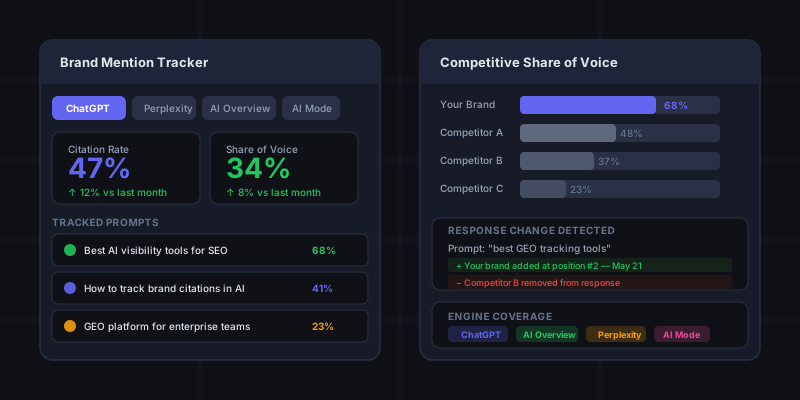
- Share of Voice — your citations vs competitor citations across the same prompt set
- Engine-specific data — ChatGPT, Perplexity, AI Overviews, and AI Mode behave very differently
- Changes over time — when citations shift, what changed in the response?
That last point is the one that matters most strategically. The generative engine optimization question isn't just "are we cited?" — it's "what would it take to be cited more, or more favorably?" Forensic diffs on citation changes give you the data to answer that.
None of this is captured through social listening. It requires direct, systematic interaction with AI engines. And because Google AI Overviews and AI Mode can only be retrieved accurately by loading a real browser — not by hitting the Google API — the quality of results varies significantly by tool.
The Best Talkwalker Alternative for AI Brand Visibility
1. RankScope — Best for AI Citation Tracking (Recommended)
Starts at $49/mo. No setup fee. Cancel anytime.
RankScope is built for one job: tracking where your brand appears in AI-generated answers. It covers all four engines that matter — ChatGPT, Google AI Overviews, Perplexity, and Google AI Mode — using real browser-rendered responses rather than API outputs.
The real browser distinction is more important than it sounds. Google AI Overviews and AI Mode results are only retrievable accurately through a live browser session. Tools that access Google through the API get different results from what your buyers actually see. RankScope's real browser approach means the data reflects reality, not an approximation.
What RankScope gives you:
- Brand citations tracked across all four engines: ChatGPT, Perplexity, Google AI Overviews and Google AI Mode
- Citation rate and Share of Voice per engine
- Competitor benchmarking — see how you compare to specific competitors in AI-generated answers
- Forensic diffs — when citation status shifts, what exactly changed in the response?
- Prompt library management — build and manage the specific queries your buyers are using
- Trend tracking over time — is your AI visibility improving, declining, or flat?
For large brands with multiple product lines or competitors, the Agency tier ($399/mo) includes 25 client workspaces and unlimited competitor tracking — suitable for brands that need to monitor across multiple business units or for agencies managing AI visibility for enterprise clients.
Pricing context for Talkwalker customers: Talkwalker enterprise contracts run $13,000–$100,000+ annually. RankScope's Agency tier is $399/mo ($4,788/year). For a brand already spending five figures on social intelligence, adding dedicated AI citation tracking is a rounding error — while closing what is arguably the fastest-growing monitoring gap in the stack.
RankScope is the right choice if: you want purpose-built, real-browser-accurate AI citation tracking across all four major engines, with forensic diffs and per-engine Share of Voice. It's the dedicated AI layer that Talkwalker cannot replace.
RankScope limitations: It doesn't do social listening, news monitoring, or web crawling. For those capabilities, a tool like Talkwalker (or one of its alternatives below) still belongs in your stack. RankScope is additive, not a replacement for social intelligence.
2. Otterly.AI — Best for Mid-Market Teams (~$99/mo)
Otterly is a solid AI citation tracker with a clean, stakeholder-friendly interface and fast setup. It covers ChatGPT, Perplexity, and Gemini — three out of the four engines that matter.
The meaningful gap: Otterly doesn't cover Google AI Overviews or Google AI Mode. Those are the highest-volume AI touchpoints for most brands given Google's search market share. For enterprise teams whose buyers primarily start with Google, this is a real coverage hole.
Otterly is a good option for mid-market teams who want clean dashboards and straightforward reporting, where Google is a secondary concern.
3. Profound — Best Enterprise AI Attribution ($499/mo+)
Profound is the enterprise tier in the AI citation space. It focuses on attribution — connecting AI citations back to business outcomes — and covers Claude, Perplexity, ChatGPT, and others with white-glove onboarding and custom reporting.
At $499/mo on the low end and significantly higher for larger enterprise deployments, Profound is positioned for teams that need C-suite-ready attribution reporting rather than just citation data. If you're evaluating what replaces Talkwalker at the enterprise level, Profound belongs on your shortlist for the AI tracking component.
Profound is a good option if: budget is secondary to depth of attribution, your organization needs custom reporting, and you're replacing a full enterprise intelligence investment rather than adding a lightweight tracker.
4. AthenaHQ — Broad Engine Coverage ($295/mo)
AthenaHQ covers eight AI engines — ChatGPT, Perplexity, Gemini, Claude, Copilot, Grok, and others — alongside content optimization recommendations. It has a strong G2 reputation (4.9/5 Spring 2026) and sits at $295/mo self-serve, between RankScope's Pro tier and Profound's entry.
For brands whose buyers use a wider range of AI tools — including Claude and Copilot, which skew toward enterprise buyers in Microsoft ecosystems — AthenaHQ's broader engine coverage may be worth the higher price point.
AthenaHQ is a good option if: you need coverage beyond the core four, you want content optimization bundled with tracking, or your audience leans heavily toward Microsoft/enterprise AI tools.
5. Peec AI — Entry Point (Free Tier Available)
Peec AI covers ChatGPT and Perplexity with a free tier that lets you get a baseline on AI citation coverage before committing to a paid tool. Good for teams earlier in the AI visibility journey who want to understand the problem before investing in a full platform.
The limitation: no Google AI Overviews, no AI Mode, and data depth at the free tier is limited. It's a good proof-of-concept tool rather than an enterprise monitoring solution.
Talkwalker vs RankScope: What Each Actually Does
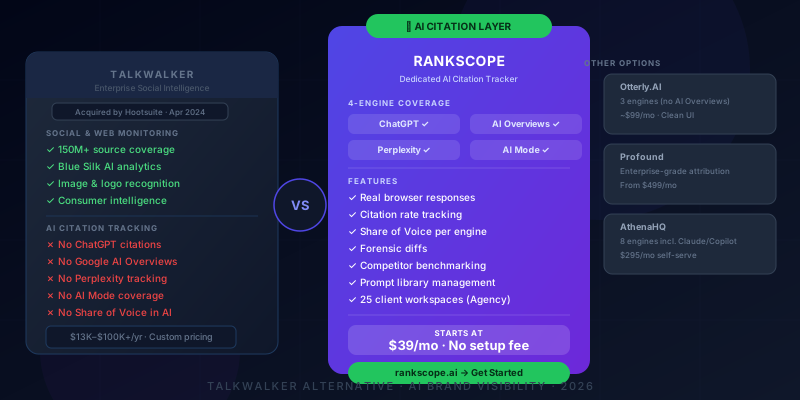
| Feature | Talkwalker (Hootsuite) | RankScope |
|---|---|---|
| Social media listening | ✅ Comprehensive | ✗ Not applicable |
| News & web monitoring | ✅ 150M+ sources | ✗ Not applicable |
| Image & logo recognition | ✅ Visual AI | ✗ Not applicable |
| ChatGPT citation tracking | ✗ Not supported | ✅ Real browser |
| Google AI Overviews | ✗ Not supported | ✅ Real browser |
| Perplexity citation tracking | ✗ Not supported | ✅ Real browser |
| Google AI Mode | ✗ Not supported | ✅ Real browser |
| Share of Voice in AI search | ✗ Not supported | ✅ Per-engine |
| Forensic citation diffs | ✗ Not supported | ✅ Full diff history |
| Competitor AI benchmarking | ✗ Not supported | ✅ Head-to-head |
| Pricing | $13K–$100K+/year | From $49/mo |
The table is stark. These tools don't overlap at all — they monitor completely different channels. An enterprise brand intelligence stack in 2026 genuinely needs both layers.
The Post-Acquisition Factor Worth Understanding
The Hootsuite acquisition of Talkwalker in April 2024 is worth addressing directly, because it's affecting how enterprise teams think about their monitoring stack.
Before the acquisition, Talkwalker competed independently as a premium enterprise listening platform. Hootsuite is primarily a social media management and scheduling tool — a different category with different buyers. Folding Talkwalker into that ecosystem has created questions about product roadmap, whether deep consumer intelligence features will remain a priority, and whether the combined product serves the strategic research use case Talkwalker was known for.
This isn't speculation. Enterprise insights teams that used Talkwalker for quarterly consumer intelligence reports — not daily monitoring — have found that the post-acquisition roadmap leans more toward the social management workflow than the strategic research workflow. Some of those teams are actively looking at alternatives.
If the roadmap concern is your primary driver, the social listening alternatives worth evaluating directly are Brandwatch (deep consumer intelligence, massive historical data, strong for strategic research), Sprinklr (enterprise-grade, complex but comprehensive), Meltwater (PR and media focus), and Digimind (enterprise media and competitive intelligence). Those compete with Talkwalker on its core turf.
But none of them solve the AI citation gap. For that, you still need a dedicated layer.
Why Enterprise Brands in Particular Need AI Citation Tracking
The AI monitoring gap matters for every brand, but it matters most for the large enterprise brands that are Talkwalker's primary customers. Here's why.
Enterprise purchase cycles involve multiple stakeholders. A procurement lead researches shortlists. A VP of Marketing validates market position. A CMO wants to know where the brand stands. Several of those stakeholders are using AI tools to build their understanding — and they're using them specifically because AI search engines are faster than manual research for competitive landscape queries.
AI brand monitoring data shows something counterintuitive: enterprise buyers aren't less likely to use AI search than smaller buyers. They're more likely to. Senior decision-makers use AI tools as research assistants. When they're evaluating three competing platforms, they may start with "which enterprise social intelligence platforms are recommended by large brands?" — and whatever ChatGPT or Perplexity says at that moment shapes the shortlist.
If you're not on that shortlist, it's not because your social media presence is weak. It's because your content, technical structure, and digital footprint don't signal clearly to AI models that you're a credible answer for that category. That's a generative engine optimization problem, and you can't solve a problem you can't measure.
The LLM Monitoring Framework for Large Brands
Enterprise teams building this capability for the first time can approach it in three stages.
Stage 1: Citation baseline. Run your core category and comparison prompts through ChatGPT, Perplexity, Google AI Overviews, and Google AI Mode. Systematically. Record where you appear, where competitors appear, and how the responses describe your product or brand. This is your baseline — the starting point against which you measure improvement.
Stage 2: Competitive intelligence. The most actionable AI monitoring data isn't "are we cited?" — it's "how does our citation rate compare to our three primary competitors, per engine, for our twenty most important prompts?" That relative data tells you where you're winning in AI search, where competitors are outperforming you, and which engines represent the biggest opportunity.
Stage 3: Content and structure optimization. The citation data tells you where the gap is. Closing it requires making your brand more citable by AI — through clear entity definition, factual density in your content, and structured web presence that AI models can retrieve and synthesize accurately. That's the iterative loop of GEO (generative engine optimization).
For enterprise brands with existing Talkwalker deployments, the practical path is clear: add RankScope as an additive layer for AI citation tracking, keep whatever social listening infrastructure is working, and run the two in parallel. The Talkwalker data tells you what people are saying publicly. The RankScope data tells you what AI engines are recommending privately, in the moment buyers are most actively researching.
What the AI Brand Monitoring Stack Looks Like in 2026
The mature brand intelligence stack in 2026 has two distinct layers:
The web and social layer — traditional monitoring covering published, indexed content across social media, news, forums, reviews, and web. Tools like Talkwalker, Brandwatch, Sprinklr, or Meltwater operate here. They're not going anywhere; social intelligence remains essential for reputation management, crisis detection, campaign measurement, and consumer insights.
The AI citation layer — a new monitoring category covering generative answers in ChatGPT, Perplexity, Google AI Overviews, and AI Mode. This didn't exist as a meaningful channel before 2023. By 2026, it's influencing buying decisions at every stage of the funnel for most enterprise categories. Tools like RankScope are built specifically for this layer.
The brands most exposed to AI search right now are those still treating brand monitoring as a single-layer problem. They have excellent coverage of published content and zero coverage of how AI engines describe their brand when buyers ask. The gap between those two layers is where competitive perception is increasingly formed.
The Bottom Line
If you're evaluating Talkwalker alternatives because of pricing, the acquisition, or roadmap concerns, the tools to look at are Brandwatch, Sprinklr, and Meltwater — all competing for the same social and web intelligence use case.
But if the question is "what gives me AI citation tracking?" — none of those answers apply. That's a different category. The leading purpose-built tool for it is RankScope, which covers ChatGPT, Google AI Overviews, Perplexity, and AI Mode with real browser accuracy and forensic diffs.
For enterprise brands already spending five figures annually on social intelligence, adding RankScope's Agency plan at $399/mo is a straightforward call. You're already invested in brand monitoring. The AI citation layer is the part of your stack that doesn't exist yet — and it's the part that's growing fastest.
You can check your AI citation coverage and see what ChatGPT, Perplexity, and Google AI Overviews are actually saying about your brand today.
Start tracking your AI brand visibility →
Frequently Asked Questions
What is the best Talkwalker alternative for AI brand visibility?
RankScope is the best purpose-built alternative for AI brand visibility. It tracks citations in ChatGPT, Perplexity, Google AI Overviews and Google AI Mode using real browser-rendered responses. Starts at $49/mo with no setup fee. For social listening as a direct replacement for Talkwalker's core functionality, Brandwatch and Sprinklr compete in that category — but neither covers AI citations.
Does Talkwalker track AI citations in ChatGPT or Perplexity?
No. Talkwalker monitors published and indexed content — social media, news, forums, reviews, and web pages. AI search engines generate synthesized answers in real time that are never indexed as web pages. Talkwalker's crawling architecture cannot capture them. A dedicated AI citation tracker is required.
Why are companies looking for Talkwalker alternatives in 2026?
Two main reasons. First, Hootsuite's April 2024 acquisition of Talkwalker raised roadmap questions for enterprise insights teams, as the combined product has moved closer to a social management workflow than the strategic consumer intelligence Talkwalker was known for. Second, regardless of the acquisition, Talkwalker has zero AI citation tracking — and as buyers increasingly use ChatGPT and Perplexity for vendor research, that monitoring gap is becoming more significant.
Can I use Talkwalker and RankScope at the same time?
Yes — and for enterprise teams still mid-contract with Talkwalker, this is the practical approach. Talkwalker handles social and web intelligence. RankScope handles AI search citations. The tools monitor completely different channels with zero functional overlap. You can run them in parallel and get a more complete picture of how your brand is perceived across all channels.
How much does Talkwalker cost compared to RankScope?
Talkwalker pricing runs $13,000–$100,000+ annually on custom enterprise contracts. RankScope starts at $49/mo (Starter, 2 engines), $149/mo (Pro, 4 engines, 150 prompts, competitor tracking), or $399/mo (Agency, 25 client workspaces, unlimited competitors). For brands already paying Talkwalker enterprise rates, adding RankScope's Pro or Agency tier adds minimal cost while filling the most significant monitoring gap in most enterprise stacks today.