Digimind has a genuine reputation in enterprise brand intelligence. It covers traditional media monitoring, social listening, competitive analysis, and market research across a massive pool of sources. If your brand intelligence workflow lives in traditional media — press coverage, broadcast mentions, social conversations, forum threads, news cycles — Digimind has earned its place in many large-brand stacks.
But there's a layer of brand intelligence it doesn't touch at all, and it's the layer that's grown fastest in the past two years.
When a procurement manager at a large enterprise searches ChatGPT for "leading brand intelligence platforms for global marketing teams" — Digimind has no way to see that interaction, let alone measure how your brand appeared in the response. When an agency's strategy director asks Perplexity to compare enterprise media monitoring tools before a pitch, that interaction is invisible to Digimind. When Google AI Overviews generate a summary of your competitive landscape at the top of a high-intent search result, Digimind cannot tell you whether you were cited.
That's the gap this post is about.
What Digimind Actually Does Well
Before jumping to alternatives, it's worth being specific about what Digimind is — because the tool has real strengths that aren't the problem here.
Digimind is an enterprise intelligence platform covering:
- Traditional media monitoring — news, broadcast, print, online publications across global sources
- Social listening — real-time monitoring of social media conversations, sentiment tracking, crisis alerting
- Competitive intelligence — tracking competitor coverage, messaging shifts, and share of voice in earned media
- Market research insights — aggregated consumer signals from web and social data
- Influencer and brand reputation monitoring — covering how key voices discuss your brand and category
The platform is built for large teams: enterprise pricing, multi-market support, complex dashboards, and the kind of data richness that PR and comms teams managing global brands actually need.
None of that is going away. AI search isn't replacing social listening, press monitoring, or crisis detection. Those capabilities matter, and Digimind does them well.
The issue is that enterprise brand intelligence in 2026 has a new dimension — and it's one that didn't exist when Digimind's core architecture was built.
The AI Citation Gap in Enterprise Brand Intelligence
Here's what's happened in the past two years: enterprise buyers changed how they research.
Senior marketing leaders, procurement teams, strategy directors, and CMOs have integrated AI tools into their daily workflow. ChatGPT, Perplexity, and Google AI Overviews are now used as research assistants for the same high-stakes queries that used to kick off hours of manual research. And when those stakeholders ask AI tools about vendor landscapes, platform comparisons, or category leaders, the answers they receive directly shape shortlists and buying decisions.
The catch is structural: AI search engines generate synthesized answers in real time. Those responses are never published as indexed web pages. They exist only in the moment someone asks. No crawler can find them. No social listening tool can aggregate them. The entire channel is invisible to monitoring infrastructure built around web crawling and content indexing.
AI brand monitoring for AI-generated answers requires a completely different approach: systematically sending prompts to AI engines, capturing the actual responses using real browser rendering, and measuring brand presence across those responses over time.
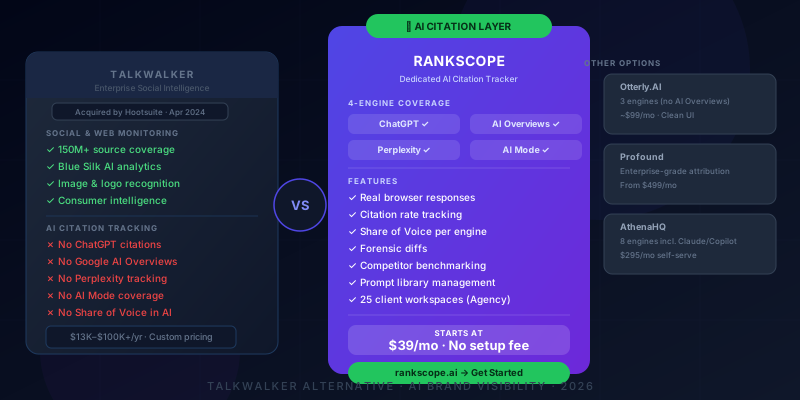
This is what dedicated AI citation trackers do — and what Digimind, Brandwatch, Talkwalker, and every other traditional brand intelligence platform cannot do. The same blind spot applies to competitive intelligence platforms like Crayon and Klue — if your stack includes a dedicated CI tool for tracking competitor web changes, see our Crayon alternative guide for the AI competitive intelligence gap there too.
What Enterprise Teams Are Actually Missing
The stakes are clearest if you think through a real enterprise purchase cycle.
A global consumer goods company is evaluating brand intelligence platforms. A research analyst starts with ChatGPT: "What are the leading enterprise brand intelligence platforms in 2026?" The response surfaces three or four names. Those names become the initial shortlist. Formal vendor evaluation follows — demos, proposals, stakeholder presentations.
If your brand isn't in that initial AI-generated shortlist, you may never get the demo request.
Traditional brand intelligence tools can tell you everything about what happened after you made the shortlist — press coverage of your product, social sentiment, analyst mentions. What they can't tell you is whether you made the AI-generated shortlist in the first place, or what the AI said about you compared to competitors.
AI search visibility — your presence and positioning across AI-generated answers — has become a foundational metric for enterprise brand intelligence. It's not a niche add-on. It's a gap in the data that affects how large buyers discover and evaluate you.
The good news: measuring this layer is straightforward with the right tool. The challenge is that none of the traditional brand intelligence platforms have built it yet.
Best Digimind Alternative for AI Brand Intelligence: RankScope
For enterprise and agency teams who need to add AI citation tracking to their brand intelligence stack, RankScope is the purpose-built tool for that layer.
What RankScope tracks
RankScope monitors brand citations across the four major AI search engines:
- ChatGPT — the AI tool most enterprise buyers use for vendor research and category-level queries
- Google AI Overviews — appearing in 11%+ of all Google searches, now the dominant format for high-commercial-intent queries
- Perplexity — particularly strong with B2B researchers, analysts, and strategy teams
- Google AI Mode — Google's full AI search interface, expanding fast in 2026
For each engine, RankScope tracks:
Citation Rate — the percentage of your tracked prompts that return your brand in the response. This is your baseline metric for AI search presence.
Share of Voice — how your citation rate compares to competitors across the same prompt set. The competitive view is often more actionable than the absolute number.
Position and framing — where in the response your brand appears (leading mention vs. passing reference vs. not mentioned), and how it's described (positive, neutral, negative, qualified).
Forensic diffs — when AI responses change, RankScope flags exactly what changed: did a competitor replace you in the response? Did the framing of your brand shift? This longitudinal tracking is what converts monitoring into actionable intelligence.
Prompt library management — you define the prompts that represent how buyers in your category actually research. Category queries, comparison queries, use-case queries. RankScope runs them systematically, not just once.
Why real browser responses matter
One technical distinction that's worth flagging for enterprise teams evaluating AI citation tools: not all AI monitoring platforms retrieve responses the same way.
Google AI Overviews and Google AI Mode are only available through an actual browser interaction with Google Search. They cannot be retrieved via the Google Search API, which returns classic organic results. Any tool that claims to track AI Overviews via an API integration is either not tracking AI Overviews at all, or is making educated inferences from other data.
RankScope uses real browser-rendered responses — the actual output a user sees when they search in Chrome. This means the AI Overview and AI Mode data is what your buyers actually see, not an approximation. For enterprise teams making budget decisions based on this data, the accuracy difference matters.
RankScope pricing for enterprise teams
The Agency plan at $399/mo is built for teams managing multiple brands or client accounts — up to 25 client workspaces, 5 tracked competitors per workspace, and 200 tracked prompts per workspace. For an agency or a large brand team tracking multiple product lines across competitors, this is the relevant tier.
Starter ($49/mo) and Pro ($149/mo) plans exist for smaller teams and single-brand use cases.
All plans: no setup fee, no annual contract required, cancel anytime.
Compare that to Digimind's custom enterprise pricing — typically five to six figures annually before you've configured anything.
Comparison: Digimind vs. RankScope
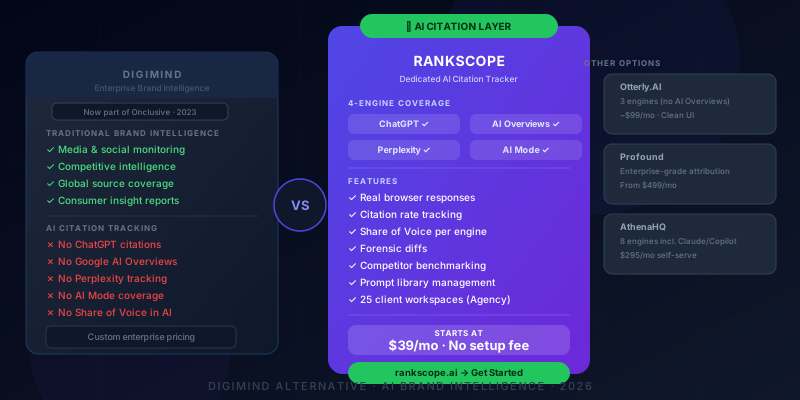
| Capability | Digimind | RankScope |
|---|---|---|
| Traditional media monitoring | ✅ | ✗ |
| Social listening | ✅ | ✗ |
| News and broadcast monitoring | ✅ | ✗ |
| Competitive intelligence (earned media) | ✅ | ✗ |
| ChatGPT citation tracking | ✗ | ✅ |
| Google AI Overviews tracking | ✗ | ✅ |
| Perplexity citation tracking | ✗ | ✅ |
| Google AI Mode tracking | ✗ | ✅ |
| Share of Voice in AI search | ✗ | ✅ |
| Forensic response diffs | ✗ | ✅ |
| Real browser-rendered responses | ✗ | ✅ |
| Pricing | Custom enterprise | From $49/mo |
The table illustrates the core point: these tools don't compete. They monitor different channels. An enterprise brand intelligence stack in 2026 needs both layers — the traditional media and social intelligence layer (where Digimind sits) and the AI citation layer (where RankScope sits). Adding them together is additive, not redundant.
Other AI Citation Tools Worth Considering
RankScope is the strongest option for enterprise and agency teams, but here are the other credible players in the AI citation tracking space:
Otterly.AI
Otterly covers ChatGPT, Perplexity, and Gemini. Clean interface, straightforward setup, around $99/mo at typical usage. The gap: it doesn't track Google AI Overviews or Google AI Mode, which are increasingly the most commercially significant AI citation surfaces. Good option for teams that don't need Google AI coverage specifically.
Profound
Enterprise-grade AI brand attribution, starting around $499/mo. Purpose-built for large brands with complex attribution needs. Strong reporting, deeper analysis, and higher price point. Worth evaluating if your use case requires detailed attribution methodology alongside the citation data.
AthenaHQ
Covers 8 AI engines including Claude and Microsoft Copilot, at $295/mo for self-serve. Broader engine coverage than most competitors. If your buyers use a wider range of AI tools than just ChatGPT and Google products, AthenaHQ's breadth is an advantage.
Peec AI
Entry-level AI search monitoring with a free tier. Good starting point for teams that want to understand the category before committing budget. Less depth than the enterprise options but lower barrier to getting started.
How to Think About Adding AI Citation Tracking to an Enterprise Stack
Enterprise brand intelligence teams evaluating this layer for the first time often ask the same question: where does this fit in our existing workflow?
The answer is simpler than it sounds.
Your existing Digimind deployment handles everything it already handles — social monitoring, press coverage, competitive earned media tracking, crisis alerting. That doesn't change. You're not replacing a system; you're plugging a gap that didn't exist when that system was built.
AI citation tracking runs in parallel. You define a prompt library — the 20 to 50 queries that represent how buyers in your category actually research vendor decisions. Category-level prompts ("best enterprise brand intelligence platforms"), comparison prompts ("Digimind vs. Brandwatch for global teams"), use-case prompts ("how to track brand mentions across global markets"). RankScope runs those prompts against all four major AI engines on a continuous basis and surfaces your citation rate, Share of Voice against named competitors, and any shifts in how the responses frame your brand.
The data feeds into the same brand intelligence workflow. Monthly reports get an AI citations section. Competitor analysis includes how competitors are appearing in AI-generated responses. Brand strategy conversations have a new dimension: not just what people are saying about you, but what AI engines are recommending when buyers ask.
Understanding generative engine optimization (GEO) gives useful context for how the citation layer works and why it's become a distinct discipline from traditional SEO and brand monitoring.
For teams new to the GEO concept, llm-monitoring gives a solid grounding in what systematic AI citation tracking looks like in practice and what metrics matter most.
Who This Post Is Actually For
If you're evaluating Digimind alternatives because you want to replace your media monitoring and social listening at a lower price point — this isn't that post. The tools that compete with Digimind on traditional brand intelligence are Brandwatch (deeper consumer intelligence, strong historical data), Talkwalker (now part of Hootsuite — see our Talkwalker alternative guide), Meltwater (PR and earned media focus), and Sprinklr (enterprise-grade social management).
Those are real alternatives to Digimind for traditional media and social intelligence.
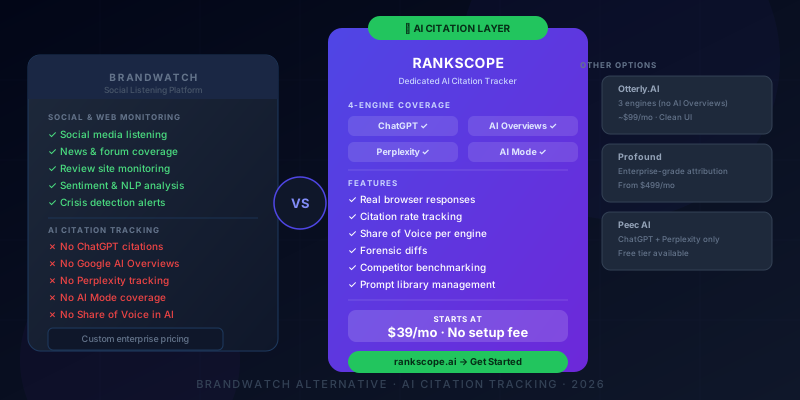
But if the question is whether your current brand intelligence stack covers AI-generated brand recommendations — what ChatGPT says about you when a buyer asks, what Google AI Overviews feature at the top of high-intent searches, what Perplexity surfaces when a strategy director researches your category before a pitch — then Digimind doesn't have a roadmap answer for that. Neither does Brandwatch, Talkwalker, or Meltwater. It's a structurally different problem.
RankScope is built specifically for that layer. It doesn't replace Digimind; it covers what Digimind can't. The AI dimension of enterprise brand intelligence — the one that's grown fastest in the past two years and will continue to grow — is what it exists to measure.
Setting Up AI Citation Tracking Alongside Digimind
For enterprise teams, here's a practical approach to getting the AI citation layer running:
Step 1: Build your prompt library. Start with 20–30 prompts that represent your most important buyer research scenarios. Category-level ("what are the leading enterprise brand intelligence platforms?"), comparison-level ("how does [your brand] compare to [competitor] for global brand monitoring?"), and use-case-level ("best tools for tracking brand mentions across earned and social in multiple markets"). These are your core tracking set.
Step 2: Run a citation baseline. Connect RankScope and run your prompt library across all four engines. The initial results tell you your current state: which engines cite you, in what position, with what framing, and how you compare to the competitors you care about. See our GEO checklist for a structured audit approach.
Step 3: Identify the gaps. The baseline will almost certainly reveal asymmetries — engines where you appear consistently, others where you're missing entirely. Comparison prompts where competitors outperform you. Prompts where the AI description of your brand is inaccurate or incomplete. These gaps are your optimization targets.
Step 4: Cross-reference with your Digimind data. If a competitor is gaining ground in AI citations and your Digimind data shows they're also increasing their share of voice in earned media, that's a coordinated signal. If they're gaining in AI but flat in earned media, they may be doing targeted GEO work that isn't yet showing up in traditional channels. The two data sources complement each other.
Step 5: Track changes over time. The value of any monitoring platform comes from longitudinal data. RankScope's forensic diffs show when AI responses change — which is when the most actionable intelligence surfaces. A competitor appearing in a response that previously featured you, a positive description becoming qualified, or your brand moving from first mention to last mention in a response: these are signals that something has shifted and merits investigation.
The Bottom Line
Digimind is a legitimate enterprise brand intelligence platform. If you're using it for traditional media and social listening, that's a reasonable stack choice.
What it doesn't cover — and structurally cannot cover — is the AI citation layer. The dimension of brand intelligence that measures what AI search engines recommend when buyers in your category are actively researching.
That layer matters most for exactly the enterprise buyer profiles that Digimind serves. Large brands with complex purchase cycles, multiple stakeholders, and buyers who use AI tools as research assistants before they ever fill out a demo form.
RankScope is purpose-built for that layer. Agency plan at $399/mo covers up to 25 workspaces — built for large brands and agency teams managing multiple clients. Get started at app.rankscope.ai — no setup fee, cancel anytime.
The two tools run in parallel. Digimind tells you what's happening in published, indexed media. RankScope tells you what AI engines are recommending in real time. In 2026, enterprise brand intelligence needs both.
Frequently Asked Questions
Is Digimind still a good platform in 2026?
Digimind remains a solid choice for enterprise teams focused on traditional media intelligence, social listening, and competitive monitoring across published and indexed content. Its core product strengths haven't diminished. The gap is a new channel — AI-generated recommendations — that the platform wasn't built to cover and hasn't added.
Can I use RankScope and Digimind together?
Yes, and this is the recommended approach for enterprise teams. They monitor different channels with no functional overlap. Digimind handles social, news, and web intelligence. RankScope handles AI engine citations. Running them in parallel gives you complete brand intelligence coverage across both layers.
What's the fastest way to see if AI citations are affecting my brand?
Set up a free RankScope account or start on the Starter plan, build a 10-prompt library of your most important category and comparison queries, and run an initial scan across ChatGPT, Google AI Overviews, Perplexity, and Google AI Mode. The results will show your current citation rate and — more importantly — where competitors are appearing when you're not. That's usually enough to make the business case for tracking this layer systematically.
How quickly do AI citation results change?
AI engines update their responses as models are updated, as retrieval systems refresh their index, and as content across the web evolves. Changes can happen quickly — days to weeks — or be stable for longer periods. The important thing is continuous monitoring. A single snapshot tells you where you are today; longitudinal tracking tells you whether you're gaining or losing ground, and what changed when shifts occur.