Best Sprout Social Alternative for AI Search Visibility in 2026
Sprout Social is one of the more capable social media management platforms on the market — publishing, scheduling, inbox management, listening, and reporting, all in one place. Marketing teams that rely on it for day-to-day social operations generally have good reason to.
But Sprout Social was built to manage and monitor social platforms. It was not built to tell you whether ChatGPT recommends your brand when a prospect asks for the best tool in your category. That's a separate problem, and as of mid-2026, Sprout has no infrastructure for it at all.
This post covers what Sprout does well, exactly where the AI visibility gap sits, and the best dedicated alternative for closing it.
What Sprout Social Does Well (Honestly)
Before getting into the gap, it's worth being direct about what Sprout Social actually delivers, because that context matters for deciding whether you need a replacement or an addition.
Publishing and scheduling. Sprout's content calendar, bulk scheduling, and approval workflows are genuinely solid for teams managing multiple brands or a busy posting cadence across platforms.
Social listening. Sprout's listening tools scan mentions, hashtags, and keyword conversations across major social platforms, with sentiment analysis and trend detection. For understanding what's being said about a brand on public social channels, this is a real capability, not a checkbox feature.
Unified inbox. Managing comments, DMs, and mentions across Instagram, X, Facebook, and LinkedIn from one interface is one of Sprout's most-used features, particularly for teams with a high volume of customer interaction on social.
Analytics and reporting. Sprout's reporting suite covers engagement, follower growth, post performance, and competitor benchmarking with exportable, presentation-ready reports — useful for teams that need to show social ROI to stakeholders regularly.
Influencer marketing (add-on). Sprout's influencer marketing tools let teams identify, manage, and measure influencer partnerships within the same platform, reducing the need for a separate point solution.
None of this is in question. Sprout is a mature, well-built platform for what it's designed to do: manage a brand's presence and conversations on social media.
What Sprout Social Cannot Do for AI Visibility
Here's the specific and complete list of what's missing, and why each gap matters.
1. No AI citation tracking, on any engine
Sprout's listening tools cover public social platforms and, to a limited extent, the broader web. They do not query ChatGPT, Perplexity, Google AI Overviews, or Google AI Mode and record what those engines say about a brand. This isn't a minor gap in an otherwise-adjacent feature — it's a completely different data source that Sprout's architecture has no path into.
2. No visibility into synthesized answers
This is the structural reason the gap exists, not just a feature Sprout hasn't gotten to yet. Social listening scans published content — posts, comments, articles that already exist somewhere public. An AI-generated answer to "what's the best tool for X" is constructed at the moment someone asks the question. It typically isn't published anywhere a listening tool could crawl. Sprout's entire detection model depends on content existing publicly first; AI answers frequently don't.
3. No Share of Voice in AI-generated answers
Share of voice in AI search — what percentage of all brand mentions across a category's AI answers go to your brand versus competitors — requires reading AI-generated text and comparing brand mentions within it. Sprout has no capability to generate or parse this kind of data.
4. No forensic tracking of AI answer changes
When an AI's answer about a brand changes — a competitor gets added, the characterization shifts — you need to see exactly what changed in the text. Word-level diff tracking of AI responses over time doesn't exist in Sprout, or in any traditional social/PR monitoring platform.
5. No sentiment analysis of AI characterization specifically
Sprout's sentiment analysis is built for social post and comment text. It has no mechanism for evaluating how ChatGPT or Perplexity characterizes a brand within a generated response — a fundamentally different kind of text with different structural patterns than a social post.
The 5 Best Sprout Social Alternatives for AI Search Visibility
1. RankScope — Best Dedicated AI Visibility Layer
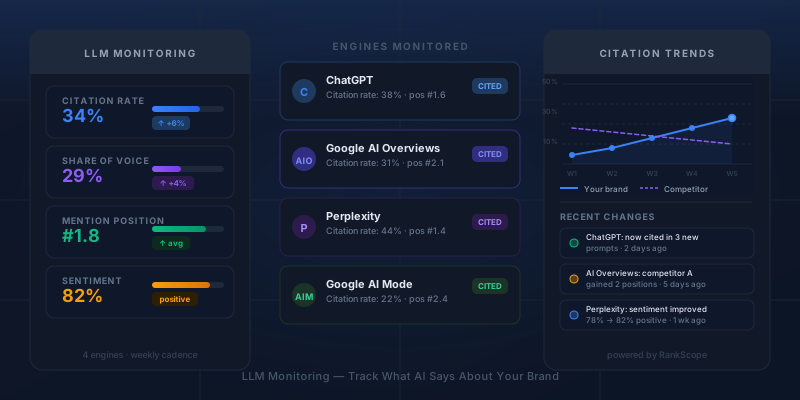
RankScope is purpose-built for generative engine optimization — tracking and improving how AI search engines represent a brand in generated answers. It covers all four major engines: ChatGPT, Google AI Overviews, Perplexity, and Google AI Mode.
The core differentiator versus lighter competitors is that RankScope tracks the full text of AI responses over time using real browser sessions — not API calls, which can return different content than what actual users see, particularly on Google's AI surfaces where responses are personalized and continuously updated. That distinction is what makes RankScope's forensic diff tracking meaningful rather than noisy: word-level change tracking, filterable by engine and date, showing exactly when a competitor got added to a response or when a brand's characterization shifted.
Engine coverage: ChatGPT, Google AI Overviews, Perplexity, and Google AI Mode — the two Google surfaces are where most brands have the largest and least-monitored blind spot.
Share of Voice per engine. For a configured prompt set, RankScope calculates the percentage of AI responses mentioning a brand versus each competitor, broken out per engine — the competitive metric that tells you whether you're gaining or losing ground.
Pricing:
- Starter: $49/month — 2 engines (ChatGPT + AI Overviews), 40 prompts, 3 competitors, 5 manual scans
- Pro: $149/month — all 4 engines, 150 prompts, 10 competitors, 30 manual scans, GA4/GSC/Looker integration, API access
- Agency: $399/month — all 4 engines, 400 prompts, unlimited competitors, 25 client workspaces, white-label reporting
No setup fee, no sales call required.
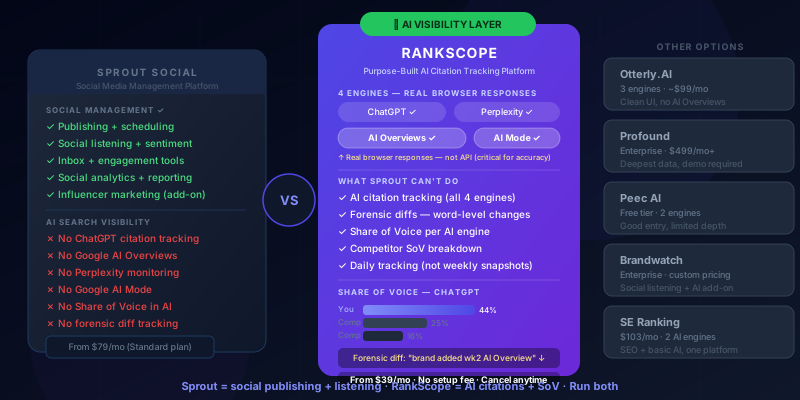
What Sprout still wins on: Everything RankScope doesn't do — publishing, scheduling, unified inbox, social listening across platforms, influencer marketing. These are parallel tools solving different problems, not competing products.
Get started with RankScope → — No setup fee · Cancel anytime
2. Otterly.AI — Best for Reporting-Focused Teams
Otterly has one of the cleanest interfaces in the AI visibility space — easy setup, readable citation trend charts, and automated weekly summaries suited to stakeholders who want the headline number without digging into raw data.
Engine coverage is ChatGPT, Perplexity, and Gemini — no Google AI Overviews or AI Mode, which is a meaningful gap for teams where Google's AI surfaces carry significant search volume.
Where it fits: Teams prioritizing clean executive reporting over deep technical diagnosis, where Google's AI surfaces aren't the primary concern.
Pricing: Starts around $99/month.
3. Profound — Best for Enterprise Requirements
Profound is the most mature enterprise-grade option in AI visibility tracking — built for large brand teams running complex, multi-market monitoring programs with hundreds of custom prompts and deep BI integration needs.
The tradeoff is access: no self-serve trial, and a required sales/procurement process before evaluation. That's a standard enterprise pattern, but a real barrier for growth-stage teams without a large procurement budget.
Where it fits: Large brands and enterprise teams with existing procurement processes and complex multi-market AI visibility requirements.
Pricing: $499/month and up, enterprise pricing on request.
4. Peec AI — Best Free Entry Point
Peec AI offers the only meaningful free tier in the dedicated AI visibility category, covering ChatGPT and Perplexity with basic citation tracking. It's a reasonable way to validate whether AI citation tracking is worth investing budget in before committing to a paid plan.
Limits on the free tier: fewer prompts, no Google AI Overviews or AI Mode, no forensic diffs, no competitive Share of Voice.
Where it fits: Early-stage evaluation or very small teams needing a zero-cost starting point.
Pricing: Free tier available; paid plans from approximately $49/month.
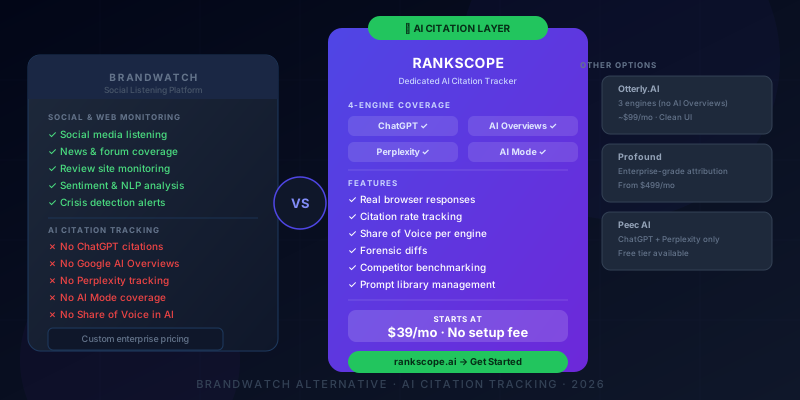
5. Brandwatch — Best If You Need Social + Basic AI Coverage in One Platform
Brandwatch is a market-leading social listening and web intelligence platform that has added a basic AI visibility module. For teams already running Brandwatch for enterprise social/PR monitoring who want AI mention data inside the same platform rather than adding a new tool, this is a reasonable consolidation option — though it's an add-on to a different core product, not a purpose-built AI citation tracker. See the full Brandwatch alternative comparison for a deeper breakdown.
If you're at a large enterprise evaluating premium social intelligence platforms, Talkwalker (Hootsuite) is another option in this tier — though it shares the same AI citation blind spot as Brandwatch.
Where it fits: Enterprise teams already invested in Brandwatch who want AI mention data without adding a separate platform.
Pricing: Custom enterprise pricing.
Sprout Social vs RankScope: The One-Line Summary
| Capability | Sprout Social | RankScope |
|---|---|---|
| Social publishing + scheduling | ✅ Full | ❌ N/A |
| Social listening (public platforms) | ✅ Full | ❌ N/A |
| Unified social inbox | ✅ Full | ❌ N/A |
| Influencer marketing | ✅ Add-on | ❌ N/A |
| ChatGPT citation tracking | ❌ None | ✅ Full |
| Google AI Overviews citations | ❌ None | ✅ Full |
| Perplexity citation tracking | ❌ None | ✅ Full |
| Google AI Mode citations | ❌ None | ✅ Full |
| Share of Voice per AI engine | ❌ None | ✅ Full |
| Forensic diff tracking | ❌ None | ✅ Full |
| Real browser responses (not API) | ❌ N/A | ✅ Yes |
There's no functional overlap here. Sprout Social and RankScope answer entirely different questions about the same brand — which is exactly why the right move is usually addition, not replacement.
Why This Gap Exists Across Social Platforms, Not Just Sprout
Sprout isn't unique here — the same gap exists in Hootsuite, Buffer, Later, and most of the social management category. These platforms were architected to manage and monitor public social content. AI-generated answers are a different kind of content entirely: synthesized on demand, not published, and evaluated by a completely different set of trust signals (training data presence, third-party corroboration, retrieval-time source quality) than what drives social engagement.
Building accurate AI citation tracking — especially for Google's AI surfaces, which require real browser infrastructure to track reliably — is a different engineering problem than crawling social feeds. It's not a surprising gap; it's just a separate category of tooling that most social platforms haven't built and, in the near term, likely won't.
For teams evaluating this decision: keep the social management platform that fits your workflow, and add a dedicated AI visibility layer for the channel it structurally cannot see.
How to Evaluate Any Sprout Social Alternative for AI Visibility
If comparing options beyond what's covered here, these questions cut to what actually matters:
Does it track Google AI Overviews at the citation level? Many tools claim AI coverage but stop at ChatGPT and Perplexity. Google AI Overviews affects a larger share of search traffic for most brands than any other AI surface — a tool without citation-level AI Overviews tracking is missing the most consequential channel.
Real browser responses or API calls? API responses from Google don't reliably match what real users see in their browser, due to personalization and continuous A/B testing. Browser-rendered tracking is more accurate and is a prerequisite for meaningful forensic diff tracking over time.
Forensic diffs, or just a mention count? A mention-rate number tells you the trend is up or down. A forensic diff tells you why — which competitor got added, what characterization changed, which source triggered the shift. Without this, tracking data has no clear path to action.
Engine-level Share of Voice against your actual competitive set? Raw mention counts don't tell you whether you're winning or losing relative to competitors. Share of Voice, calculated per engine, does.
For a broader view of the category, best AI visibility tools for 2026 covers the full landscape in more depth.
The Two-Layer Stack
The cleanest framing for this decision: Sprout Social and RankScope answer different questions about the same brand.
Sprout Social tells you:
- What's being said about your brand on Instagram, X, LinkedIn, and Facebook?
- How is your social engagement trending?
- What's your response time to customer inquiries on social?
- How does your follower growth compare to competitors?
RankScope tells you:
- Is your brand mentioned when someone asks ChatGPT to recommend tools in your category?
- What percentage of Google AI Overviews in your space include your brand?
- What specifically changed in an AI response when your citation rate moved?
- Are you gaining or losing Share of Voice in Perplexity versus a named competitor?
Sprout's Standard plan starts at $79/month per user. Adding RankScope Starter at $49/month means covering both social operations and AI search visibility for a combined cost that's still below most single-platform enterprise SEO tools. See the RankScope pricing page for the full tier breakdown.
The social layer is covered. For most marketing teams currently running Sprout, the AI layer is the one still missing. If your marketing stack also includes HubSpot, the same logic applies — see the best HubSpot alternative for AI search visibility for how the two-tool setup works across the full demand generation stack.
Get started with RankScope → — No setup fee · Cancel anytime
Frequently Asked Questions
What is the best Sprout Social alternative for AI search visibility? RankScope is the best Sprout Social alternative specifically for AI search visibility. It tracks brand citations across Perplexity, ChatGPT, Google AI Overviews and Google AI Mode using real browser-rendered responses, includes forensic diff tracking, and calculates Share of Voice per engine. It starts at $49/month. Sprout Social has no AI citation tracking capability at all — this is an addition to Sprout, not a replacement.
Does Sprout Social have any AI search features? As of mid-2026, no. Sprout covers publishing, scheduling, social listening, and analytics for social platforms — all focused on public social content. There's no feature for monitoring what ChatGPT, Perplexity, Google AI Overviews, or Google AI Mode say about a brand.
Should I cancel Sprout Social if I start using RankScope? No, unless you're not actually using Sprout's core features. If you rely on Sprout for publishing, scheduling, or social listening, there's no reason to cancel — the two tools have zero overlap. Most teams add RankScope alongside Sprout rather than replacing it.
What's cheaper — Sprout Social or its AI visibility alternatives? Sprout Social's Standard plan starts at $79/month per user. Among AI visibility tools, Peec AI has a free tier and RankScope Starter is $49/month — both cheaper than Sprout's entry tier, though they solve a different problem entirely rather than competing on the same feature set.
Can Sprout Social's listening tools pick up AI-generated mentions indirectly? Rarely, and not reliably. If someone screenshots an AI answer and posts it on social media, Sprout's listening tools could catch that secondary post. But this only catches AI answers that happen to get shared publicly — it has no way to systematically query AI engines and check what they say about a brand on demand.