AI Search Monitoring: How to Track Your Brand Across AI Engines
Your brand is being discussed in AI-generated answers dozens of times a day. Buyers ask ChatGPT which tools to use. Google AI Overviews summarize the options in your category. Perplexity synthesizes recommendations from across the web. None of these conversations fire a Google Alert. None of them show up in Search Console. Without active monitoring, you have no idea whether AI engines are recommending you, ignoring you, or misrepresenting you.
AI search monitoring is the practice of fixing that blind spot — systematically tracking what AI engines say about your brand, at what frequency, relative to which competitors, and whether those things are changing over time.
This guide covers exactly how to set it up: what to monitor, what scan cadence to use, how to configure alerts that are actually useful, and — critically — how to convert monitoring data into improved AI visibility. It ends with how RankScope's Signals feature automates the operational layer.
What AI Search Monitoring Actually Is
AI search monitoring means systematically running queries through AI engines and recording what comes back, on a repeating schedule.
That distinguishes it from two adjacent things that get conflated with it:
One-time AI audits. Running your prompts once to take a snapshot of where you stand. An audit tells you your current state; monitoring tells you whether things are getting better, worse, or staying flat — and catches when they change unexpectedly.
Traditional brand monitoring. Tools like Brand24, Brandwatch, and Mention scan the web for published text that mentions your brand. AI-generated answers aren't indexed anywhere — ChatGPT's response to "what's the best tool for X?" doesn't exist as a web page you can crawl. The only way to capture it is to ask the question yourself.
Monitoring is the operational layer on top of an initial audit: same prompt library, same engines, run repeatedly on a schedule, with alerts when things move.
The underlying reason this matters has grown significantly over the past two years. Google AI Overviews now appear on more than 11% of all Google searches. ChatGPT processes over 100 million daily queries. Perplexity grew its user base by more than 300% through 2025. Buyers in almost every B2B category regularly use AI engines to research products before making a decision. A brand that isn't monitoring AI search is operating without visibility into a channel that's directly influencing purchase intent.
For a broader picture of what AI search visibility means as a concept — and why it differs structurally from traditional search rankings — AI search visibility: what it is and how to measure it covers the full framework.
The Four Things Worth Monitoring
Not everything you can measure deserves attention every week. Here are the four signal types that give you actionable data, versus the ones that create noise.
1. Share of Voice
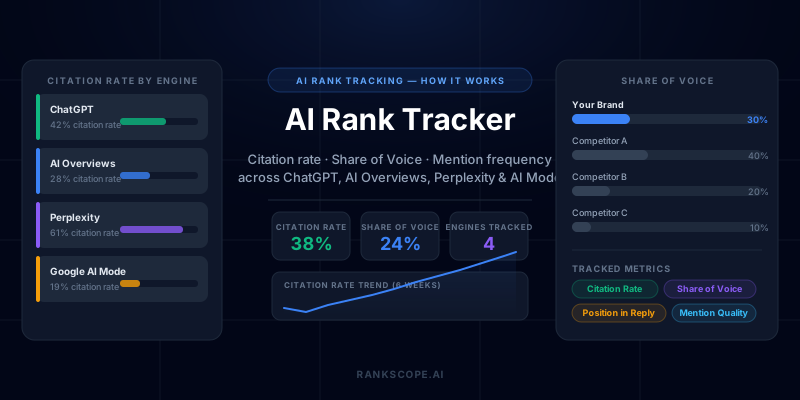
Share of Voice in AI search is your brand's citations as a percentage of all brand citations across your tracked competitor set, for a given prompt set and time period.
Formula: (Your citations ÷ Total citations for all tracked brands) × 100
This is the single most strategically important metric in AI search monitoring. Raw citation rate tells you your absolute performance — how often you appear on a given prompt. Share of Voice tells you your relative performance — how much of the category's AI visibility you own.
A brand with a 25% citation rate sounds decent in isolation. In a category where the market leader holds 70% Share of Voice, that 25% is a distant second. In a fragmented category where no competitor exceeds 15%, a 25% rate is dominant.
Track Share of Voice at the category level (across all prompts) and per prompt cluster. Prompt clusters are groups of queries with similar intent: "best tools for X," "how to solve Y," "compare A vs B." Your Share of Voice may be strong in one cluster and weak in another — that tells you exactly which intent areas need content investment.
For a deep dive on calculating and interpreting Share of Voice per engine and per prompt cluster, see the complete guide to Share of Voice in AI search.
2. Mention Rate (Citation Rate)
Mention Rate is the percentage of times your brand appears when a specific prompt is run multiple times. Also called citation rate.
Formula: (Runs where your brand appeared ÷ Total runs) × 100
This is the foundational metric that everything else rests on. A single check tells you almost nothing — AI engines vary their responses based on session context, model version, retrieval state, and a dozen other factors. Running a prompt 10 times and seeing your brand appear 4 times gives you a 40% citation rate; that's a meaningful signal. Running it once and seeing your brand appear tells you nothing statistically useful.
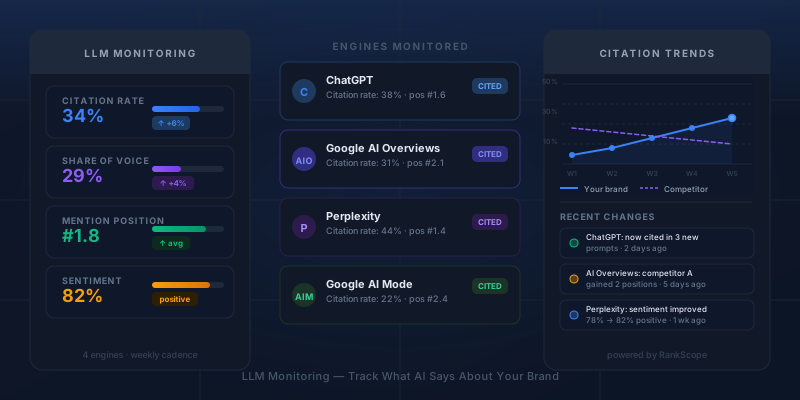
For monitoring purposes, track Mention Rate per prompt and per engine separately. Your Mention Rate in ChatGPT for a given prompt may be entirely different from your Mention Rate for the same prompt in Google AI Overviews. That engine-level granularity is what tells you where to focus optimization effort.
Benchmarks from platform data: citation rates above 30% indicate strong AI visibility. 10–30% means you're present but not dominant. Below 10% is effectively invisible for that prompt. Most brands measuring for the first time find themselves below 5% on most prompts.
3. Competitor Movements
Monitoring only your own metrics misses half the picture. Competitor movements — changes in who appears, how often, and in what position — are often the first signal that something significant has shifted in a category's AI visibility landscape.
Watch for:
- New entrants: Competitors that suddenly appear in responses where they weren't before. This usually signals they've published new content or earned coverage on a third-party source AI engines weight heavily.
- Position gains: A competitor who was consistently cited third or fourth moving to first position. Even without changes in raw citation rate, a position improvement represents a meaningful competitive shift.
- Share of Voice jumps: A competitor's Share of Voice increasing by 10+ percentage points in a single week. This kind of jump is usually traceable to a specific content or coverage event.
- Displacement: When your Mention Rate drops at the same time a competitor's rises, they're displacing you on specific prompts. That's the clearest signal for a targeted competitive gap analysis.
Tracking competitors isn't about obsessing over the competition — it's about understanding the ecosystem your citations exist in. A category where total citations are growing (all brands are being cited more) is a different situation from one where your losses are direct transfers to a competitor.
4. Sentiment Shifts
Sentiment monitoring catches cases where you appear in AI responses but are framed in a way that works against you.
The difference matters:
- "[Brand] is widely regarded as the leading platform for..." — cited positively
- "[Brand] is one option, though users have noted..." — cited neutrally
- "[Brand] has faced criticism for..." — cited negatively
A negative or cautionary framing in an AI-generated recommendation is arguably worse than not appearing at all. A buyer reading a neutral or negative AI summary of your brand may form a worse impression than if they'd found you through their own research.
Sentiment shifts — moving from consistently positive to increasingly neutral framing — are often traceable to specific third-party sources AI engines are drawing on. A recent G2 review update, a comparison article published by a competitor, or a critical piece of press coverage can feed AI citation sentiment within days.
Track sentiment qualitatively at first (positive/neutral/negative per prompt per engine), then look for patterns. If the same prompt consistently generates neutral framing across multiple engines, that's the framing to investigate.
Setting Up Your Monitoring Scope
Before you pick a cadence or set up alerts, you need the right monitoring scope — the set of prompts and competitors you're tracking.
Building a Prompt Library
Your prompt library is the set of queries you run through AI engines to measure your visibility. For monitoring purposes, these should be stable over time — you want trend data on the same prompts, not a constantly shifting set.
Core prompt types for AI search monitoring:
- Category queries: "what are the best [your category] tools?" / "top [your category] platforms in 2026"
- Problem queries: "how do I [specific problem your product solves]?" / "what's the best way to [outcome buyers want]?"
- Comparison queries: "[your category] tools compared" / "[competitor A] vs [competitor B]"
- Use-case queries: "best [your category] tool for [specific use case or team type]"
- Decision queries: "should I use [your category] or [adjacent category]?"
Start with 20–30 prompts. This is enough to get meaningful data without overwhelming your monitoring setup. You can expand to 50+ prompts once you have the operational cadence working.
Resist the temptation to include branded queries ("tell me about [your brand]") in your core monitoring set. Those prompts measure awareness and sentiment for users who already know you, not discovery for buyers who don't. Keep them in a separate sentiment-monitoring cluster.
Selecting Your Competitor Set
Track 3–6 direct competitors alongside your own brand. More than 6 starts producing noisy Share of Voice data that's hard to interpret. Prioritize competitors that:
- Are already appearing in AI responses in your category (confirm this in your initial baseline)
- Target the same buyer profile as you
- Have meaningfully different market positions (not just the closest competitor — include the category leader if that's not you)
Doing a Baseline First
Before you can monitor change, you need a baseline: what's your current citation rate, Share of Voice, and sentiment across your prompt set?
Run your full prompt library through each AI engine, execute each prompt at least 10 times, and record the full data. This is your T0 measurement — the point you compare everything else against.
If you're doing this manually, budget a day or two for the baseline. If you're using an automated tool, this is the initial crawl before your scheduled monitoring starts.
Scan Cadence: How Often to Run Your Monitoring
Cadence is one of the most practically important decisions in an AI search monitoring setup. Too infrequent and you miss fast-moving changes. Too frequent and you burn time on variance rather than real signal.
Weekly Scans — The Baseline for Most Brands
Weekly is the right cadence for most brands running active GEO programs. It gives you enough data points to distinguish real trends from random variance, and the operational overhead is manageable.
At weekly cadence:
- You catch meaningful citation changes within 7 days of them happening
- You build a trend line quickly enough to see directional movement within a month
- Weekly alerts don't create monitoring fatigue
One week's data is still not enough to declare a trend — use 3-week and 4-week rolling averages to smooth out weekly noise when interpreting results.
Daily Scans — For Active Publishing Periods
Switch to daily scanning for two to four weeks after:
- Publishing new blog content, landing pages, or updated service pages
- Earning a significant backlink or press mention
- Making structural changes to your site (new sections, schema markup additions, robots.txt changes)
AI engines can update their citation behavior within days of indexing new content. Daily scanning during these periods lets you see the impact of specific content investments quickly, rather than waiting 30 days for your next weekly comparison.
This is where monitoring transforms from reporting to feedback loop. You publish content, you run daily scans, you see whether citations moved — and if they did, you can identify which specific prompt/engine combinations responded. That's the data that tells you whether your GEO content strategy is actually working.
Hourly/Real-Time — Usually Not Worth It
Unless you're managing brand reputation for a high-profile product launch or a crisis situation, real-time monitoring of AI search adds noise without adding strategic value. AI citation patterns don't typically move on an hourly basis under normal conditions. Save the operational overhead.
Monthly — The Minimum Viable Cadence
For brands not actively running GEO campaigns, monthly scanning is a minimum-viable cadence. It won't catch fast-moving competitive shifts, and it produces trend data slowly — you'll be looking at quarterly trends, not monthly ones. But it's vastly better than no monitoring at all.
If you're just starting to understand your AI search presence and aren't yet investing in optimization, monthly scanning gives you the baseline data to build a business case for more active monitoring.
How to Set Up Useful Alerts
Dashboards require someone to log in and look at them. Alerts bring the important signal to you. For operational monitoring, alerts are more valuable than dashboards.
The key to useful alerts is threshold-based rules — not "tell me when anything changes," but "tell me when a specific metric crosses a meaningful threshold."
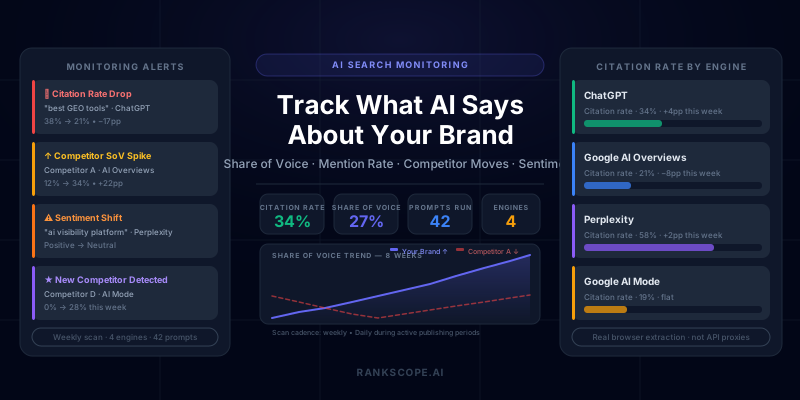
Alert Type 1: Citation Rate Drop
Trigger: Your citation rate on any tracked prompt drops by more than 5 percentage points in a single week.
Why this threshold: Citation rates fluctuate by ±2–3 points week-to-week due to normal AI response variance. A 5-point drop is outside that variance band and indicates a real shift worth investigating.
Action: Run a manual spot-check on the affected prompt and engine combination. Check whether a competitor has gained citations in your place. Review whether your content on that topic has changed, and whether AI crawlers can still access it.
Alert Type 2: Competitor Share of Voice Spike
Trigger: Any tracked competitor's Share of Voice increases by more than 10 percentage points week-over-week.
Why this threshold: A 10-point jump is significant in Share of Voice terms and is almost always traceable to a specific event — a major content publication, a new backlink from an authority site, or a change in how an AI engine weights certain sources.
Action: Identify which specific prompts drove the share shift. Look at what new content the competitor has published recently. Check whether they've been featured in any new third-party roundups or comparison articles that AI engines might be drawing from.
Alert Type 3: Sentiment Degradation
Trigger: Three or more consecutive prompt runs on a key prompt return neutral or negative sentiment when previous runs returned positive.
Why this threshold: Single-run sentiment variance is common. Three consecutive runs in the same direction is a pattern, not noise.
Action: Read the full AI response carefully and identify what framing language shifted. Check for recent third-party content (G2 reviews, comparison articles, press coverage) that might be feeding the changed framing. Look at which cited sources appear in the negative/neutral responses that didn't appear before.
Alert Type 4: New Competitor Appearance
Trigger: A brand that wasn't appearing in your tracked responses appears in more than 20% of runs on a specific prompt.
Why this threshold: A 20% appearance rate on a single prompt in a single week means the competitor has a real citation foothold on that topic, not a one-off appearance.
Action: Research the competitor's recent content on the relevant topic. Identify whether they've published a new page, earned press coverage, or been added to an existing roundup. Assess whether you need to update or create content to compete for that citation.
The Four AI Engines and What Makes Monitoring Them Different
AI search monitoring isn't one-size-fits-all across engines. Each one pulls from different sources, updates at different speeds, and responds to different optimization signals.
ChatGPT
ChatGPT in web search mode (the default for ChatGPT Plus and Teams users in 2026) retrieves live content via Bing. This means your Bing indexing status directly affects whether your content can be cited. New content can appear in ChatGPT search results within days of Bing indexing it.
For monitoring purposes: ChatGPT Search mode citations are the most directly connected to your current content strategy. Changes in citation rate here are often directly traceable to content you've published or updated. Check Bing Webmaster Tools alongside your monitoring data when investigating citation shifts.
ChatGPT also has a non-search mode that draws from training data only — its knowledge cutoff is February 2026 for current GPT-5.6 models. For the most current tracking-relevant behavior, run monitoring queries with search mode enabled.
Google AI Overviews
Google AI Overviews are the most undertracked surface in most AI search monitoring setups, and also the highest-volume. Appearing in 11%+ of all Google searches means billions of impressions daily across your category.
The monitoring complexity: AI Overviews use real browser rendering, and tools that rely on Google's API often return zero AI Overview data because the API doesn't surface them. Accurate monitoring of AI Overviews requires real browser extraction — not API proxy tools. This is a critical differentiator between monitoring tools and one of the most common sources of blind spots in AI search programs.
When monitoring AI Overviews, note that many Overviews cite sources without explicitly naming the brand in the text. Track both text citations and source citations separately — appearing as a cited URL in an Overview has real traffic value even without explicit brand-name mention.
Perplexity
Perplexity does live web crawling with heavy freshness weighting. New content can appear in Perplexity citations within hours of publication. This makes Perplexity the fastest-feedback engine for content investments — if you publish something relevant, Perplexity is often the first place you see the citation.
Perplexity also has the most transparent citation behavior: it shows numbered source links explicitly in every response. For monitoring purposes, track both brand mentions in the response text and whether your domain appears in the cited sources list.
Google AI Mode
Google AI Mode handles multi-turn conversational queries and produces longer, more structured responses than a standard AI Overview. It's increasingly used for complex product research — the kind of extended evaluation process that directly precedes purchase decisions.
For monitoring AI Mode effectively, test multi-turn sequences rather than single queries: "what are the best tools for X?" → "which of those are best for [use case]?" → "what does [your brand] specifically offer?" The citation behavior can differ significantly between the initial query and follow-up questions within the same session.
How to Act on What You Find
Monitoring without action is a reporting exercise. The value of an AI search monitoring program is in the operational response to what you discover.
When Citation Rate Drops
A citation rate drop on a specific prompt is the highest-priority alert. Here's the diagnostic sequence:
-
Check crawlability first. Verify that GPTBot, OAI-SearchBot, and PerplexityBot aren't blocked in your
robots.txt. This is a surprisingly common cause of sudden citation drops — a configuration change or hosting migration that inadvertently blocks AI crawlers. -
Check Bing indexing. For ChatGPT citation drops specifically, verify that your relevant pages are indexed in Bing Webmaster Tools. Google indexing doesn't guarantee Bing indexing.
-
Review the competing response. Who's appearing in your place? What does their cited content cover that yours doesn't? This is the content gap signal that drives your next content investment.
-
Check for recent third-party coverage changes. Have any comparison articles, roundups, or review pages that previously cited you been updated? Have new roundups appeared that don't include you?
For a complete guide to closing citation gaps once you've identified them, the AI rank tracker guide covers the measurement-to-action loop in detail.
When Competitors Gain Share
A competitor Share of Voice jump tells you someone moved. Your job is to find out what they did and whether you need to respond.
Start with their recent content: check their blog for new posts in the past 30 days, look at new pages on their site, run a reverse backlink check for new links from authority sites. Then check the actual AI responses — read what the AI says about them now versus what it said before. Has the framing changed? Are new sources being cited?
Not every competitor gain requires a response. A competitor gaining Share of Voice on a prompt cluster that's not strategically important to you isn't worth diverting resources toward. Focus your competitive response on prompts that drive buyers in your target ICP.
When Sentiment Shifts
Sentiment shifts are often the hardest to act on quickly, because the root cause is usually third-party content you didn't write. The typical sequence:
- Read the full AI response and identify the specific framing that shifted (what's the AI saying now that it wasn't before?)
- Look for the source: check which pages appear in the AI's cited sources for the negative/neutral response
- If the source is a review platform (G2, Capterra, Trustpilot), review what's changed there recently and respond to new reviews
- If the source is a comparison article, reach out to the publisher about accuracy if appropriate
- If the AI is drawing on training data about an old product version or discontinued feature, publish updated content that explicitly addresses the outdated framing
Sentiment monitoring connects directly to your broader brand management work — it surfaces reputational signals from AI engines that wouldn't show up in traditional channels. The guide on how to optimize content for AI search covers the content-level tactics for improving how AI characterizes your brand.
When New Competitors Appear
A new competitor appearing in your tracked responses is the most actionable alert for your content strategy. It tells you:
- A specific topic or query type where you may have a content gap
- What category of competitor is encroaching (adjacent product, new entrant, category redefiner?)
- Whether the new entrant is being cited from their own content, from third-party roundups, or from social/community sources
The right response depends on the citation mechanism. If the new competitor has published strong original content on a specific topic, your response is publishing better content. If they've been added to 10 new comparison roundups, your response is getting onto those same roundups. If they're being cited from community discussions, your response involves building presence in those communities.
The Role of Manual vs Automated Monitoring
For most brands, the question isn't whether to monitor — it's whether to do it manually or automate.
Manual Monitoring: When It Makes Sense
Manual monitoring is appropriate for:
- Initial baselines before investing in tooling
- Small prompt libraries (under 20 prompts)
- Initial brand audits where you're exploring what to monitor
Manual monitoring is not appropriate for:
- Ongoing weekly/daily cadence at any real scale
- Competitive tracking across 4+ competitors and 4 engines simultaneously
- Alert delivery — there's no automated notification for manual checks
The fundamental problem with manual monitoring at scale is the same one that makes a single check statistically useless: you need to run each prompt multiple times per engine to get meaningful citation rates. At 30 prompts × 4 engines × 10 runs each, that's 1,200 manual queries per monitoring cycle, plus the time to record and normalize the data. At weekly cadence, that's a significant ongoing operational cost.
Automated AI Search Monitoring
Automated tools change what's operationally feasible. They run your prompt library on schedule, execute each prompt with sufficient sample sizes, aggregate the citation data, and deliver alerts without human effort per cycle.
When evaluating automated AI search monitoring tools, the criteria that matter most:
Engine coverage. All four major engines should be included: ChatGPT, Google AI Overviews, Perplexity, and Google AI Mode. Tools that cover only two or three have structural blind spots. Google AI Overviews in particular requires real browser extraction to measure accurately — any tool that uses the Google API for AI Overview monitoring is measuring a proxy, not the actual data.
Prompt flexibility. Can you define your own prompt library? Monitoring tools that constrain you to preset keywords miss the prompt-level granularity that makes AI search monitoring actionable.
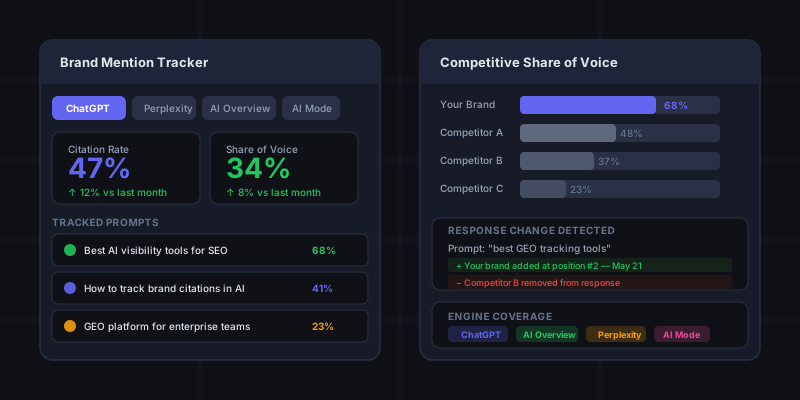
Change detection (forensic diffs). Can the tool show you what changed in an AI response between monitoring cycles — not just that your citation rate changed? The diff view is what makes monitoring a feedback loop: you can see exactly when a competitor was added to a response, or when your brand's framing shifted, or when a new source entered the citation set.
Alert configuration. Can you set threshold-based alerts, or does the tool only offer scheduled reports? Operational monitoring requires real-time (or near-real-time) alerts, not weekly email digests.
Competitor tracking. Share of Voice is relative — you need competitor data alongside your own to interpret your metrics. Single-brand monitoring tools give you an incomplete picture.
For a full comparison of what's available, the guide to AI brand monitoring tools covers the major platforms with honest assessments of each.
Building a Monitoring Workflow Your Team Will Actually Use
The most comprehensive monitoring setup is useless if nobody acts on the data. Here's how to structure an AI search monitoring workflow that stays operational:
Assign a Clear Owner
AI search monitoring data doesn't automatically route to the right person. Assign a single owner responsible for reviewing alerts, triaging action items, and reporting on trend metrics. This is typically a content marketing manager, SEO lead, or brand manager — whoever owns the brand's content strategy.
Triage Alerts, Don't React to Everything
Not every alert requires an immediate response. Create a simple triage protocol:
- Citation rate drop >10pp on a top-priority prompt: Investigate within 48 hours
- Competitor Share of Voice spike >15pp: Investigate within one week
- New competitor appearing on a high-priority prompt: Evaluate within two weeks
- Sentiment shift on a secondary prompt: Review in next monthly analysis
This prevents monitoring from creating constant reactive work while ensuring the highest-priority signals get fast attention.
Connect Monitoring to Content Planning
The most valuable use of AI search monitoring data is feeding your content roadmap. Every citation gap, competitor gain, and sentiment shift is a content signal. Build a standing agenda item in your content planning process: "What did AI monitoring show this month, and what content investments does it suggest?"
This is how monitoring becomes a strategic asset rather than a vanity metrics dashboard. Teams running this loop consistently — monitoring data → content investment → re-monitoring to confirm the result — build compounding AI visibility advantages over time.
RankScope Signals: Automated AI Search Monitoring
RankScope's Signals feature is the automated monitoring layer built specifically for this workflow.
Here's what it does:
Scheduled scanning across all four engines. Signals runs your configured prompt library through ChatGPT, Google AI Overviews, Perplexity, and Google AI Mode on your set cadence — daily, weekly, or a custom schedule. Real browser extraction for AI Overviews and AI Mode ensures accurate data, not API proxies.
Multi-run citation rate calculation. Each prompt is executed multiple times per cycle, automatically averaging to a statistically reliable citation rate. No spot-check variability — you see your real citation rate, not a single-session snapshot.
Forensic response diffs. When an AI response changes — your brand gets added or removed, a competitor's framing shifts, a new source appears in the citation set — Signals shows you exactly what changed and when. You see the before/after diff, not just that a metric number moved.
Competitive Share of Voice tracking. Signals tracks your configured competitor set alongside your brand, calculating real-time Share of Voice per prompt and per engine. You see how the competitive landscape is shifting, not just your own numbers in isolation.
Threshold-based alert delivery. Configure citation rate drop alerts, competitor Share of Voice alerts, and sentiment shift alerts with custom thresholds. Alerts deliver immediately when a threshold is crossed, not on a reporting schedule.
Engine-level breakdown. Every metric is broken down by engine, so you can see that your Perplexity citation rate improved while your AI Overviews rate declined — and investigate the engine-specific dynamics driving each.
RankScope plans that include Signals start at Pro ($149/month — all 4 engines, 150 prompts, full competitor tracking) with Agency plans ($399/month) for multi-brand or client monitoring. Full feature details are on the platform page, pricing details at rankscope.ai/pricing.
Teams that need AI search monitoring at the brand level — tracking how AI describes a product brand specifically — can see how RankScope is built for that use case at RankScope for brands.
Frequently Asked Questions
What is AI search monitoring? AI search monitoring is systematically running queries through AI engines — ChatGPT, Google AI Overviews, Perplexity, Google AI Mode — on a repeating schedule to track how your brand appears in their responses over time. It's the operational layer that turns a one-time AI audit into a continuous feedback loop.
What's the difference between AI search monitoring and AI search tracking? The terms are largely interchangeable in practice. "Tracking" tends to emphasize the measurement side — what are my current numbers? "Monitoring" tends to emphasize the ongoing observation side — are things changing, and am I being alerted when they do? A functional program does both.
How often should I monitor AI search? Weekly is the right baseline for most brands. Switch to daily scans for the first two weeks after publishing new content or making major site changes. Monthly is a minimum-viable cadence for brands not actively running GEO campaigns.
Can I do AI search monitoring without a paid tool? For initial baselines and small prompt libraries (under 20 prompts), manual monitoring is viable. At any serious scale — weekly cadence, 50+ prompts, 4 engines, competitive tracking — the manual operational cost becomes impractical. The multiple-run requirement (10+ runs per prompt for statistical reliability) is particularly expensive to execute manually.
Does Google Search Console cover AI search monitoring? No. GSC tracks clicks from traditional Google search results and some AI Overview interaction data, but it doesn't show you whether your brand is being cited in AI-generated answers. You need dedicated AI search monitoring for citation rate, Share of Voice, and sentiment data.
What engines should I monitor? Prioritize ChatGPT, Google AI Overviews, Perplexity, and Google AI Mode — the four engines that account for the majority of AI-generated brand discovery in 2026. Beyond these, Gemini standalone, Claude.ai, and Grok have meaningful but smaller footprints for most B2B categories.
AI search is already a primary research channel for buyers in most B2B categories. The brands investing in monitoring now are building something that compounds: data that connects content investments to citation outcomes, competitive intelligence on how the AI landscape in their category is evolving, and an early-warning system that catches visibility shifts before they become invisible losses.
The monitoring setup itself is simpler than it sounds. A 30-prompt library, four engines, a weekly cadence, and threshold-based alerts for the four signal types above is a complete operational program. Everything from there is tuning and iteration.
The brands not monitoring are optimizing without feedback — publishing content, making site changes, earning coverage, and having no way to know whether any of it is moving their AI search presence in the right direction.
For teams that already run a traditional competitive intelligence program with tools like Crayon or Klue, AI search monitoring is the missing layer — those platforms track what competitors publish on the web, but they have no visibility into how competitors perform in AI-generated answers. See our Crayon alternative guide for how AI search monitoring complements web-based CI.
RankScope's Signals feature handles the full monitoring workflow automatically — running your prompt library, detecting response changes, tracking competitors, and alerting you when anything moves. Start a free trial at app.rankscope.ai or explore how it works before signing up.