If you're searching for a Mention alternative in 2026, you're probably in one of two very different situations.
The first: Mention's pricing has started to feel like a lot for what it delivers. Agency plans that used to be reasonable now start at $599/mo+. The base plan caps you at 5,000 mentions per month and 2 alerts — limits that hit fast for any brand with meaningful volume. You want the same core functionality at a price that doesn't make your quarterly review awkward.
There are plenty of tools in that lane: Brand24, Awario, Mention's own lower tiers. That's a legitimate shopping exercise.
The second: you're using Mention, it's doing its job, but you've started to notice something it can't explain. Your buyers mention doing research on ChatGPT before hopping on discovery calls. A competitor keeps showing up in AI-generated answers and you're not. Someone on your team Googled your product category and got an AI Overview that listed three competitors — none of which was you. Mention's real-time alerts show nothing, because none of that conversation is indexed on the web.
This post is primarily for the second group. If Mention is your social monitoring tool and you're wondering what fills the AI citation gap, that's what we're covering here.
What Mention Actually Does Well
Let's be straight about this: Mention is a genuinely decent tool for what it was designed to do. It monitors brand mentions across social media (Twitter/X, Instagram, Facebook, Pinterest, Reddit, YouTube), news sites, blogs, forums, and some review platforms. It has Boolean search operators for precise query building, near-real-time alerts, sentiment analysis, automated report templates, and a clean interface that doesn't require a learning curve.
For SMBs, agencies with multiple clients, and PR teams that need to catch brand mentions before they become crises, Mention handles the basics reliably. The agency plan's multi-account management is genuinely useful for marketing agencies tracking many brands simultaneously. The alert system is fast.
For basic brand monitoring — knowing when someone publishes something about you on the public web — Mention works.
The problem isn't what Mention does. It's what it structurally cannot do, and in 2026, that gap has become the most important monitoring blind spot in the market.
The AI Citation Blind Spot
Mention's architecture works on a fundamental assumption: brand mentions exist somewhere as published text on the internet. Someone tweets about you, a journalist writes a story, a Reddit thread mentions your product — Mention crawls for it, finds it, and alerts you.
AI search engines have broken that assumption entirely.
When someone types "what's the best brand monitoring tool for a small marketing team?" into ChatGPT, the response is generated in real time by a language model drawing on training data and, in some configurations, live web retrieval. That synthesized answer is never published anywhere as an indexed web page. It exists only in the session where the question was asked. Mention's crawler has nothing to find — not because Mention is missing coverage, but because there is literally no indexed content to crawl.
The same applies to every major AI search surface in 2026. Google AI Overviews appear above the traditional results on roughly 11% of all Google searches, generating a summarized answer that is rendered on-the-fly from Google's systems. Perplexity produces cited, synthesized answers that are the response — there's no separate article to index. Google AI Mode functions similarly, with AI-generated answers that replace the traditional results page for many queries.
Every one of these surfaces is completely invisible to Mention. Not partially covered. Not "beta coverage coming Q4." Completely invisible, by architecture.
This isn't a knock on Mention's engineering team. It's a structural property of how web crawling works versus how AI search monitoring works. The question for your team is whether that gap matters for your business — and in most B2B categories in 2026, it does.
Why This Gap Is Hitting Mention Users Hard Right Now
The timing is awkward for Mention users specifically, for two reasons.
First, Mention's pricing restructure in 2025 pushed agency plans significantly higher. Teams already doing the math on whether $599/mo is justifiable are simultaneously discovering that Mention has zero coverage of the fastest-growing brand discovery channel. That combination — rising cost, new monitoring gap — is prompting a lot of re-evaluation.
Second, Mention's core customer profile maps almost exactly onto the audience most affected by AI search. SMB and mid-market marketing teams. Agency teams managing multiple client brands. PR teams doing reputation monitoring. These are precisely the people whose buyers are using ChatGPT and Perplexity to generate vendor shortlists before doing any other research. If Mention is your monitoring backbone and AI search is where your buyers start, you have a real problem.
The data context matters here. Google AI Overviews now appear in over 11% of all Google searches, concentrated in high-commercial-intent categories. ChatGPT has surpassed 200 million weekly active users. Perplexity usage in B2B research contexts has grown consistently throughout 2025 and 2026. These are not niche channels.
If your brand is actively recommended in AI-generated answers when buyers ask about your category, that's influencing consideration and pipeline before anyone visits your website, reads your reviews, or encounters the social content that Mention monitors. If you're not being recommended — and your competitors are — that's a leak in your funnel that Mention's data will never surface.
What AI Citation Tracking Actually Measures
Before we get to alternatives, it's worth being clear about what AI citation tracking actually does — because it's genuinely different from anything in the traditional brand monitoring stack.
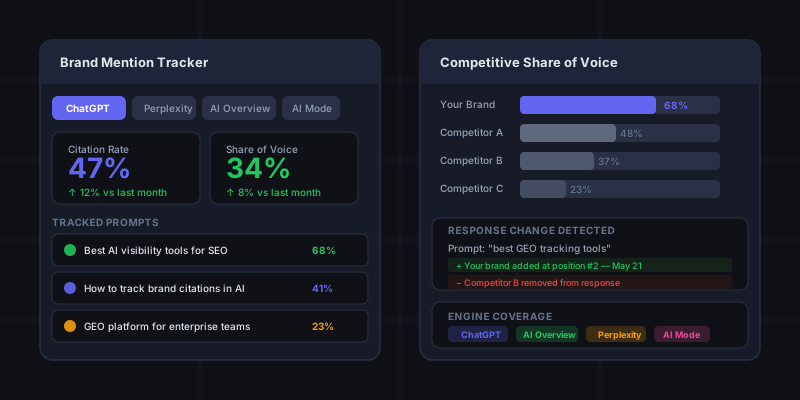
An AI citation tracker systematically queries AI search engines with prompts that reflect how buyers in your category actually research decisions. Not "mention [your brand name]" queries — those will obviously find you. Category-intent queries: "what's the best [product category] for small teams?" or "compare [your brand] vs [competitor]" or "what tools do [your ICP persona] use for [use case]?" The tracker records whether your brand appears in the response, where it appears, how it's described, and how your visibility compares to competitors — across each AI engine separately.
Over time you get:
- Citation rate — the percentage of relevant prompts where your brand appears
- Share of Voice — your citations vs competitor citations on the same prompt set
- Position in response — are you the first brand mentioned, or fifth in a list?
- Engine-specific data — ChatGPT, Perplexity, AI Overviews, and AI Mode often give very different results for the same query
- Forensic diffs — when your citation status changes, what specifically changed in the response?
None of these metrics exist in Mention. None of them exist in any traditional social listening or web monitoring tool. They require direct, systematic interaction with AI engines — and crucially, the results are only accurate if you're using real browser-rendered responses, not API outputs. This matters especially for Google AI Overviews and AI Mode, which can only be retrieved accurately by loading an actual browser in Google Search. Tools that query Google via API show different (often incorrect) AI Overview data.
This is the monitoring layer that fills the gap Mention leaves.
Best Mention Alternative for AI Brand Monitoring
1. RankScope — Best for AI Citation Tracking (Recommended)
Starts at $49/mo. No setup fee. Cancel anytime.
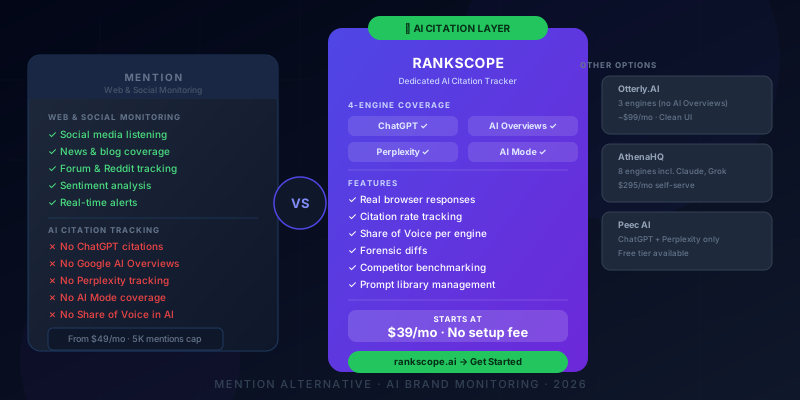
RankScope is purpose-built for the problem Mention can't solve: tracking whether your brand appears in AI-generated answers across the four AI search engines that matter in 2026 — ChatGPT, Google AI Overviews, Perplexity, and Google AI Mode.
The technical differentiator that matters most is real browser rendering. RankScope retrieves AI Overviews and AI Mode results by loading actual browser sessions against Google Search — not by hitting an API. Most competitor tools that access Google via API show inaccurate or incomplete AI Overview data because the API returns different results from what a real user sees. RankScope shows you what your buyers actually see.
What RankScope tracks:
- Brand citations across ChatGPT, Perplexity, and both of Google's AI surfaces, AI Overviews and AI Mode
- Citation rate per engine over time — is your AI visibility improving or declining?
- Share of Voice vs competitors on matched prompt sets
- Position in response — first mention vs buried in paragraph five
- Forensic diffs — exactly what changed in the AI response when your citation status shifted
- Prompt library management — build the query set that reflects your buyers' actual research behavior
For teams asking "why did we stop showing up in ChatGPT answers last month?" forensic diffs are the feature that answers it. That level of diagnostic capability is unique to RankScope in the current market.
Pricing:
- Starter: $49/mo — 2 engines, 40 prompts, 3 competitors
- Pro: $149/mo — 4 engines, 150 prompts, 10 competitors, GA4/GSC integrations
- Agency: $399/mo — 4 engines, unlimited competitors, 25 client workspaces
To put this in context: a Mention Solo plan is $49/mo and gives you 5,000 mentions/month and 2 alerts, with no AI tracking. A RankScope Starter at $49/mo gives you systematic AI citation tracking across 2 engines. For teams paying $199/mo for Mention ProPlus and getting zero AI visibility data, adding RankScope Pro at $149/mo fills the entire gap for a combined spend still below what Mention's agency tier costs.
RankScope is the right choice if: you need dedicated AI citation tracking with real browser accuracy, forensic diffs, and all four major AI engines in one platform. If you already use Mention for web/social listening, RankScope is the additive layer — the two tools cover completely different monitoring surfaces.
RankScope limitations: It doesn't do social listening, web monitoring, or traditional brand mention tracking. If you need those capabilities, Mention or a social listening alternative still belongs in your stack alongside it.
2. Otterly.AI — Best for Clean UI and Quick Setup (~$99/mo)
Otterly is a solid AI citation tracker with a clean, intuitive interface that makes it easy for teams to pull reports without a lot of configuration overhead. It covers ChatGPT, Perplexity, and Gemini.
The key limitation for 2026: Otterly misses Google AI Overviews and Google AI Mode. With AI Overviews now appearing in 11%+ of all Google searches, and AI Mode expanding its rollout, that's a meaningful coverage gap for brands whose buyers use Google heavily.
Otterly is a good option if: you prioritize ease of use over maximum engine coverage, and Google isn't your primary buyer-research channel.
3. AthenaHQ — Best for Multi-Engine Coverage ($295/mo)
AthenaHQ covers eight AI engines — ChatGPT, Perplexity, Gemini, Claude, Copilot, Grok, and others — making it the broadest coverage platform in the market. It has strong ratings (4.9/5 on G2) and bundles AI content optimization with tracking.
The price point ($295/mo self-serve) sits comfortably between RankScope Pro and Profound. If you need broader engine coverage beyond the core four, or you want content optimization tooling bundled with monitoring, AthenaHQ is worth evaluating.
AthenaHQ is a good option if: multi-engine coverage past the main four matters for your audience, or you want tracking and content optimization in the same platform.
4. Profound — Best for Enterprise-Grade AI Attribution ($499/mo+)
Profound is the enterprise play in the AI citation monitoring space. It goes deep on attribution — connecting AI citations back to business outcomes, tracking citation sentiment across Claude, Perplexity, ChatGPT, and others, with white-glove onboarding and executive-level reporting.
The price point means it's positioned for large enterprise marketing teams that need to justify AI monitoring investment at the CMO or CFO level. If your team is currently at Mention's agency tier ($599/mo+) and you're evaluating an AI-first replacement, Profound is worth including in your shortlist.
Profound is a good option if: you're enterprise, you need deep attribution and custom reporting, and budget isn't the binding constraint.
5. Peec AI — Best Entry Point for Testing (Free Tier Available)
Peec AI offers a free tier covering ChatGPT and Perplexity that lets you get a baseline on AI citation coverage without any financial commitment. It's the right starting point for teams that want to see what AI citation tracking surfaces before committing to a paid platform.
The limitation: Peec AI doesn't cover Google AI Overviews or AI Mode, and the data depth at free tier is limited. It's a proof-of-concept tool, not a production monitoring stack.
Peec AI is a good option if: you want to validate whether AI citation tracking is worth investing in before committing to a paid plan.
Mention vs RankScope: Side-by-Side
| Feature | Mention | RankScope |
|---|---|---|
| Social media monitoring | ✅ Twitter/X, Instagram, Facebook, Reddit | ✗ Not applicable |
| Web/news/blog monitoring | ✅ Real-time alerts | ✗ Not applicable |
| Forum monitoring | ✅ (higher plans) | ✗ Not applicable |
| ChatGPT citation tracking | ✗ Not supported | ✅ Real browser |
| Google AI Overviews | ✗ Not supported | ✅ Real browser |
| Perplexity citation tracking | ✗ Not supported | ✅ Real browser |
| Google AI Mode | ✗ Not supported | ✅ Real browser |
| Share of Voice in AI search | ✗ Not supported | ✅ Per-engine |
| Forensic diffs | ✗ Not supported | ✅ Full diff history |
| Citation rate trend tracking | ✗ Not supported | ✅ Over time |
| Pricing | From $49/mo (5K mentions, 2 alerts) | From $49/mo (2 engines, 40 prompts) |
The table is fairly stark. These tools solve different problems. Mention gives you a monitoring view into the published, indexed web — social, news, blogs, forums. RankScope gives you visibility into AI-generated answers — the channel that's increasingly where buying decisions start.
A complete brand monitoring stack in 2026 needs both layers.
The Channel That Forms Opinions Before the Web Does
Here's the thing that makes AI citation monitoring genuinely urgent for most marketing teams: it's not competing with social listening. It's capturing a completely different moment in the buyer journey.
When someone Googles your brand or your category, and Mention picks up coverage from that search's resulting articles and social conversations, that's the middle-to-late stage of awareness. By the time a journalist writes about your product or a Reddit thread starts discussing your category, the AI-generated shortlist has already formed in your buyer's head.
The sequence increasingly looks like this: buyer has a problem → asks ChatGPT or Perplexity "what are the best tools for [use case]?" → gets a 3–5 brand shortlist from AI → does targeted research on those specific brands → Googles, reads reviews, checks social → makes a buying decision.
Mention monitors everything from step three onward. The decision about which brands make the shortlist — step two — is invisible to it. AI citation tracking is the only monitoring layer that sees step two.
This is also why AI brand monitoring has become a two-category market. You need traditional social/web listening for reputation management, crisis detection, and community engagement. You need AI citation tracking for brand discovery and consideration monitoring. Most teams thinking about a Mention alternative are actually realizing they need to add a category, not just swap a tool.
If You're Looking for a Direct Mention Social Listening Replacement
If your primary reason for evaluating Mention alternatives is the pricing or feature gaps in its social monitoring product — not the AI tracking question — there are a few tools worth comparing directly:
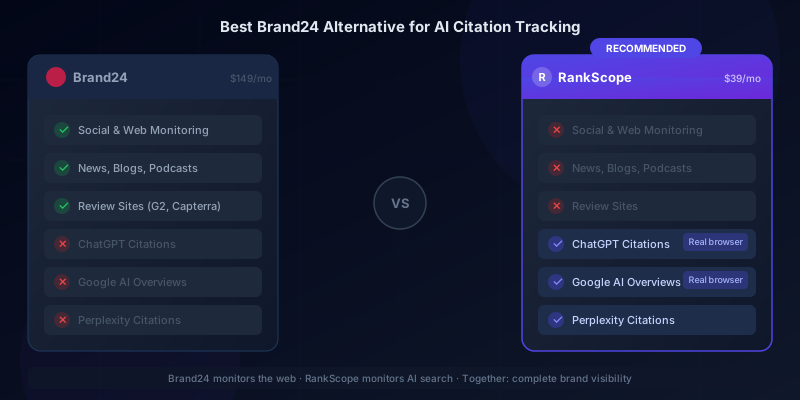
Brand24 ($149–$349/mo) is the most direct comparable. It covers social, news, blogs, podcasts, and review sites. Historical data goes back further than Mention's on most plans. The AI Insights feature helps surface trends in mention data. Brand24 also has the same AI citation blind spot as Mention, but as a traditional social listening replacement, it's the most natural upgrade path.
Awario ($29–$249/mo) is a solid lower-cost option for web and social monitoring, particularly popular for Reddit tracking. No AI citation tracking.
Talkwalker (enterprise pricing) is the premium social intelligence platform — significantly more expensive than Mention but with a corresponding depth of data, consumer intelligence analytics, and 150M+ source coverage.
For teams whose primary issue is Mention's pricing or its monitoring gaps on standard channels, Brand24 is usually the simplest path. For teams who've realized the real gap is AI search visibility, RankScope addresses something none of these alternatives can.
Combining Mention-Style Monitoring With AI Citation Tracking
Adding AI citation tracking to an existing social listening setup is straightforward — the platforms don't compete. Here's a practical starting point:
Step 1: Build your prompt library. Identify 20–30 queries that represent how buyers in your category research decisions. Category queries ("best brand monitoring tools for agencies"), comparison queries ("Mention vs Brand24"), use-case queries ("how to track brand mentions in real time"). These become your AI tracking prompt set.
Step 2: Run a baseline. Before you do anything else, establish where you currently stand in AI-generated answers. Run your prompt library manually through ChatGPT, Perplexity, and Google AI Overviews — or use RankScope to automate this. Record citation rate, position, and how you're described.
Step 3: Map the competitive landscape. Add 3–5 competitors to your tracking prompt set. Relative data — your Share of Voice vs theirs — is usually more actionable than absolute citation rate numbers.
Step 4: Set a monitoring cadence. AI engine responses shift as models update and web content evolves. Weekly or bi-weekly automated monitoring gives you trend data without manual overhead. RankScope handles this automatically and flags when responses change.
Step 5: Connect to content. When you appear in AI responses, look at what content drove that citation. When you don't appear, forensic diffs show you what changed. That feedback loop is how you improve your AI search visibility over time.
For teams who've been running on Mention for brand reputation and social listening, this is purely additive — you're not changing your existing workflow, you're adding a monitoring layer for a channel Mention structurally can't see.
To understand how this fits into a broader LLM monitoring framework — including the full metrics hierarchy and how to set up systematic AI search monitoring — that guide walks through the methodology in depth.
The Bottom Line
Mention is a legitimate brand monitoring tool with genuine strengths in social and web listening. If your primary issue is the pricing or feature set on Mention's social monitoring side, Brand24 is the most natural alternative in the same category.
But if the question you're actually asking is "how do I see what AI search engines say about my brand?" — neither Mention nor any of its traditional social listening competitors are part of that answer. That's a different category entirely, and the purpose-built tool for it is RankScope.
The economics work out reasonably too. If you're paying Mention's agency rates ($599/mo+) and getting zero AI monitoring visibility, adding RankScope at $49–$149/mo doesn't just fill the gap — it does it for less than most Mention plan upgrade costs. If you're on Mention's Solo or Pro plan for social listening and you want to add AI citation tracking, the combined spend is manageable.
The more important point is strategic. AI-generated answers are forming brand shortlists before buyers do any web research, read any articles, or encounter any social content. That's the channel Mention can't see. Whether you use Mention, Brand24, or any other web monitoring tool for the traditional layer, you need a dedicated AI citation tracker for the new one.
You can check your current AI citation coverage for free and see what ChatGPT, Perplexity, and Google AI Overviews are actually saying about your brand right now.
Frequently Asked Questions
What is the best Mention alternative for AI brand monitoring?
RankScope is the best Mention alternative for AI brand monitoring. It tracks brand citations on ChatGPT, Perplexity and Google's two AI surfaces using real browser-rendered responses — exactly what your buyers see. Starts at $49/mo with no setup fee. For traditional social/web listening as a Mention replacement, Brand24 ($149/mo) is the most direct comparable.
Does Mention track AI citations in ChatGPT or Perplexity?
No. Mention monitors social media, news, forums, and web publications — content that is published and indexed. AI search engines like ChatGPT, Perplexity, Google AI Overviews, and Google AI Mode generate synthesized answers in real time. Those responses are never indexed as web pages, so Mention's crawling architecture cannot capture them. A dedicated AI citation tracker like RankScope is required for that monitoring layer.
Why is Mention so expensive now?
Mention restructured its pricing in 2025. The Solo plan starts at $49/mo (capped at 5,000 mentions/month, 2 alerts), Pro is $99/mo (10,000 mentions, 5 alerts), ProPlus is $199/mo, and agency plans start at $599/mo. Many teams find the lower tiers hit their mention caps quickly, while the agency tier is priced significantly above comparable social listening tools like Brand24. The pricing increase is one of the primary reasons teams are actively evaluating alternatives in 2026.
Can I use Mention and RankScope together?
Yes — and for most marketing teams, this is the recommended setup. Mention handles social media and web mention monitoring. RankScope handles AI search visibility. The two tools solve different problems and have near-zero functional overlap. Most teams running both pay around $89–$248/mo combined depending on Mention plan, with RankScope at $49–$149/mo.
What's the cheapest way to get AI citation tracking?
Peec AI offers a free tier covering ChatGPT and Perplexity — it's the lowest-cost entry point for testing AI citation tracking. For production monitoring across all four major AI engines (including Google AI Overviews and AI Mode), RankScope Starter at $49/mo is the most affordable option with meaningful coverage. Otterly.AI is approximately $99/mo for ChatGPT, Perplexity, and Gemini without Google AI Overviews.