ChatGPT SEO Tool: How to Track & Optimize Your Brand in ChatGPT Search
ChatGPT crossed 200 million monthly active users in 2025. By 2026, it's a primary search interface for a meaningful slice of informational and commercial queries — the same queries that used to flow entirely through Google.
When someone asks ChatGPT "what's the best project management software?" or "which AI visibility tool should I use?" or "compare Salesforce and HubSpot," ChatGPT generates an answer. It names specific products. It makes recommendations. It shapes buying decisions.
And for most brands, that process is completely invisible. They have no idea whether they're being cited. No idea what ChatGPT says about them when it does. No idea how they compare to competitors in those responses.
This guide covers two distinct things that both get called "ChatGPT SEO tools":
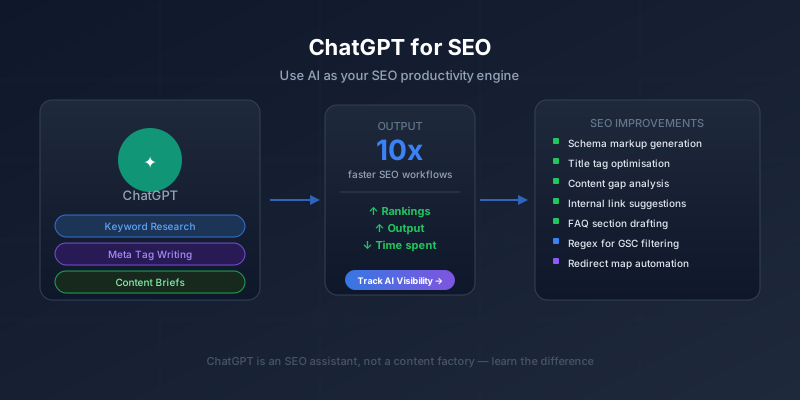
- Using ChatGPT as a productivity tool for SEO work — writing briefs, clustering keywords, generating schema markup
- Tracking and optimizing your brand's appearance in ChatGPT's responses — the citation tracking and GEO problem
The second one is where most teams have a blind spot. We'll cover both, but spend more time on the gap.
What Is ChatGPT as a Search Engine?
ChatGPT's search behavior has evolved significantly. It's no longer just a text generator — it's functioning as a primary research and decision-making interface for millions of users.
What makes ChatGPT different from Google as a search surface:
- Synthesized answers, not links. ChatGPT generates a direct answer that names specific brands, products, and services. There's no list of 10 blue links — there's typically a recommendation of 3-5 options with brief context on each.
- Conversational refinement. Users follow up, ask for comparisons, narrow by use case or budget. Each turn shapes the brand recommendations they receive.
- No clear ranking signal. You can't check "ChatGPT position 1" the way you can for Google. It's probabilistic — ChatGPT may recommend you in 70% of relevant queries and not in 30%, and that ratio changes as the model updates.
- Training data and citations. ChatGPT's recommendations are shaped by what it was trained on: third-party reviews, comparison articles, forum discussions, press coverage, and content on your own site. Getting cited in those sources is how you influence its recommendations.
For brands, the implications are direct: if your category has high purchase intent and buyers use ChatGPT to research options, your ChatGPT citation rate is a revenue metric.
Part 1: Using ChatGPT as an SEO Productivity Tool
This is the well-documented half. ChatGPT is genuinely useful for speeding up SEO workflows. A few practical applications:
Keyword clustering and intent mapping
Paste a list of keywords into ChatGPT and ask it to cluster them by search intent and topic. It handles this well and saves significant time compared to manual clustering. Example prompt:
"Cluster these 50 keywords by search intent (informational, commercial, transactional) and group related topics together: [keyword list]"
Content brief generation
Given a target keyword and a brief description of your product, ChatGPT can generate a solid content brief — suggested H2s, key questions to answer, entities to mention. It's not a replacement for SERP analysis, but it's a fast starting point.
Schema markup generation
Paste your FAQ section or How-To guide and ask ChatGPT to generate the corresponding JSON-LD schema markup. It does this accurately for most schema types and saves the manual coding.
Internal linking suggestions
Give ChatGPT your sitemap or list of published posts and ask it to suggest internal linking opportunities for a specific new post. Useful for finding logical link paths you might miss.
Meta description and title tag variants
For bulk metadata work, ChatGPT can generate 3-5 variants of title tags and meta descriptions for a given page. You review and select; it handles the drafting.
The honest limitation: ChatGPT's knowledge cutoff means it can't pull live SERP data, check your current rankings, or tell you what's actually ranking for a keyword today. For anything that requires real-time search data, you still need a dedicated SEO platform.
Part 2: Tracking and Optimizing Your Brand in ChatGPT
This is where most teams have a gap — and where the real opportunity is in 2026.
Does ChatGPT mention your brand?
The fastest way to find out: open ChatGPT and ask the questions your buyers actually ask. For a SaaS product:
"What are the best [your category] tools in 2026?" "Compare [your category] options for [your target buyer]" "What should I use for [use case your product solves]?"
If your brand appears consistently in the first 1-3 responses: you have a healthy ChatGPT presence. If you appear occasionally or not at all: you have a GEO problem.
The issue with manual checking: it's inconsistent. ChatGPT's responses are probabilistic — the same prompt can return different results. You'd need to ask dozens of variants across dozens of prompts to get a statistically meaningful picture. And you'd need to do it daily to catch changes.
That's why dedicated ChatGPT SEO tracking tools exist.
How ChatGPT citation tracking works
Tools like RankScope automate the process of tracking your brand across ChatGPT's responses at scale:
- You define the prompts — the questions your buyers ask that should trigger your brand as a recommendation
- The tool queries ChatGPT daily across those prompts, capturing the full response text
- Citation detection identifies whether your brand appears, where it appears in the response, and how it's described
- Forensic diffs show you exactly when a response changes — if ChatGPT stops recommending you after a competitor publishes a new comparison page, you see the before/after
- Share of voice tracks your citation rate versus named competitors across all your tracked prompts
The output is actionable: you know your ChatGPT citation rate, what your competitive SoV looks like, and you get an alert when something material changes.
What actually moves your ChatGPT citation rate
ChatGPT's training data determines who it recommends. The practical levers:
Third-party coverage. ChatGPT heavily weights third-party review sites, comparison articles, and forum discussions. Being listed and reviewed on G2, Capterra, Product Hunt, and TrustRadius directly feeds into its training data. More reviews, better ratings, more mentions in "best X for Y" articles = higher citation probability.
Comparison content. When other sites publish "[Your category] alternatives" or "[Competitor] vs [Your brand]" comparison posts, and they include you with positive framing, that content trains ChatGPT to recommend you in comparison queries.
Your own content, structured correctly. Clear, entity-rich content on your site that directly answers the questions buyers ask — with your product name, use cases, pricing, and competitive positioning stated plainly — gets picked up as training data. Schema markup (especially FAQ schema) helps signal the structure.
Authoritative citations. When well-regarded publications in your industry mention your brand in context — TechCrunch, industry newsletters, analyst reports — that builds the authority signal ChatGPT uses to determine whether you're worth recommending.
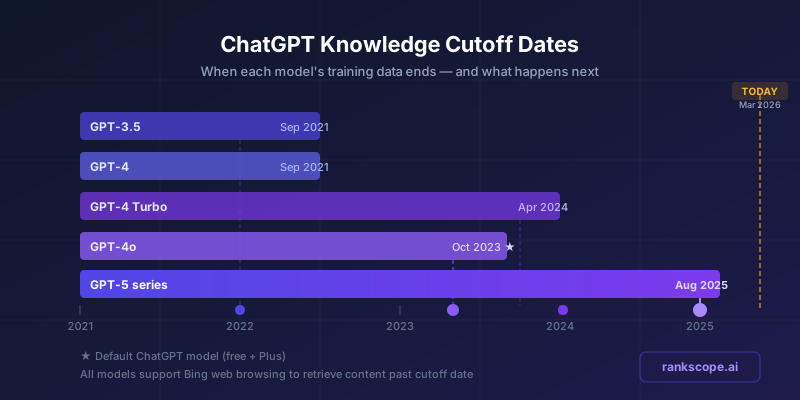
Response recency. ChatGPT's training has a knowledge cutoff — for GPT-5.6 (current model as of 2026), that's February 2026. Fresh content published after that cutoff won't appear in ChatGPT's base responses, but can influence responses via ChatGPT's web browsing feature when it's enabled. The practical implication: keeping your third-party listings and site content current matters for both training data and browsing.
ChatGPT SEO Tools: What to Use
For ChatGPT citation tracking
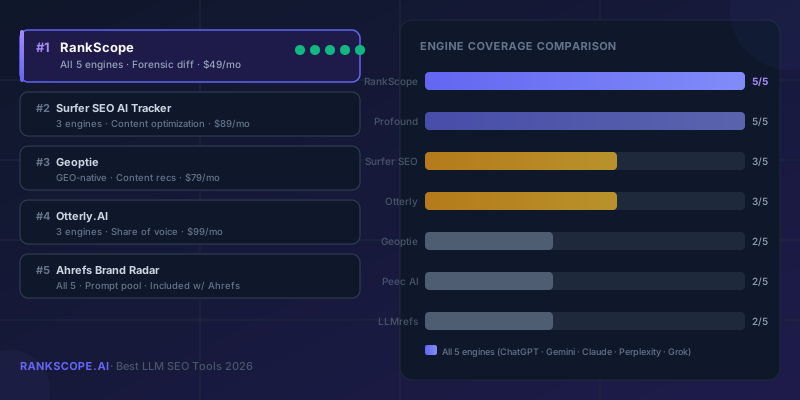
RankScope — Tracks ChatGPT citations alongside Google AI Overviews, Perplexity, and Google AI Mode in one dashboard. Custom prompts, forensic diffs, competitive Share of Voice. Starts at $49/mo, self-serve. This is the tool if ChatGPT visibility is a business priority, not a curiosity.
Otterly.AI — Good ChatGPT tracking with a clean interface. Also covers Perplexity and Gemini. Stronger on the mid-market side.
Peec AI — Lighter-weight option with a free tier. Good starting point if you're new to this and want to test before committing.
Profound — Enterprise-level depth, covers ChatGPT plus Claude and Gemini. Heavy lift and $499/mo+, but the most detailed attribution data available for large teams.
For ChatGPT as a productivity SEO tool
ChatGPT itself (GPT-4o / GPT-5.6) — Direct API or ChatGPT.com. Use it for keyword clustering, brief generation, schema markup, title/meta variants. Cheapest and most flexible option.
Ahrefs AI features + Semrush AI — Both have integrated AI assistants that combine ChatGPT-style writing assistance with live keyword and backlink data. If you're already on either platform, these are worth using.
Jasper / Surfer SEO — Purpose-built for AI-assisted content creation with SEO optimization baked in. Better for high-volume content production than ad-hoc tasks.
ChatGPT vs. Google AI Overviews: Which Matters More?
A common question when thinking about ChatGPT SEO is how to prioritize versus Google AI Overviews (Google's AI-generated summaries at the top of search results).
Volume: Google AI Overviews appear on approximately 15-20% of all US Google searches. Google processes ~8.5 billion searches/day. That's 1.2-1.7 billion AI Overview appearances daily. ChatGPT processes ~10 million queries/day. By raw volume, Google AI Overviews have massively more exposure.
Intent quality: ChatGPT users skew toward higher-consideration research. Someone who opens ChatGPT to research B2B software is often deeper in the buying process than someone clicking a Google AI Overview on a quick query.
Tracking difficulty: Google AI Overviews are harder to track reliably because they require real browser sessions (API calls don't return AI Overviews). Tools that query via API — including some tracking platforms — get incomplete data on AI Overviews coverage. RankScope uses real browser sessions specifically for this reason.
The honest answer: Track both. The two surfaces serve different parts of the buyer journey, and a gap in either one is a real cost.
How to Audit Your ChatGPT Presence in 10 Minutes
Before investing in a paid tracking tool, do this manual baseline audit:
- List 5-10 questions your buyers ask when researching your category
- Open ChatGPT (use GPT-5.6 / GPT-4o for current results)
- Ask each question and record: does your brand appear? Position 1, 2, 3? How is it described?
- Repeat each prompt 3 times (responses vary) — note the consistency
- Run the same prompts for 2-3 competitors
If you appear in 7/10 prompts and competitors appear in 9/10: you have a 2-position gap to close. If you don't appear at all: you have a foundational GEO problem to solve.
The free GEO audit on RankScope automates this and adds Perplexity, Google AI Overviews, and Google AI Mode to the baseline.
FAQ
Is ChatGPT a good SEO tool?
ChatGPT is an excellent productivity tool for SEO tasks — keyword clustering, content briefs, meta descriptions, schema markup generation. It's not a replacement for tools that have live search data (keyword volumes, SERP rankings, backlink data). Use it for the writing and structuring work; use dedicated SEO platforms for the data work.
Can ChatGPT help me rank on Google?
Indirectly. ChatGPT can help you produce better-structured, more comprehensive content that ranks well. It doesn't have access to your current rankings, live keyword data, or Google's algorithm signals. Think of it as a capable content collaborator, not a ranking tool.
How do I get my brand mentioned in ChatGPT?
The main levers: get listed and reviewed on third-party review sites (G2, Capterra, Product Hunt), earn mentions in comparison articles and roundups on authoritative sites in your industry, publish clear entity-rich content on your own site that answers the questions buyers ask, and build citations in the publications ChatGPT's training data sources from. See how to get cited by ChatGPT for a full playbook.
How do I track if ChatGPT is recommending my brand?
Manually: ask the prompts your buyers ask in ChatGPT and record the results. Programmatically: use a ChatGPT citation tracking tool like RankScope that monitors your prompts daily and alerts you when your citation rate changes.
Does ChatGPT use my website content?
ChatGPT's base training includes web content with a cutoff of February 2026 (GPT-5.6). Content published after that date doesn't appear in base responses but may be accessed via ChatGPT's web browsing feature when enabled. Keeping your site content current, well-structured, and schema-marked helps both for post-cutoff browsing and for future training runs.
What's the difference between ChatGPT SEO and traditional SEO?
Traditional SEO optimizes for Google's ranking algorithm — keyword placement, backlinks, page speed, technical signals. ChatGPT SEO (GEO) optimizes for inclusion and positive framing in AI-generated answers — entity recognition, third-party authority signals, structured content, and citation coverage. The tactics overlap somewhat but the metrics, tools, and day-to-day work are different enough to warrant separate programs.
The Bottom Line
ChatGPT is a search engine. If you're in a category where buyers research before purchasing, and you're not tracking whether ChatGPT recommends you, you have a blind spot in your acquisition data.
The good news: this space is young enough that the gap between "tracking it" and "not tracking it" is still significant. Brands that establish their ChatGPT presence and citation tracking programs now will have a meaningful data and optimization advantage as the surface matures.
Start with the manual audit. If the results are good — great, keep an eye on it. If you're absent or inconsistent, that's a solvable problem. RankScope's free audit is the fastest way to get a full baseline across all four AI search engines at once.
Want to go deeper? See how to rank in ChatGPT for the full optimization playbook, or LLM SEO tools for a comparison of every major platform in this category.